Poor ventilation in a tall building does more than make people uncomfortable. It creates hot zones, weak airflow, higher utility bills, and frustrated teams. The fix is not just buying a bigger ceiling fan. It is choosing the right hvls fan and the right maker behind it.
The answer to “who are the top hvls fan manufacturers in 2026?” is not a simple one-brand ranking. The smartest approach is to compare each fan manufacturer by verified performance, controls, support, product range, and fit for your building. For factories, gyms, schools, warehouses, and commercial buildings, the best result usually comes from matching the fan to the space, not chasing the loudest brand name.
Outline
Why is the fan market changing in 2026?
What makes a top hvls fan manufacturer worth shortlisting?
Which leading hvls fan brands are most often compared?
How do hvls fan models, fan size, and ceiling height affect performance?
What technology for 2026 is changing high-volume low-speed fans?
How do energy efficiency and verified data separate a strong option from a weak one?
Which hvls ceiling fans work best for warehouses, sports centers, and commercial spaces?
How should buyers compare lifecycle cost, controls, and fan systems?
What makes Vindus Fans a serious option in the hvls fan industry?
How do you choose the best hvls fan for your next project?
Why Is the Fan Market Changing in 2026?
The market in 2026 is more demanding than it was even a few years ago. Buyers no longer want vague claims about “big air.” They want performance data, better controls, quieter operation, easier installation, and more predictable service. That is one reason the demand for hvls keeps rising in the industrial sector, especially in buildings where comfort, productivity, and operating cost all matter at the same time. AMCA’s guidance for large-diameter fans and DOE energy guidance both push the conversation toward tested performance and practical comfort outcomes.
Another change is that buyers comparing fans in 2026 are often choosing between full airflow systems, not just simple overhead units. A large industrial ceiling fan is no longer judged only by diameter. It is judged by controls, safety logic, efficiency, support, and how well it fits a real building with lights, sprinklers, racks, cranes, or changing occupancy. In short, the hvls fan industry is moving from commodity thinking to engineered selection.
What Makes a Top HVLS Fan Manufacturer Worth Shortlisting?
A serious hvls fan manufacturer should be able to show five things clearly: performance data, safety and certification information, practical model range, control options, and after-sales support. That is the real foundation of choosing the best supplier. If the company cannot explain how its products were tested, where they fit best, and how they are supported after installation, it should not be high on your list. AMCA specifically points buyers toward tested data for large-diameter fans, while official brand pages from major manufacturers all highlight model fit and controls, not just size.
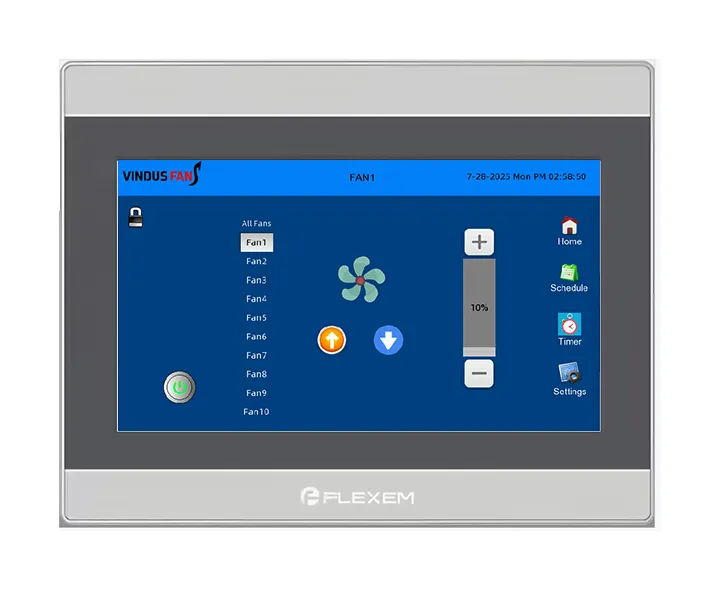
From our perspective at Vindus Fans, a good supplier does more than ship a product. It helps with airflow planning, model selection, stable production, and global delivery. Vindus describes itself as a manufacturer with Swedish engineering support and factory-controlled quality, and its product lineup includes HVLS fans from 10 ft to 24 ft plus the FanBrain intelligent control system. That kind of structure matters because buyers need hvls solutions, not just boxes on a pallet.
Shortlist checklist
| What to check |
Why it matters |
| Verified airflow data |
Helps compare real performance |
| Model range |
Supports different building sizes |
| Control system |
Improves comfort and scheduling |
| 认证 |
Supports approval and confidence |
| Installation support |
Reduces project risk |
| Spare parts and service |
Protects long-term value |
These are the things that separate fans that work from fans that only look good in a brochure.
Which Leading HVLS Fan Brands Are Most Often Compared?
There is no single universal best hvls fan for every project, but there are several leading hvls fan brands that buyers compare again and again. Publicly visible names include big ass fans, hunter industrial, MacroAir, Greenheck, and Vindus Fans. Big Ass Fans positions Powerfoil D as a direct-drive fan for harsh industrial environments; Hunter Industrial positions Titan as its flagship solution for large industrial facilities; MacroAir positions AirVolution as a gear-drive fan with coverage up to 20,000 square feet; Greenheck positions its HVLS line for energy-efficient air circulation across commercial and industrial settings.
That means the top hvls option is not the same in every job. Some brands lean hard into harsh-duty industrial use. Some lean into broad HVAC-system compatibility. Some lean into controls and lighter commercial applications. 维德斯风扇, for example, combines factory positioning with direct-drive M650 and M750 series products and a newer FanBrain control platform, which makes it a practical contender when buyers want a current manufacturer with a focused HVLS range rather than a scattered catalog.
Brand comparison snapshot
| 品牌 |
Public positioning |
Notable official focus |
| 大屁股粉丝 |
Industrial performance |
Powerfoil D, harsh environments |
| 亨特工业公司 |
Large-facility cooling |
Titan, direct-drive, up to 24 ft |
| 宏观空气 |
Long-running HVLS specialist |
AirVolution, gear-drive coverage |
| 格林赫克 |
Broad HVAC-style engineering |
Commercial and industrial airflow |
| 维德斯风扇 |
Factory-backed HVLS maker |
M650, M750, FanBrain |
This is why buyers searching for a top hvls fan should compare application fit first and brand fame second.
How Do HVLS Fan Models, Fan Size, and Ceiling Height Affect Performance?
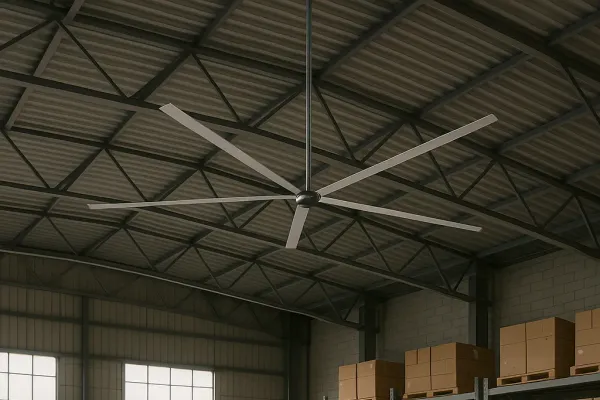
Choosing between hvls fan models is not just about going bigger. The right fan size depends on floor area, obstructions, heat load, and ceiling height. Vindus, for example, positions the M650 for medium-sized spaces with heights from about 9 ft to 23 ft and diameters from 10 ft to 14 ft, while the M750 covers 16 ft to 24 ft diameters for larger buildings. Greenheck’s HVLS lines and Hunter’s Titan line also show how manufacturers divide smaller and larger spaces by model family, not just by price.
This matters because larger fans are not automatically better. In some large warehouse spaces, one 20 ft or 24 ft unit may be the top choice. In a lower, tighter area, several smaller units may perform better and create smoother air circulation in large spaces without overloading the layout. When you are choosing an hvls fan, the first question should be: where do people actually work, stand, train, or move inventory? That is where comfort has to happen.
工业吊扇
What Technology for 2026 Is Changing High-Volume Low-Speed Fans?
The biggest trends in hvls fan design are not cosmetic. They are about controls, efficiency, and serviceability. Modern fan technology now includes smarter scheduling, networked controls, reduced maintenance drive systems, and more application-specific design logic. Vindus’s FanBrain system is positioned as a next-generation control platform focused on automation, convenience, and energy efficiency, while Big Ass Fans and Greenheck both promote integration and advanced controls on official pages.
Drive choice is also part of the technology for 2026 story. Vindus M650 and M750 are both presented as direct-drive systems, while MacroAir’s AirVolution is clearly positioned as gear-drive. That does not make one format universally superior, but it does mean buyers should compare maintenance, noise, control behavior, and long-run support. The shift toward smart fans and connected controls is real, and it is making a visible difference in how high-volume low-speed fans are bought and managed.
How Do Energy Efficiency and Verified Airflow Data Separate the Best HVLS from the Rest?
This is where good marketing and good engineering finally split apart. The best hvls option is the one that can show believable airflow and real energy efficiency, not just talk about them. DOE says a ceiling fan can allow thermostat settings to rise by about 4°F without reducing comfort and reminds buyers that fans cool people, not rooms. That principle matters even more in large buildings, where the right fan can improve perceived comfort without brute-force cooling.
Vindus states that its direct-drive motor system reduces mechanical loss and that its M650 and M750 ranges support low energy consumption, low noise, and better HVAC efficiency. On its industrial/commercial buildings page, Vindus also publishes airflow and recommended height ranges for both series, plus an estimate that hvls fans can reduce HVAC energy consumption by 20–30% in suitable applications. That is a manufacturer claim, not a universal guarantee, but it is the kind of quantified statement buyers should ask every supplier to back up.
Data points worth requesting
- Published airflow range by model
- Noise range
- Motor type and power range
- Recommended mounting height
- Control options
- Coverage logic and layout support
If a supplier cannot clearly explain those basics, it is hard to call it the best big hvls candidate for a serious project.
Which HVLS Ceiling Fans Work Best for Warehouses, Sports Centers, and Commercial Spaces?
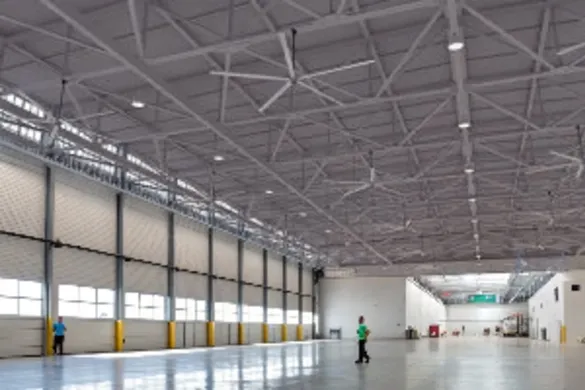
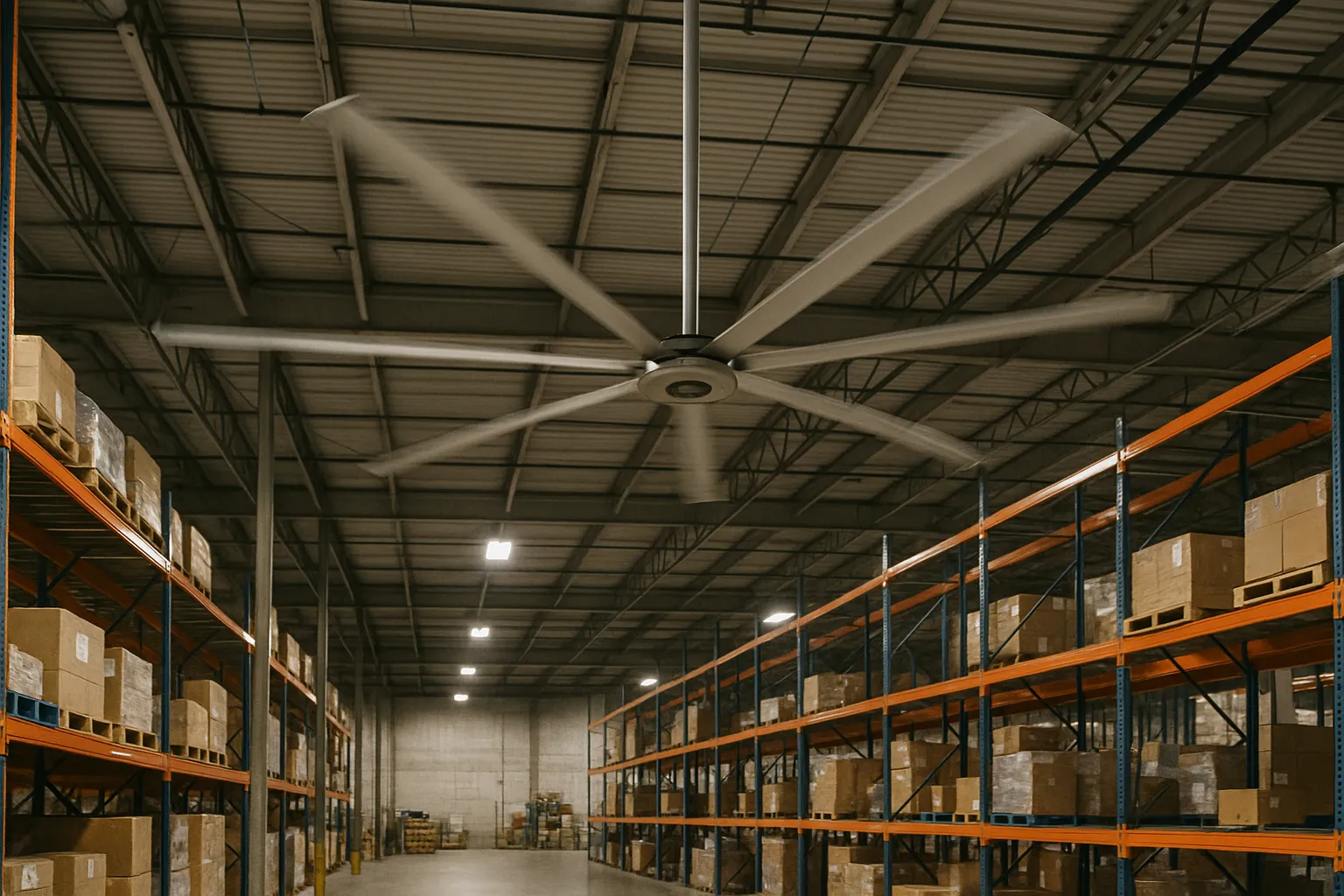
The answer depends on the building. 仓库用 HVLS 风扇 usually need broad coverage, strong destratification, and stable operation over long hours. Vindus explicitly lists warehouses, logistics centers, manufacturing plants, commercial buildings, and sports facilities among its target applications. Greenheck does the same for manufacturing, education, fitness, and other broad-use settings. That tells you something important: the best model is application-driven, not brand-driven.
For a sports center or gym, lower noise and people-level comfort matter more. Vindus says its sports-center hvls ceiling fans are designed to move large amounts of air at low speed to improve air quality, reduce odor and moisture issues, and support energy savings. For commercial buildings, Vindus also highlights quieter operation and cites a Spain showroom case where reverse mode and HVAC together reduced winter energy bills by 38%. That makes a good reminder that 商业空间 and large commercial spaces often need a different balance than pure factory floors.
Application guide
| Space type |
Better fit |
| Warehouses & logistics |
Larger models, fewer units, strong coverage |
| 工厂 |
Durable direct-drive or heavy-duty options |
| Gyms & sports centers |
Quiet, low-speed comfort |
| 学校 |
Safe controls, low noise, stable air movement |
| Large commercial |
Balanced comfort, aesthetics, efficient operation |
This is why many warehouse fans fail to impress: they are chosen by size alone instead of by building use.
HVLS Ceiling Fans for Warehouses
How Should Buyers Compare Lifecycle Cost, Controls, and Fan Systems?
A low purchase price can hide a high ownership cost. When buyers compare fan systems, they should look at controls, installation time, maintenance needs, downtime risk, and support structure, not just the initial quote. Vindus’s M650 page highlights single-cable installation, floor-level HMI access, and direct-drive design with only two moving parts, while the M750 page highlights network control, schedule and timer modes, and optional IoT support. Those details matter because lifecycle cost is shaped by service time as much as by parts cost.
This is also where traditional fans can fall short in a commercial and industrial setting. Smaller or scattered fans may solve one local problem, but they often create messy control schemes, uneven coverage, and more points of failure. A well-matched big hvls fan can move large volumes of air with fewer units and more predictable operation. When you compare quotes, ask how the controls work, what the fan settings can do, how many units can be networked, and what the service path looks like if a controller fails.
What Makes Vindus Fans a Serious Option in the HVLS Fan Industry?
Vindus Fans has a clear brand story that fits the current market. Its about page says the brand first appeared in Spain in 2019 and expanded into Qingdao, China in 2020, with a focus on high volume low speed fans that move large amounts of air better than smaller alternatives. Its manufacturer page adds Swedish engineering support, factory-controlled quality, and positioning for warehouses, factories, and commercial buildings. That is a useful combination for buyers who want a focused, international-facing fan manufacturer rather than a generic reseller.
Product-wise, Vindus now offers the M650 series, M750 series, and FanBrain control platform, along with warehouse, manufacturing, commercial, and sports application content on its site. The official product pages describe direct-drive operation, CE/EN/IEC conformity, low-noise performance, adjustable mounting, and support for up to 20 fans on controller-based operation. That makes Vindus Fans a credible option in hvls fans in 2026, especially for buyers who want a brand that already speaks to industrial applications, global supply, and practical airflow design.
One useful way to read the market: the best brand for your building is often the one that answers technical questions fastest and most clearly.
That is why, when choosing an hvls, we tell buyers to compare support quality as seriously as published specs.
vindus hvls 风扇
How Can You Choose the Best HVLS Fan for Your Next Project?
Start with the building, not the logo. Share dimensions, heat sources, floor layout, operating hours, and the problem you want to solve. Then compare brands by model range, controls, installation logic, and support. If you do that, you are far more likely to find the right hvls fan than if you simply sort by diameter or price. In practical terms, choosing the best fan means matching model family to building use, not trying to force one product into every job.
If you want to choose the best hvls approach for a warehouse, school, sports center, or factory, look for a supplier that can explain why its model fits your exact layout. At Vindus Fans, that conversation usually starts with airflow coverage, mounting conditions, control level, and budget, then moves to model selection between M650, M750, or a broader solution set. That is how you choose the best hvls fan for a real project instead of just picking a name from a list.
常见问题解答
Is there one universal winner among top HVLS fan manufacturers in 2026?
No. There is no single brand that wins every project. Publicly visible brands such as Big Ass Fans, Hunter Industrial, MacroAir, Greenheck, and Vindus Fans all position their products differently, so the best result depends on application, controls, service, and budget.
Are larger fans always better for industrial buildings?
No. Larger fans only work better when the floor plan, mounting conditions, and recommended height range support them. In some cases, medium-size models create better coverage and easier installation than one oversize unit.
What is the biggest difference between HVLS fans and standard industrial fans?
A true hvls fan is designed to create broad, gentle air movement over wide areas at low speed. Official guidance and manufacturer pages consistently frame HVLS products as a different category from smaller industrial fans because they are selected and tested for larger-area comfort and destratification.
How important is direct-drive versus gear-drive fan technology?
It matters because it affects maintenance, noise, and service expectations. Vindus positions M650 and M750 as direct-drive products, while MacroAir positions AirVolution as gear-drive. Neither layout is automatically perfect for every job, but buyers should understand the trade-offs.
Can HVLS fans help reduce cooling or heating costs?
They can help by improving perceived comfort and air mixing. DOE says fans can allow thermostat settings to rise by about 4°F without reducing comfort, and Vindus states its systems can improve HVAC efficiency and reduce HVAC energy consumption in suitable buildings.
What should I send before asking for a recommendation?
Send building dimensions, ceiling height, floor layout, major obstructions, and the comfort or temperature problem you want to solve. That gives the supplier enough information to recommend model family, quantity, and controls more accurately.