Poor air circulation makes large spaces hot, stuffy, and costly to run. Workers feel tired, machines face more heat stress, and cooling bills rise. The right industrial fan solutions help move air evenly, support comfort, and reduce wasted energy.
Industrial fan solutions use equipment such as HVLS fans, blowers, ceiling fans, and exhaust fans to improve airflow, temperature balance, and ventilation in large buildings. For warehouses, factories, gyms, schools, and commercial facilities, the best system depends on space size, ceiling height, heat sources, air quality needs, and operating cost goals.
文章提纲
What Are Industrial Fan Solutions and Why Do Large Buildings Need Them?
How Do HVLS Fans Improve Airflow in a Warehouse?
Industrial Fan vs Blower vs Exhaust Fans: What Is the Difference?
Why Is Air Movement Important for Temperature Control and Worker Comfort?
How Can Destratification Reduce HVAC Energy Consumption?
Which Commercial Fans Are Best for Factories, Gyms, and Schools?
What Should You Check Before Industrial Fan Installation?
How Do Air Circulation and Ventilation Affect Air Quality?
Can Evaporative Coolers Work with Industrial Fans?
How to Choose the Right Fan Manufacturer for Long-Term Reliability?
FAQs About Industrial Fan Solutions
关键要点
What Are Industrial Fan Solutions and Why Do Large Buildings Need Them?
An industrial fan is designed to move large volumes of air across wide, open, or high-ceiling spaces. In commercial and industrial buildings, it supports comfort, cooling, ventilation, and process stability. Unlike small residential fans, these systems are built for long hours, larger motors, stronger structures, and demanding industrial environments.
As an HVLS fans manufacturing plant, we often see the same problem: customers do not only need “a fan.” They need airflow solutions that fit their building. A warehouse, a school gym, a food workshop, and a metal fabrication facility all need different airflow planning.
Typical goals include:
- Improving comfort for workers and visitors
- Reducing hot spots near roofs, machines, or loading areas
- Supporting energy-efficient cooling
- Helping existing hvac systems work better
- Improving general air quality
- Lowering long-term operating costs
According to OSHA, engineering controls that make the workplace cooler can help reduce heat exposure risks in indoor and outdoor work areas. That is why better air circulation is not only about comfort; it can also support safer work planning.
How Do HVLS Fans Improve Airflow in a Warehouse?
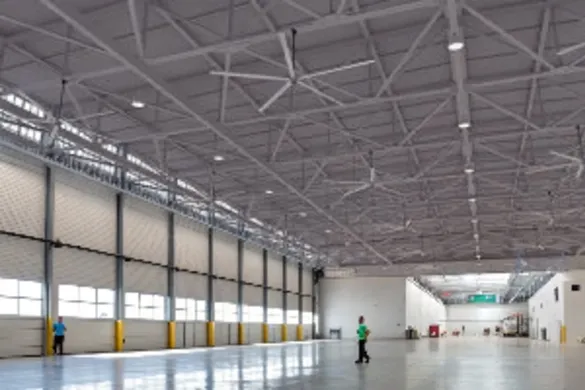
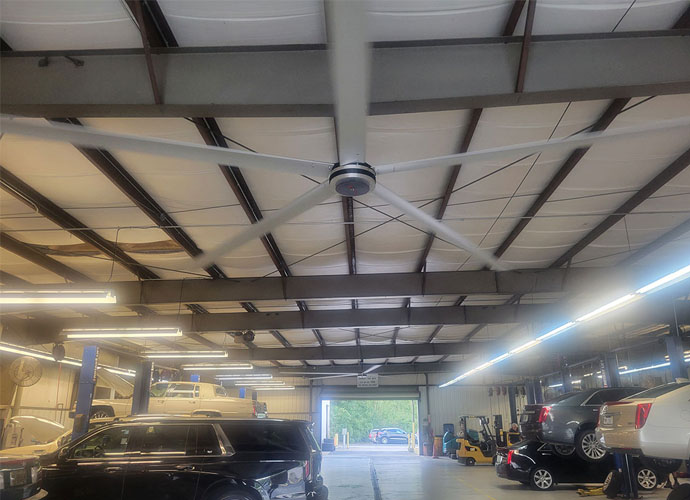
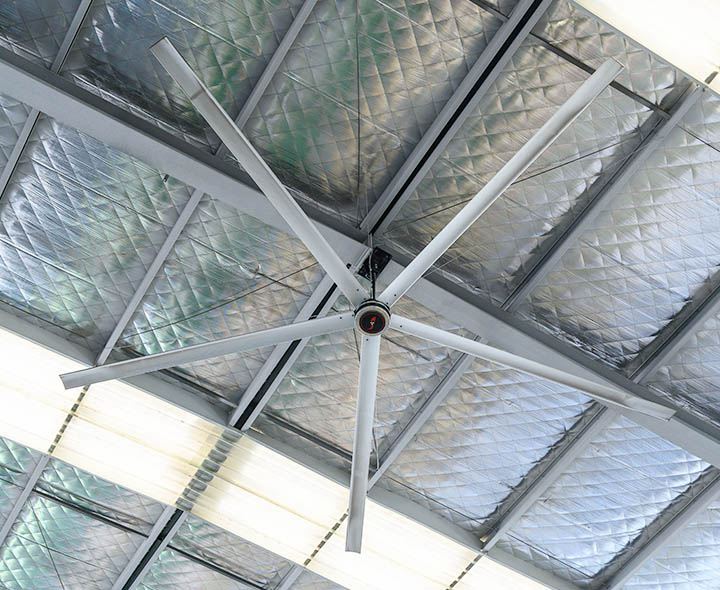
HVLS means high-volume, low-speed. These large-diameter fans are often used in logistics centers, production halls, sports centers, and aircraft-style open spaces. Instead of pushing a small, strong air jet, 超低噪音风扇 create wide and gentle air movement across a large floor area.
This matters because a large building does not cool like a small office. Heat can collect near the roof. Workers can feel still air at floor level. A properly planned hvls ceiling system helps move air downward and outward, creating more even comfort without harsh wind.
Here is a simple comparison:
| 风扇类型 |
最佳用途 |
Air Pattern |
Common Buyer Goal |
| HVLS 吊扇 |
Large open buildings |
Wide, gentle airflow |
Comfort and energy savings |
| Wall-mounted fan |
Workstations and small zones |
Directional air |
Spot cooling |
| 落地扇 |
Flexible temporary areas |
Local air stream |
Quick setup |
| Exhaust fan |
Heat, odor, or fume removal |
Air extraction |
Ventilation support |
| 鼓风机 |
Focused air pressure |
High-pressure flow |
Process or ducted use |
For a high-ceiling warehouse, the main benefit is coverage. One properly selected HVLS unit can often serve a broad area where many small fans would create uneven comfort and clutter.
Industrial Fan vs Blower vs Exhaust Fans: What Is the Difference?
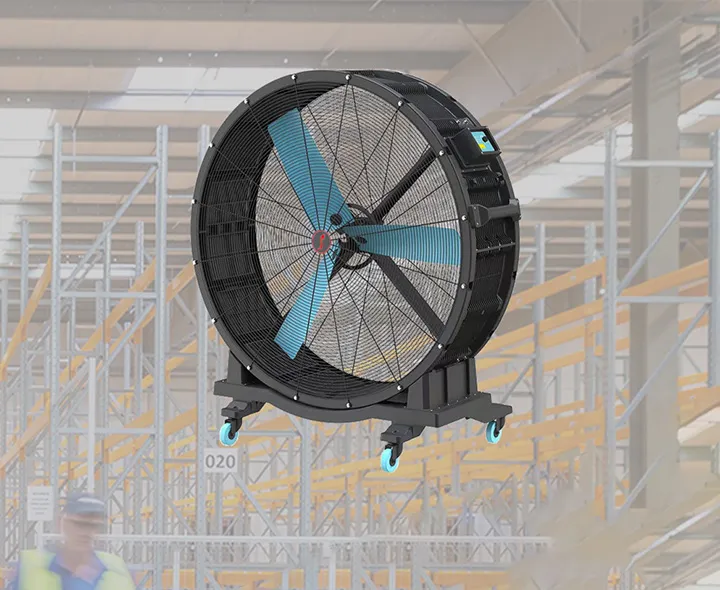
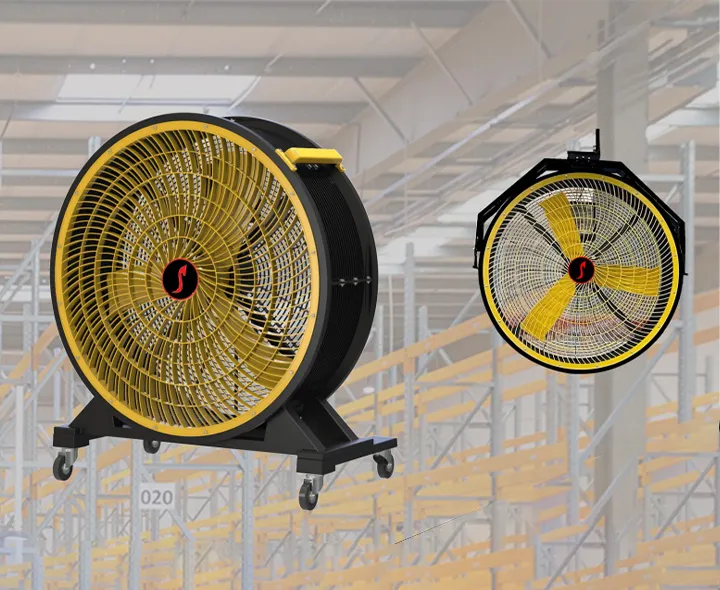
一个 工业风扇 usually focuses on moving air through a space. A blower is often used when higher pressure is needed, such as pushing air through ductwork, equipment, or an enclosure. Exhaust fans remove unwanted air, heat, moisture, smoke, or odor from a building.
There are also different fan structures. An axial fan moves air along the fan shaft direction and is common for general circulation. Axial fans are often used where large air volume and lower pressure are required. A centrifugal fan changes the direction of air through an impeller and is often selected when pressure resistance is higher. The term centrifugal is common in process ventilation, dust systems, and some industrial equipment designs.
When buyers compare fans and blowers, the key is not the name. The key is the result. You need to match airflow with the building layout, heat load, pressure needs, safety concerns, and working conditions.
A simple rule:
“Choose air circulation fans for comfort, exhaust systems for removal, and blowers for pressure-driven airflow.”
Why Is Air Movement Important for Temperature Control and Worker Comfort?
Good air movement helps people feel cooler because moving air supports heat loss from the body. ASHRAE Standard 55 includes elevated air speed as part of thermal comfort evaluation, showing that air speed can affect how occupants feel in warm conditions.
In real buildings, this means a fan does not need to lower the actual air temperature to improve comfort. It can create a cooling effect by moving air across people and surfaces. This is why commercial fans are widely used in gyms, schools, production floors, and logistics centers.
Common comfort problems include:
- Hot upper air in high-ceiling rooms
- Still air in corners and work zones
- Heat from machines or lighting
- Uneven cooling between open doors and inner areas
- Poor comfort near loading docks
For facility managers, comfort links directly to productivity. When workers feel too hot, they slow down, take more breaks, and may make more mistakes. OSHA notes that heat stress can reduce performance and lead to lost productivity, illness, or worse outcomes.
How Can Destratification Reduce HVAC Energy Consumption?
Destratification means mixing warm upper air with cooler lower air to reduce temperature layers. In tall buildings, warm air naturally rises. Without mixing, the roof area may be much warmer than the floor. That can waste heating or cooling energy.
During cooler seasons, ceiling-level warm air can be pushed back down slowly. During warm seasons, steady circulation helps reduce perceived heat. This can help reduce hvac load when the overall system is designed and operated correctly.
The U.S. Department of Energy has developed energy conservation standards for commercial and industrial fans and blowers, reflecting the importance of fan performance and energy use in building systems. AMCA also publishes standards related to Fan Energy Index testing for commercial and industrial fans and blowers.
Simple Air Layer Chart
| Building Zone |
Without Air Mixing |
With Planned Fan System |
| Ceiling level |
Heat collects |
Warm air is mixed |
| Middle zone |
Uneven comfort |
More stable temperature |
| Work level |
Stuffy or cold spots |
Better comfort |
| 暖通空调系统 |
Works harder |
Can operate more efficiently |
The goal is not to run more equipment. The goal is energy efficiency through better air distribution.
Which Commercial Fans Are Best for Factories, Gyms, and Schools?
Different facilities need different commercial fans. A sports center needs quiet comfort. A factory may need durable motors and a strong structure. A school gym needs safe operation, simple controls, and low noise. A logistics facility needs broad coverage and easy maintenance.
For industrial applications, we usually divide selection by space type:
| 空间类型 |
Common Need |
Suggested Fan Direction |
| Factory workshop |
Heat control near machines |
Heavy-duty ceiling or wall fans |
| Gym or sports center |
Quiet comfort |
HVLS or large ceiling fans |
| School hall |
Safe and stable airflow |
Ceiling fans with protected control |
| 仓库 |
Large-area circulation |
HVLS 风扇 |
| Food processing area |
Clean operating conditions |
Easy-clean, planned ventilation |
| Paint booths |
Air extraction and safety control |
Specialized exhaust system |
Some buyers search for patterson fan or similar known brands when comparing market options. That is normal. But the better question is: which supplier can design the system around your building, not just sell a standard unit?
If you want to shop industrial fans, compare motor quality, blade structure, control system, noise level, safety design, after-sales support, and the real spec sheet.
What Should You Check Before Industrial Fan Installation?
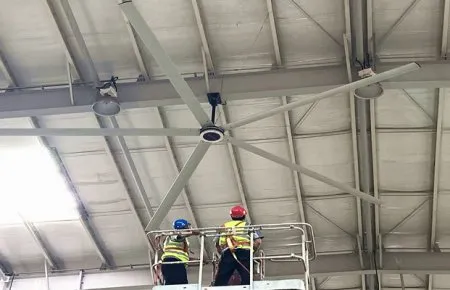
Before installation, the supplier should understand your building. A fan that looks good online may not fit your ceiling height, beam structure, power supply, or safety distance. Planning comes first.
Key checks include:
- Building length, width, and height
- Ceiling structure and mounting points
- Door locations and open loading areas
- Heat sources and machine layout
- Worker positions and comfort zones
- Existing HVAC and fresh air systems
- Power supply and control needs
- Safety clearance around blades
A good 生产工厂 should help you choose the right fan, not push one model for every project. For example, a high-roof logistics center may need HVLS units, while a smaller workshop may benefit from wall-mounted units or pedestal fans in selected zones.
For heavy projects, we also review operating hours, maintenance access, motor protection, and control options such as variable frequency drives. These allow speed adjustment, helping operators balance comfort and energy consumption.
安装 HVLS 风扇
How Do Air Circulation and Ventilation Affect Air Quality?
Air circulation moves air inside the space. Ventilation brings in or removes air. They work together, but they are not the same. Circulation can improve comfort, while ventilation helps manage heat, moisture, odor, and indoor pollutants.
In some facilities, air movement alone is not enough. If there is a contaminant source, such as smoke, dust, chemical vapor, or process odor, the building may also need exhaust, air filtration, or dedicated filtration systems. The final goal is clean air and a safer working environment.
Common facilities with higher air planning needs include:
- Welding or metal workshops
- Chemical plants
- Power generation areas
- Battery or electronics production
- Food and beverage workshops
- Dust-producing material handling areas
In facilities with combustible dust, fan and ventilation planning must follow safety requirements. In harsh sites, buyers may also need special motors, sealed electrical parts, a safety damper, or temperature-rated components.
Can Evaporative Coolers Work with Industrial Fans?
Yes, evaporative coolers can work with fans in some dry or semi-dry climates. A cooler adds cooled air through water evaporation, while fans help distribute that air across a larger area. This can support energy-efficient cooling in certain warehouses, workshops, and open commercial spaces.
However, evaporative cooling is not ideal for every building. It depends on humidity, air exchange, process requirements, and local climate. In high-humidity areas, the cooling effect may be weaker. In sensitive production areas, moisture control may also matter.
A practical combination may look like this:
| System Part |
功能 |
| Evaporative cooler |
Adds cooler air |
| HVLS 风扇 |
Spreads air across the floor |
| Exhaust system |
Removes hot or stale air |
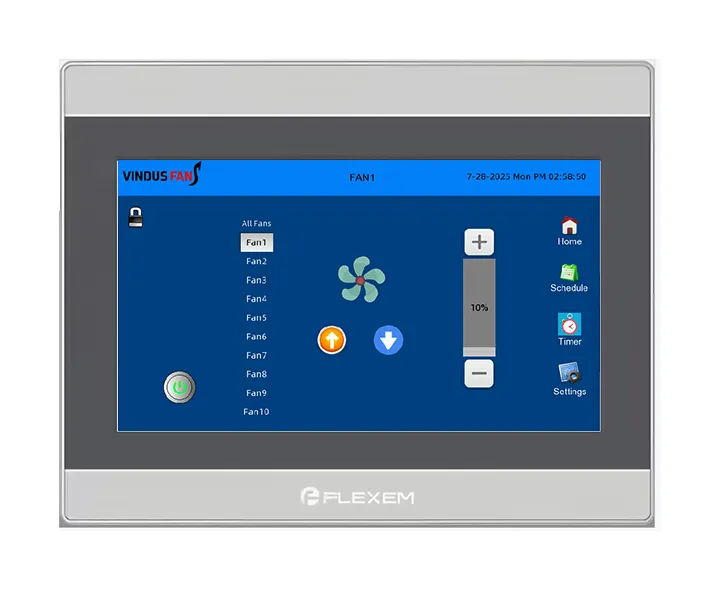
| Control panel |
Adjusts speed and timing |
This approach can create airflow while supporting comfort. But the design must be balanced. Too much air pressure, poor placement, or wrong fan size can reduce performance.
How to Choose the Right Fan Manufacturer for Long-Term Reliability?
A fan is not a short-term purchase. It may run for years in industrial use, often for long hours every day. That is why reliability and efficiency matter more than the lowest unit price.
As an HVLS fans manufacturing plant, we recommend checking five things before buying:
- Engineering support
Can the supplier review your building size, use case, and layout?
- Product structure
Is the fan frame strong, stable, and built for long-term operation?
- Motor and control quality
Are the motor, controller, and safety devices suitable for your site?
- Testing and documentation
Can the supplier provide product drawings, manuals, and performance details?
- After-sales service
Can you get parts, guidance, and technical support after delivery?
Buyer Decision Matrix
| Buyer Concern |
What to Ask the Supplier |
| 舒适 |
What coverage area can this model support? |
| 安全 |
What protection design is included? |
| 成本 |
How does speed control help reduce energy? |
| 噪音 |
What is the noise level under normal use? |
| 维护 |
How easy is cleaning and inspection? |
| Project fit |
Can you provide layout suggestions? |
The best supplier offers expert air movement support, not just a product list.
M750 系列 HVLS 风扇
Case Study: Warehouse Airflow Upgrade for a Hot Logistics Facility
A logistics customer had a large warehouse with high ceilings, wide doors, and many loading zones. In summer, workers felt strong heat near the center of the building. Small portable fans helped only near individual stations, but the overall space still felt stuffy.
We reviewed the floor layout, door openings, racking zones, and worker paths. The solution used HVLS ceiling units for broad circulation, combined with selected local fans near packing areas. The goal was not to blast air everywhere. The goal was controlled comfort.
Result Summary
| Problem |
Solution Direction |
Expected Benefit |
| Hot air stayed near the roof |
Ceiling-level mixing |
More even temperature |
| Workers felt still air |
Large-area airflow |
Better comfort |
| Too many small fans |
Fewer large units |
Cleaner floor space |
| High cooling cost concern |
Speed control |
Lower waste |
The customer gained a more stable indoor environment and a simpler fan layout. For facilities that operate long shifts, this kind of planning can support comfort, safety, and operating cost control.
FAQs About Industrial Fan Solutions
What is the main purpose of an industrial fan?
The main purpose is to move large amounts of air for comfort, cooling, ventilation, or process support. In large buildings, it helps reduce hot spots, improve worker comfort, and support better temperature balance.
Are HVLS fans better than high-speed fans?
They are better for large open areas where wide, gentle coverage is needed. A high-speed fan may work well for a small zone, but HVLS fans are often better for broad floor areas because they move air slowly over a larger space.
How much airflow do I need for my warehouse?
The required cfm depends on building size, ceiling height, heat sources, door openings, and comfort goals. A supplier should calculate or estimate airflow based on your actual layout instead of using one standard answer for every project.
Can industrial fans help reduce energy costs?
Yes, they can help reduce energy waste when used correctly with HVAC, ventilation, or cooling systems. The main benefit comes from better air distribution, temperature mixing, and adjustable operation.
Do industrial fans need regular maintenance?
Yes. Most fans need periodic checks for fasteners, blades, motor condition, control systems, and cleaning. A heavy-duty fan is built for tough use, but regular inspection still protects safety and performance.
Can fans be used in high-temperature areas?
Some fans can be designed for high-temperature conditions, but the supplier must know the working temperature, air content, motor location, and safety requirements. The inlet condition and air path should also be reviewed.
关键要点
- Industrial fan solutions help improve comfort, airflow, and operating efficiency in large buildings.
- HVLS fans are ideal for wide spaces such as warehouses, gyms, sports centers, schools, and manufacturing facilities.
- Fans, blowers, and exhaust systems serve different purposes, so selection should match the real building problem.
- Better air circulation can support comfort without always lowering the actual room temperature.
- Destratification helps reduce temperature layers in high-ceiling spaces.
- Ventilation, exhaust, and filtration may be needed when heat, odor, dust, or contaminants are present.
- The best buying decision is not only about fan size. It is about layout, safety, controls, maintenance, and long-term support.
- Work with a manufacturing partner that can review your project and recommend practical air movement solutions for your building.