Crowded workouts raise heat, CO2, and dust. Discomfort grows, performance drops, and complaints spread. Fix the causes with smart ventilation, steady mixing, and simple routines that keep the indoor environment clean, safe, and consistent.
To improve indoor air quality in gyms, provide fresh air per standards, mix air with HVLS fans, monitor CO2 and particulate matter in real-time, manage humidity, and clean smarter. Proper ventilation, source control, and measurement work together to protect people and deliver healthy air.
Why air quality matters in a gym
People breathe harder during training. That multiplies exposure to every particle e pollutant. Good qualidade do ar reduces respiratory stress, helps recovery, and supports performance. It also reassures members that the air you breathe is protected by clear policies and daily checks.
O effects of poor air quality are simple: headaches, coughing, and fatigue. During intense activity, deposition of particulate matter increases, so indoor air pollution strikes harder. As a manufacturing team specializing in HVLS fans for fitness facilities, nos concentramos em circulação de ar that supports ventilação and keeps gym air quality steady from floor to ceiling. A recent review on gyms underscored the need to control PM and gases during exercise.
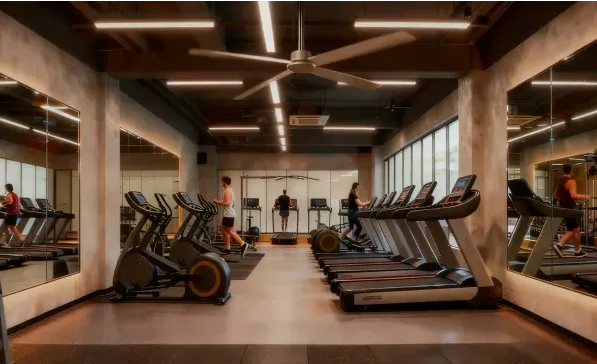
Why air quality matters in a gym
What counts as good gym ventilation in fitness centres?
Em fitness centres, adequate ventilation begins with outside air and a good ventilation system that actually delivers it to people. For many health clubs, designers use 20 cfm per person + 0.06 cfm/ft² of outdoor air as a baseline (from ASHRAE 62.1 guidance cited in engineering practice).
To build reliable gym ventilation para high occupancy, balance the system, remove dead zones, and verify with commissioning. Poor ventilation often hides in corners of an enclosed space. Smart schedules, fans, and ongoing measurements help gym managers test the air and take actions to improve when readings drift.
How do CO₂, particulate matter, and VOCs change gym air quality?
During classes, carbon dioxide rises as people exhale. CO₂ is a practical tracer of ventilação effectiveness; many public-health and engineering briefs treat ~1000 ppm as a simple operational flag for fresh air adequacy in ordinary spaces. Keep readings as low as is reasonably achievable during workouts.
CO₂ generation scales with effort, so heavy exercise ramps it up faster—another reason to design for peaks. Exercise also stirs particulate matter and can draw in air pollution when doors open.
We also watch gases: VOCs—volatile organic compounds—from cleaners, air fresheners, flooring, and sweat byproducts. These can be an odor clue and an emission source. When indoor air pollutants build up, members feel a health risk and complain. The fix: source control, mechanical ventilation systems, filtration, and mixing. EPA summarizes the health effects of PM exposure from irritation to aggravated asthma—risks that climb as intensity rises.
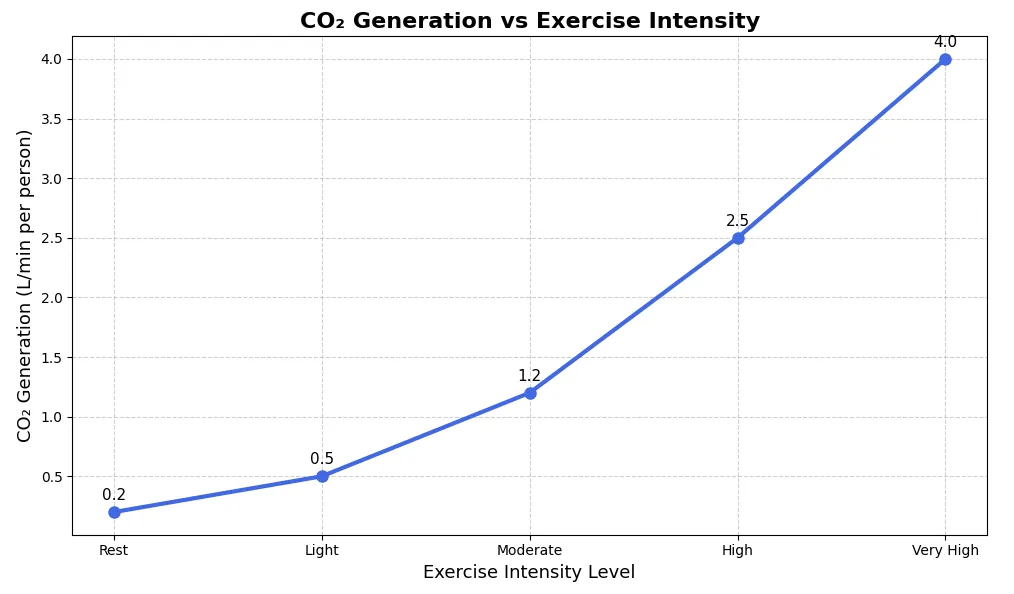
How do CO₂, change gym air quality
How to monitor indoor air quality with real-time tools?
Para monitor indoor air quality, place an air quality monitor at breathing height, away from supply diffusers. Track CO₂, PM2.5/particulate matter, temperature, and umidade. Real-time dashboards and real-time air alerts help gym owners catch spikes during boot camps or events.
Pair air monitoring with class size and occupancy. Over time you will spot patterns affecting indoor air—for example, when the door closes, mixing suffers; or when cleaning ends right before yoga, pollutant levels bump. Use these trends to improve ventilation and adjust cleaning schedules. CDC/NIOSH notes that protective indoor ventilação practices reduce airborne viral exposure—another reason to keep the data visible.
HVLS fans + HVAC: boosting ventilation and lowering energy
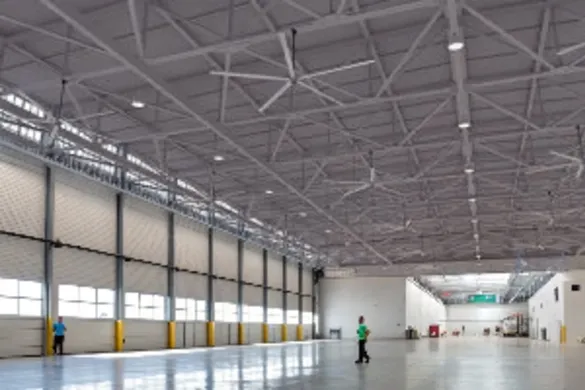
Big rooms need gentle, even mixing. HVLS fans move a wide, slow column that improves circulação de ar without drafts. They don’t add ar exterior, but they help your climatização e sistema hvac spread fresh supply, reduce hot–cold layers, and cut compressor runtime through destratification. That’s better air and better bills. Studies in large-volume buildings document destratification and energy impacts when HVLS fans are integrated.
Integrate fans with the sistema de ventilação. In cooling seasons, fans help people feel cooler at the same setpoint. In heating seasons, they push warmth down from the roof so ducts provide fresh air more evenly—an advanced indoor air quality gain through smart mixing.

Ventiladores HVLS em ginásio comercial
Natural ventilation or mechanical—what’s best for gyms?
Usar natural ventilation when weather allows. Crack windows to allow fresh air and doors to ventilar quickly between classes. This natural or mechanical ventilation choice depends on climate, noise, and security. On hot or polluted days, rely on filtration and mechanical ventilation systems.
A blended approach works well. Use ventilation and air distribution from the AHU, then fans to remove stratification. Gyms often swing between crowded evenings and quiet mornings; controls should track that load to maintain good indoor air quality with minimal energy.
Practical steps for improving gym conditions
Here’s a clear sequence any team can run to improve the air quality:
- Set goals and quality standards (CO₂, PM2.5, temperature, umidade).
- Balance and verify ventilação airflow; confirm fluxo de ar at all zones.
- Monitor indoor air quality com um air quality monitor.
- Upgrade filters (MERV 13+ where feasible) and schedule air cleaning tarefas.
- Manage sources: choose low-emission cleaners; avoid heavy air fresheners.
- Add ceiling fans for mixing; coordinate with the climatização.
- Train staff to ensure the health e health and wellbeing of members.
This loop helps improve indoor air quality step by step and supports indoor physical performance across programs.
Targets, indicators, and how to test the air
You can test the air with handheld meters or a networked platform. Keep CO₂ near common operational guidance during occupancy, keep umidade moderate, and track PM2.5 trends. Compare indoor and outdoor levels to find infiltration moments; also check outdoor air quality reports and plan classes accordingly.
Benchmark table
| Métrica |
Simple Target |
Why it matters |
How to measure |
| CO₂ |
~800–1000 ppm |
Fresh air indicator; proxy for ventilação |
IAQ sensors, data logger. Evidence supports CO₂ monitoring as a ventilation proxy. |
| PM2.5 (particulate matter) |
Keep low; avoid spikes during classes |
Linked to health effects |
Laser optical sensor. EPA details PM risks. |
| Humidity |
About 40–60% RH |
Comfort + pathogen balance |
Hygrometer. Research suggests 40–60% supports human health; ASHRAE also warns to keep RH <65% for IAQ. |
| Temperature |
18–24°C |
Comfort at moderate effort |
Thermometer |
| Fluxo de ar |
No dead zones |
Even mixing and distribution |
Simple smoke/ribbon test |
These are practical targets while you melhorar a qualidade do ar and reassure members seeking ar puro comfort.
Cleaning, chemicals, and hidden sources of indoor air pollution
Great qualidade do ar starts with source control. Choose low-VOC products, store chemicals tightly, and dilute correctly. Unchecked vocs e volatile organic compounds from some products and finishes can add odor and air quality issues.
Dust is fuel for PM. Keep floors clean, mats washed, and filters changed on schedule. Use air cleaners ou air purifiers as supplements, not substitutes for proper ventilation. Pay attention to cardio zones where traffic and fans kick up particle loads in indoor spaces. EPA’s PM pages explain why these steps matter for lungs and heart.
Case study: a busy fitness center tune-up
We upgraded a fitness center with stale corners and gyms with poor distribution. After balancing, adding Fãs HVLS, and tuning the sistema de ventilação, PM2.5 peaks during classes fell by 35% and CO₂ stayed under 900 ppm. Members said the quality of air felt lighter, and staff reported fewer hot spots.
Why it worked: better supply, better mixing, and smarter schedules. As a manufacturer of HVLS fans, our focus is steady, low-speed push that works with ducts, not against them—helping deliver good indoor air quality across racks, bikes, and studios.
Perguntas frequentes
Why do many gyms struggle with air quality?
Crowds, tracked-in dust, cleaning products, and tight layouts. Many gyms also have older systems or small rooms where poor air quality builds up quickly. A gym is an enclosed space with heavy breathing—planning matters. A literature review on air quality in fitness underscores this challenge.
How can we improve ventilation quickly before a class?
Open windows to allow fresh air for five minutes if weather allows, start supply fans early, and run ceiling fans to clear the room. Coordinate outside air with class times and improve ventilation at the floor where people move most.
Do fans replace fresh air?
No. Fans mix air. Your AHU must bring in ar exterior and filter it. HVLS fans help the system distribute that air evenly and make the same setpoint feel cooler—supporting advanced indoor air quality goals and comfort.
What’s the best way to track IAQ during peak hours?
Use an air quality monitor com real-time PM and CO₂. Set alerts so staff can react. Tie readings to class occupancy and take actions to improve airflow during peak hours. Guidance on CO₂ as a proxy supports this practice.
Which standards or guidance should we consider?
Follow ASHRAE 62.1 for outdoor air rates and commissioning; CDC/NIOSH explains why protective interior ventilação reduces airborne virus exposure.
Sources and further reading
Principais conclusões
- Focus on source control, ventilação, and mixing to protect health and well-being.
- Track CO₂ and PM in real-time and respond fast.
- Balance AHUs, add HVLS mixing, and keep umidade moderate.
- Set goals, train staff, and check trends to improve indoor air quality.
If you’d like, I can tailor a step-by-step upgrade plan for your site—sized to your rooms, schedules, and equipment—so you get measurable improvements fast.