Hot, still air in a busy plant or gym drains energy, slows work, and pushes workers and customers to the limit. Productivity drops, complaints rise, and energy bills climb. You don’t need a full HVAC redesign—you need simple, smart airflow that just works.
An industrial portable fan is a high-airflow, movable unit designed to push a lot of air through large spaces like factories, warehouses, sports centers, and shops. It boosts ventilation, helps people feel several degrees cooler, and reduces the load on HVAC so you save energy while keeping your team comfortable.
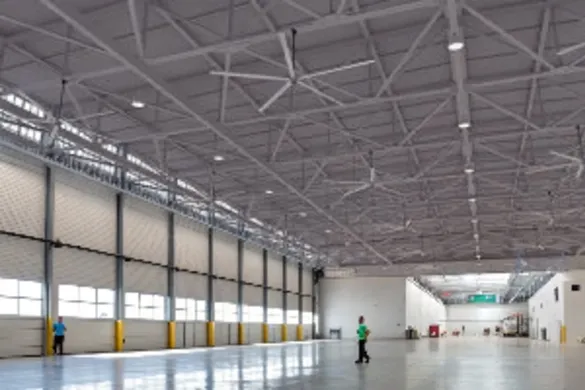
As a HVLS fans manufacturing plant, we design big ceiling fans and industrial portable units for real-world plants, warehouses, gyms, and schools. In this guide, I’ll walk you through how an industrial portable fan works, how much airflow you really need, and how to choose the right पंखा for your application—so you can keep people safe, productive, and comfortable without wasting money.
What Is an Industrial Portable Fan?
एक industrial portable fan is a high-capacity औद्योगिक पंखा built on a frame with wheels or handles so you can move it wherever you need strong airflow. Instead of cooling only one small corner, these units push air across long aisles, production lines, and courts.
In our own factory, we treat this product as the fast, flexible partner to our HVLS ceiling fans. HVLS fans destratify and mix the whole volume of air overhead, while portable units deliver a focused jet of air right where people are working. Together they work incredibly well for व्यावसायिक facilities that need both wide coverage and spot cooling.
You can उपयोग a portable unit for:
- Short-term projects
- Hot spots near ovens or welders
- Temporary installations, like events or seasonal peaks
- Areas where you can’t install ceiling or wall प्रशंसक
Think of it as a mobile airflow tool—easy to roll in, plug in, and aim exactly where your team needs relief.
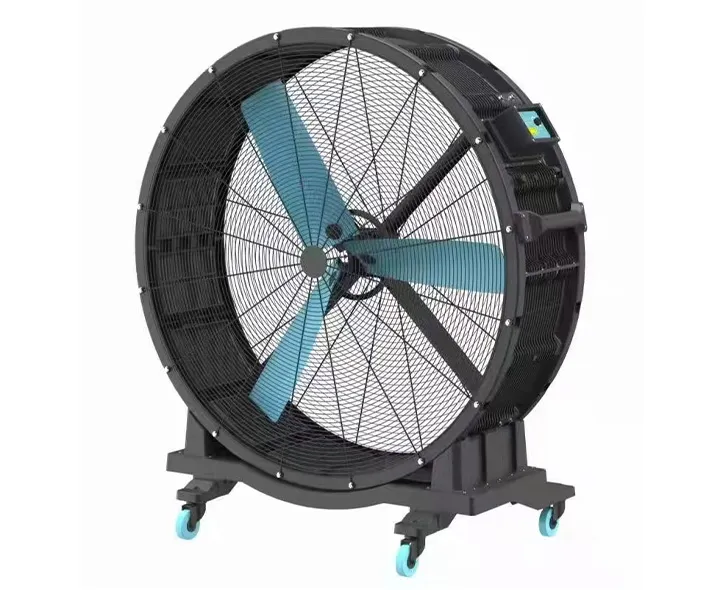
industrial portable fan
How Does an Industrial Portable Fan Work in Your Factory or Shop?
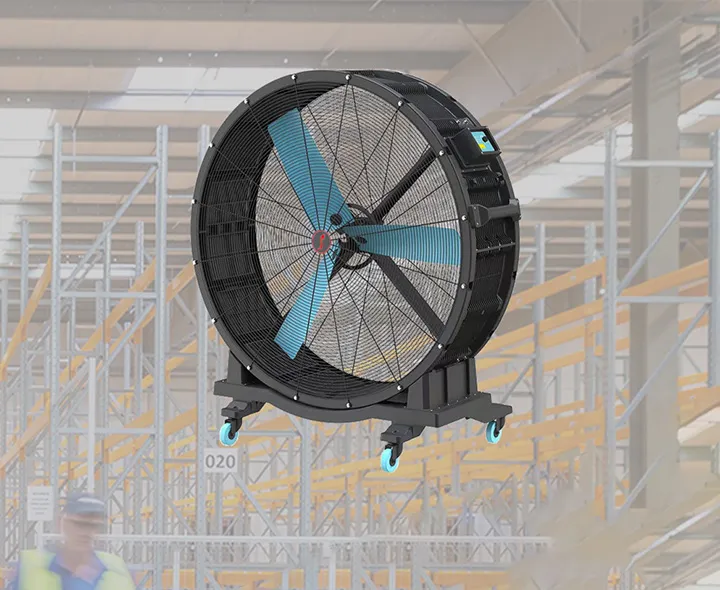
Inside the housing, an electric motor spins a set of blades. The blade design and angle create a focused stream of moving air that feels like a steady breeze instead of a sharp draft. Many ड्रम प्रशंसक sit in a rounded, barrel-shaped casing that helps guide airflow forward in a tight cone.
That moving air travels across the floor, picks up heat and moisture from people and equipment, and then mixes with the rest of the room. As your skin feels that breeze, sweat evaporates faster, so workers feel cooler even if the thermostat doesn’t change. This is what HVAC engineers call improved air circulation, and it’s a surprisingly powerful comfort tool.
In a metal shop or warehouse, we often move the unit behind workers to wash the hot air off their backs and push it toward an exhaust area. In assembly lines or packing zones, these units become an important part of your cooling equipment, especially where ducting is too expensive or too slow to change.
Industrial Portable Fan vs Fixed Systems and HVAC Cooling Systems
You might wonder, “Why not just add more air-conditioning?” In large spaces, traditional शीतलन प्रणालियाँ can be extremely expensive to install and run. By contrast, HVLS fans plus portable units can reduce HVAC energy consumption by up to 20% per year, according to independent energy studies.
A few key differences:
HVAC only
- Precise temperature control
- Very high capital and running cost
- Slow to react when doors open or processes change
HVLS + industrial portable fan
- Uses less energy by mixing air and reducing hot and cold spots
- Can make a space feel up to 10°F cooler with airflow alone
- Flexible—roll units where people actually stand
Brands in our field report that one large HVLS fan can replace multiple small units while still cutting energy use by up to 50% in big rooms. When you add mobile units under that airflow, you sharpen the cooling effect right at the workstations.
For you, that means fewer complaints, better comfort, and a faster payback period—often in just a few seasons of heavy use.
How Much Airflow (CFM) Do You Really Need from a Large Industrial Portable Drum Fan?
The most common airflow rating for a portable fan is cubic feet per minute, or सीएफएम. Many industrial mobile units fall between 5,000 and 20,000 CFM, and some बड़े औद्योगिक drum units can push even more.
Typical airflow ranges by type:
| पंखे का प्रकार |
Typical Size |
Typical Airflow (CFM) |
Best Location |
| Small cage fan |
18–20 in |
3,000–6,000 CFM |
Small work cells |
| Portable drum / barrel unit |
24–36 in |
6,000–15,000+ CFM |
Aisles, loading docks |
| Extra-large industrial drum |
36 in+ |
15,000–30,000+ CFM |
Production lines, open warehouses |
In our plant’s projects, these fans are commonly used in warehouses, production halls, and logistics hubs where high airflow over long distances matters more than precise temperature control.
To size an industrial portable unit, we usually start with:
- Room size and ceiling height
- Number of people and heat sources
- Existing ceiling fans or HVAC
- How close you can position the unit to workers
For many factories, a powerful 24–36″ mobile drum unit is the sweet spot—big enough to reach across a bay, but still easy to roll through doors and aisles.
Main Types of Portable Industrial Fans: Barrel, Pedestal and Floor Units
When you look at the variety of industrial portable units on the market, it’s easy to get lost. The main families we recommend are:
1. Barrel / Drum Units
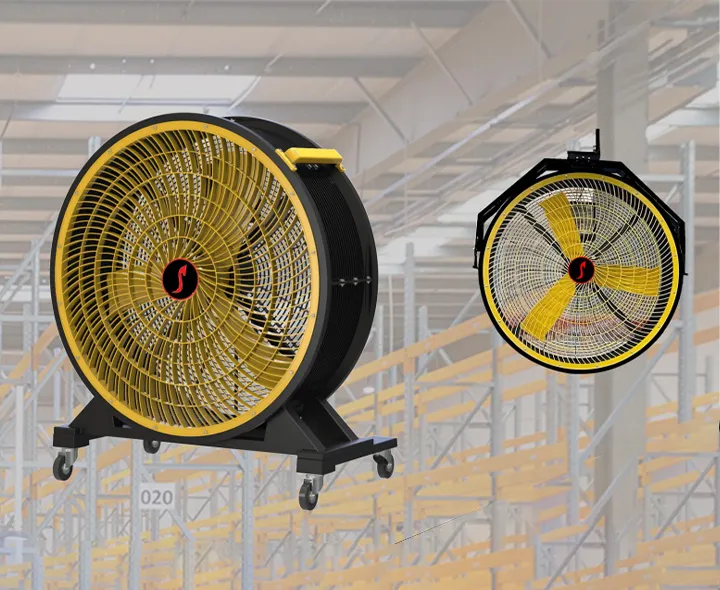
These are the classic “yellow or black tub” units you see in factories and gymnasiums. Drum fans sit low to the ground, usually on wheels, and push a lot of air in one direction. This makes them ideal for long aisles, shipping docks, and assembly lines.
Some models even work as a portable tilt blower so you can angle the stream upward along a rack or mezzanine. The drive can be direct or belt-driven; belt units can be quieter in some cases.
2. Pedestal and Industrial Floor Fans
ए कुरसी unit lifts the airflow up closer to head height on an adjustable stand. This is helpful near tables, inspection lines, and light assembly where workers stand still. Low-profile industrial floor fans are useful where there isn’t enough space or budget for a drum unit but you still want strong airflow on a specific station.
3. Caged, Wall and Mountable Units
Some portable units can sit on a stand today and go on a mount tomorrow. We see many clients choose hybrid units that work as a wall-hung cage fan in one season and roll around on a cart in the next. This kind of versatile hardware pays for itself faster because it adapts quickly when the layout changes.
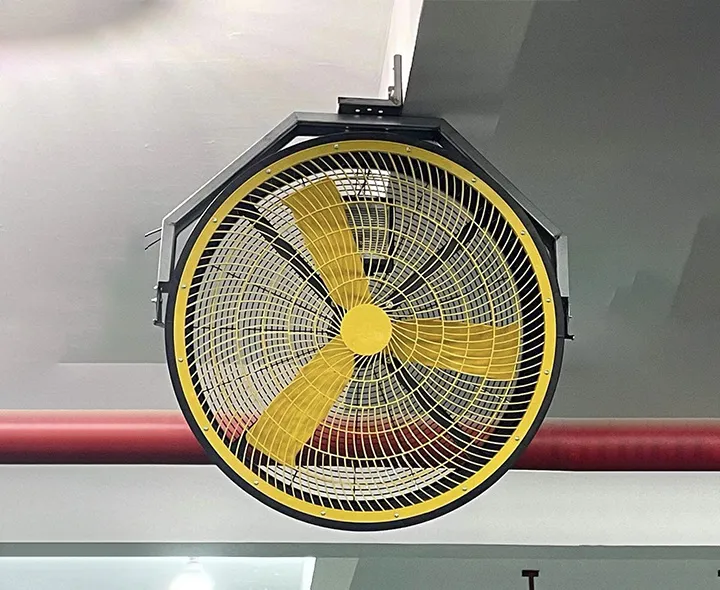
Oscillating wall mount fan
Portable Industrial Ventilation for Heat, Fumes and Hazardous Areas
Cooling comfort is only half the story. In many plants, you also need portable industrial ventilation to dilute fumes, weld smoke, dust, or vapors. Here we look beyond comfort airflow and pay close attention to safety.
These units pull fresher air in and push dirty air out, helping you meet standards in areas like welding booths, paint touch-up zones, and battery rooms. Some are rated for hazardous locations, with special motors and switches designed not to spark.
In chemical storage areas or confined spaces, the आवेदन is more critical. We often work with safety teams to place hose-type ventilators, portable blowers, and एचवीएलएस पंखे together so the air path is clear from clean intake to safe exhaust.
In continuous operations, we also check motor duty ratings and required run time. Here, a heavy-duty industrial unit with the right certifications is more important than looks.
How to Choose Power, Phase and Other Specs for the Right Industrial Portable Model
Once you know the size and type, it’s time to look at electrical details and controls. This is where a fan specialist earns their keep.
Key specs we review with every customer:
- मोटर power (HP or kW) and efficiency
- Voltage and phase (single- or three-phase supply)
- नमूना airflow rating, including max and low speed
- Noise level in dB at a standard distance
- Duty cycle and protection class
Here’s a simple spec checklist you can walk through with your engineering team:
- Power & supply – Match the motor to your plant voltage and phase.
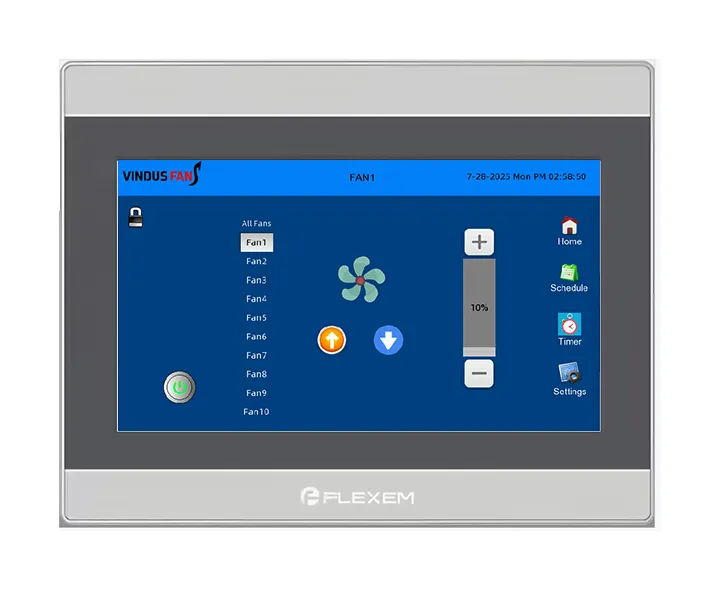
- Controls – Decide if you want simple pull-cords or remote speed control with multiple presets.
- Mobility – Check wheel size and frame design for real-world floors and ramps.
- Drive – Choose between direct drive and belt drive depending on noise and maintenance preferences.
- Rating – Look at ingress protection and whether the unit is suitable for humid or dusty locations.
If you’re running lines across several halls, we often प्रस्ताव the same family of units in a few sizes, so maintenance and spares stay simple across the whole उद्योग site.
Outdoor Cooling, Mist and Evaporative Cooler Options
Many of our customers also need airflow outdoors—loading bays, sports courts, or open-air workshops. In those cases, a weather-rated आउटडोर unit is a smart option.
You can combine:
- Industrial portable units for airflow
- Mist systems or बाष्पीकरणीय coolers for added comfort
- HVLS ceiling units under canopy roofs
Brands such as Portacool provide portable शीतक units that blend evaporation with fan airflow, while our HVLS ceiling products smooth out the air across the space.
When you pair these correctly, you get strong comfort without soaking the floor or burning through energy. For mixed indoor/outdoor docks, we often design a mix of wall units, HVLS fans, and portable units so you can direct airflow away from open doors and keep bugs and fumes out.
Key Features of Heavy-Duty Industrial Portable Fans Built to Last
For factories, schools, and sports centers, the purchase decision is about more than just price. You want units that are हमेशा के लिए तैयार किया गया है, stand up to real abuse, and keep running year after year.
We recommend paying close attention to these features:
- Durable frames – welded steel, powder-coated, with tough wheels
- Fully enclosed motors to keep dust out
- Guard spacing that meets safety standards
- Stable bases that don’t tip when you roll over thresholds
As a manufacturer, we build our HVLS and portable units with the same गुणवत्ता control standards: incoming inspection, balance testing, run-in time, and full load tests. That’s how we make sure your industrial portable units survive warehouses, ball games, and busy plants.
For large projects, our engineering team can प्रस्ताव airflow simulations, layout advice, and integration with existing systems. We see ourselves as your long-term ventilation partner rather than just a box shipper.
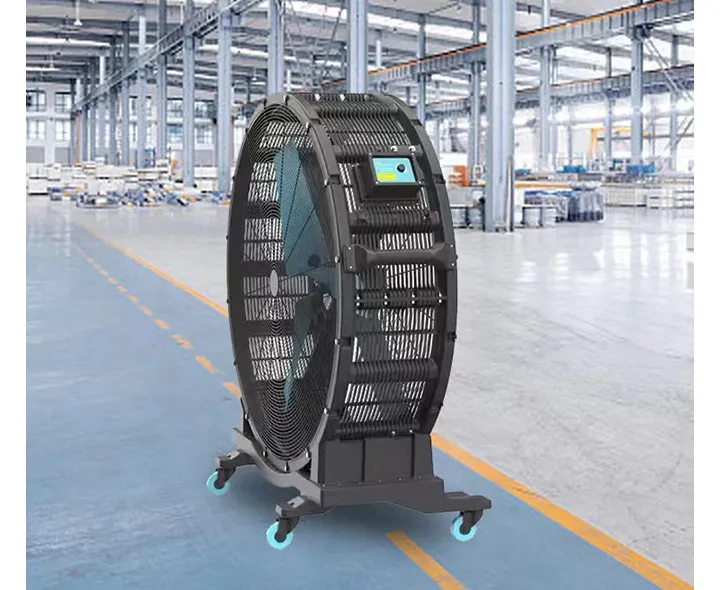
Key Features of Heavy-Duty Industrial Portable Fans
Case Study: How We Use Industrial Portable Fans in Real Projects
Let’s look at a simple example from a client warehouse.
- Area: 8,000 m²
- Use: pallet picking and storage
- Existing system: several HVLS units plus rooftop AC
During summer, workers still complained about hot spots in the picking aisles. We added a set of heavy-duty drum units at the aisle ends, positioned to blow across the pick faces. That solution became a permanent आवेदन once management saw the difference.
Results:
- Perceived temperature drops of 5–7°C in the hottest aisles (based on worker feedback)
- Fewer complaints about fatigue by mid-shift
- Ability to turn the AC setpoint up by 1–2°C, shaving energy cost
In projects like this, portable units become a flexible part of the airflow toolkit: easy to reposition when you change rack layouts, and fast to deploy during rare but extreme heat waves.
Where Are Industrial Portable Fans Used Most Often?
Across our customer base, industrial portable units show up in many settings:
- Manufacturing lines and equipment bays
- School gyms and sports centers
- व्यावसायिक warehouses and logistics depots
- Food and beverage plants
- Car workshops and small fabrication shops
In all of these, industrial portable units help ठंडा people, support वेंटिलेशन, and keep air moving around process equipment. When we design a new airflow plan, we often start with HVLS ceiling products, then add portable units as mobile tools to fine-tune comfort at specific stations.
FAQs About Industrial Portable Fans
What is the difference between an industrial portable fan and a normal shop fan?
A normal shop unit is usually smaller and meant for light duty. An industrial portable unit is larger, has a tougher frame, and delivers far more airflow to handle factories, gyms, and warehouses. It’s a heavy-duty tool designed for long run-times in demanding environments.
How do I decide where to place industrial portable fans?
Start with the places where people stand still or do heavy work. Aim the airflow along the length of aisles, not straight into faces. Avoid blocking exits or creating trip hazards with cords. Your goal is smooth circulation, not a hurricane at one point.
Can I use industrial portable fans in hazardous areas?
Only models that are rated for hazardous locations should go into areas with flammable vapors or dust. Talk to a ventilation specialist or safety engineer before you select units for these zones. Standard units may not be safe in those spaces.
Do industrial portable fans replace HVLS ceiling fans?
In most large buildings, they don’t replace— they complement each other. HVLS units mix the whole air volume; industrial portable units treat specific hot spots. Used together, they can reduce HVAC energy use और improve comfort more than either solution alone.
Are industrial portable fans noisy?
Noise depends on blade shape, speed, and drive type. Many modern units have better blade geometry and quieter motors. In offices beside production areas, we often specify lower-speed units and add HVLS fans to maintain comfort without excessive noise.
Can I integrate industrial portable fans into future upgrades?
Yes. Because they’re portable, you can redeploy them as your plant grows. They are easy to plug into new lines, different bays, or short-term projects. They’re also a good way to test airflow patterns before you invest in permanent ducting or more ceiling units.
Quick Specification Snapshot
Here’s a simple comparison table you can keep as a reference when you shortlist units:
| मानदंड |
Basic Shop Fan |
Industrial Portable Drum Fan |
| Typical Airflow |
2,000–4,000 CFM |
6,000–20,000+ CFM |
| Frame |
Light, consumer grade |
Steel, heavy-duty frame |
| Mobility |
Small stand, no wheels |
Large wheels, easy to roll |
| Best आवेदन |
Small rooms, garages |
Warehouses, plants, sports centers |
| Expected Service Life |
Shorter, light use |
Longer, हमेशा के लिए तैयार किया गया है with care |
Use this as a starting point, then add your own columns for voltage, motor power, environment, and budget.
Key Takeaways (Bookmark These)
- Use industrial portable fans as flexible tools to kill hot spots, support ventilation, and support your existing HVAC and HVLS ceiling units.
- Size by airflow and application, not by guesswork—know how much CFM you need and where you want the airflow to travel.
- Choose the right type (drum, pedestal, floor, or hybrid) to match worker positions, obstacles, and layout.
- Check specs carefully: voltage, phase, drive, duty rating, and protection class all matter in real plants.
- Invest in durable, heavy-duty construction so your units survive real factory life and keep people comfortable for years.
- Partner with a manufacturer who builds both HVLS and industrial portable units and can help you design a full-facility airflow plan, not just sell you a box.