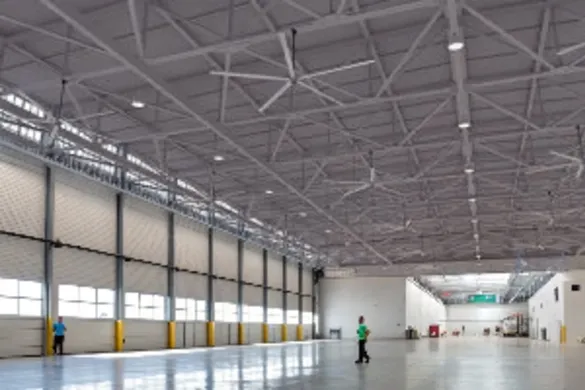
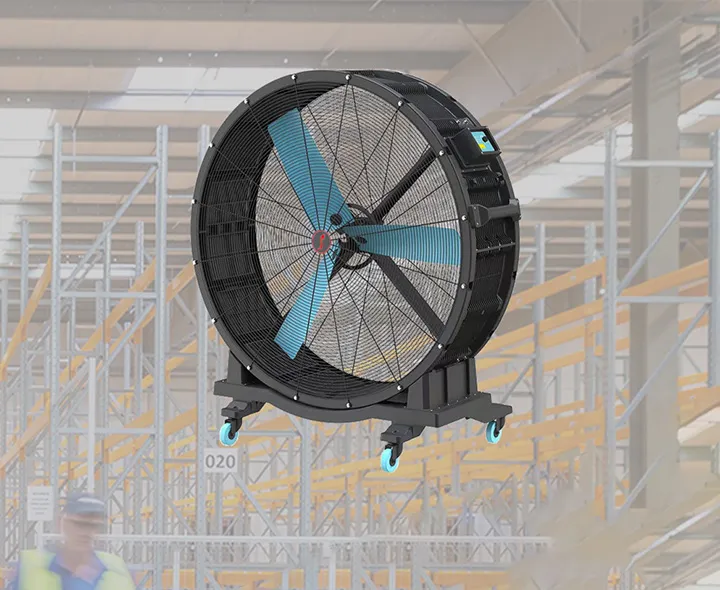
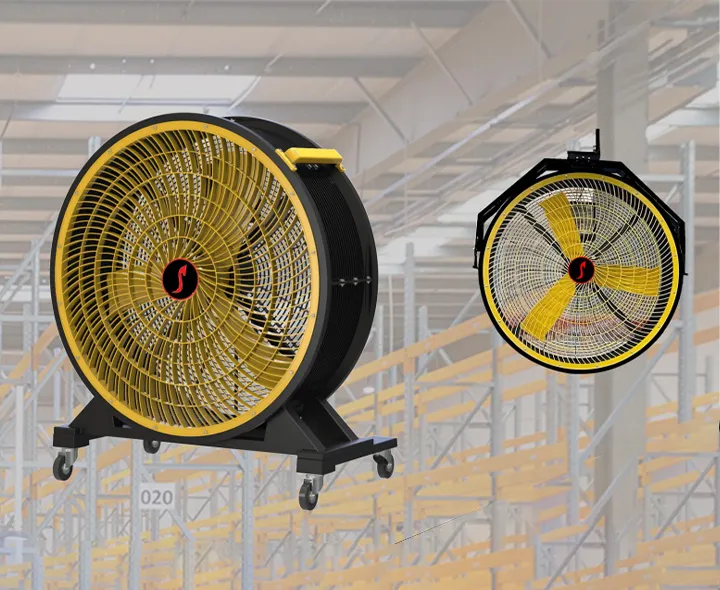
Hot zones, cold aisles, rising energy costs, and tired staff can quietly drain warehouse performance. The fix is not just “more fans.” It is choosing the right एचवीएलएस पंखा system that improves वायु प्रवाह, supports comfort, and works with your building, not against it.
For most buyers in 2026, the top गोदामों के लिए एचवीएलएस पंखे are not defined by brand hype. The best choice is usually an AMCA-certified, properly sized, variable-speed एचवीएलएस पंखा with strong controls, safe sprinkler integration, and proven हवा की गति आपके लिए गोदाम layout. These fans are built for बड़े स्थान, better हवा परिसंचरण, and lower operating strain on एचवीएसी प्रणालियाँ.
What makes an HVLS fan one of the best warehouse fans in 2026?
When people search for the best HVLS, they often expect a simple brand list. In real projects, I look at something else first: can the fan deliver stable वायु प्रवाह, safe installation, controllable fan speeds, and strong performance and efficiency over time? In warehouse environments, that matters more than a flashy brochure. AMCA’s guidance and DOE’s compliance framework both push buyers toward verified air performance and efficiency data instead of loose marketing claims.
In plain terms, the top HVLS fans in 2026 are the ones that help you हवा प्रसारित करें across big floor plates, reduce hot and cold layers, and stay easy to control. Good systems also fit the real job: pick faces, loading zones, mezzanines, assembly lines, or storage aisles. That is why choosing the best fan starts with the building use, not just the fan catalog.
Quick buyer view: top HVLS fan setups for warehouses in 2026
| Warehouse need |
Best-fit HVLS approach |
Why it works |
| Tall storage with high ceilings |
Large-diameter, variable-speed ceiling fan |
Better floor-to-छत mixing and broad coverage |
| Mixed-use distribution center |
Zoned fans with grouped controls |
Lets you adjust each work area |
| Hot loading bay area |
HVLS + ventilation strategy |
Improves perceived cooling and proper ventilation |
| Retrofit building |
Direct-drive fan with simple mounting package |
Easier service and cleaner installation |
| Energy-focused facility |
Fan with verified CFEI and sensors |
Helps cut unnecessary ऊर्जा की खपत |
That decision logic lines up with AMCA’s testing and certification approach, DOE’s ceiling-fan efficiency rules, OSHA heat guidance, and ASHRAE comfort guidance.
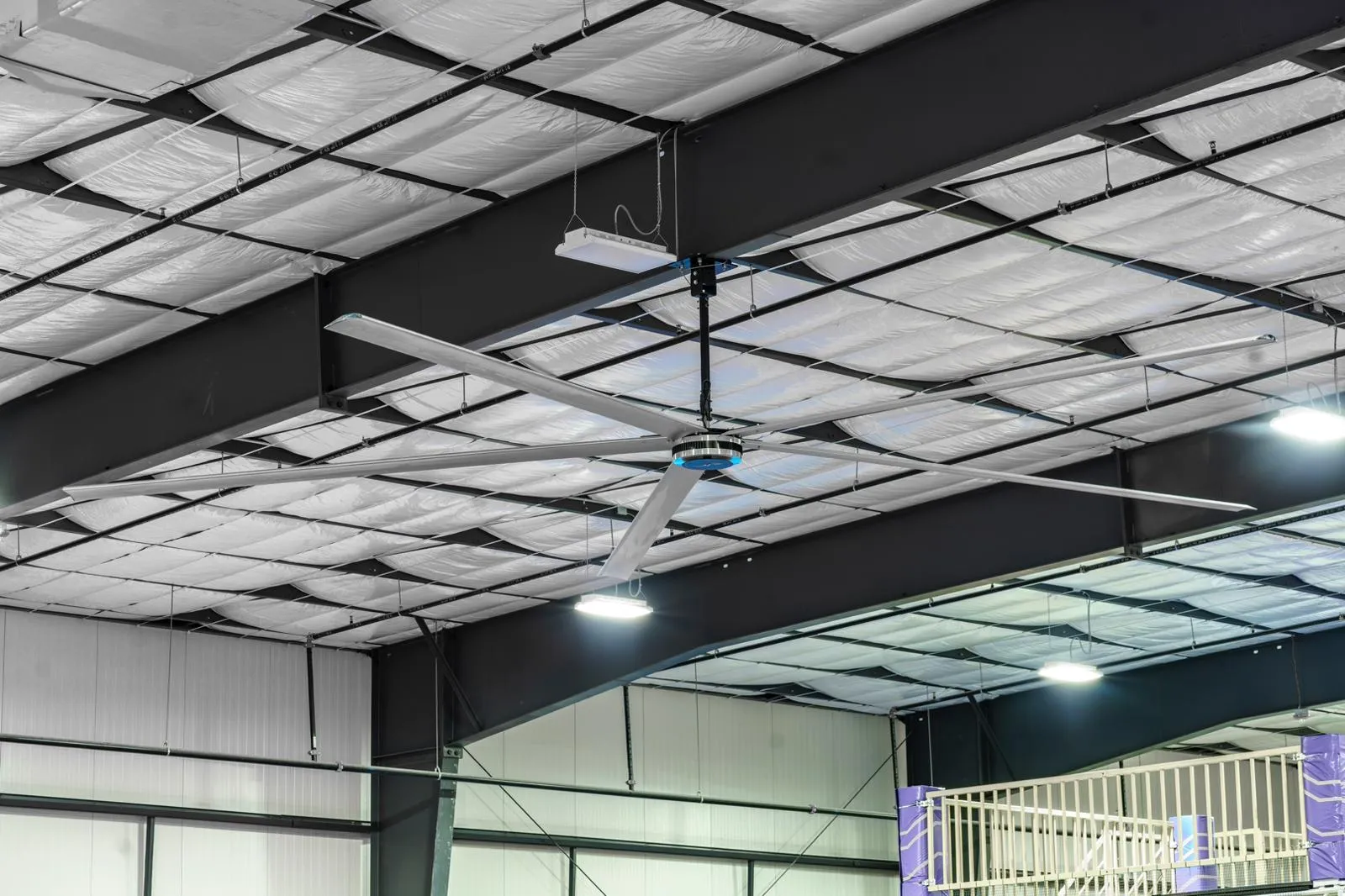
What makes an HVLS fan one of the best warehouse fans in 2026?
Why do warehouses and factories need HVLS fans instead of traditional fans?
कई में औद्योगिक स्थान, small high-speed fans solve only small pockets of discomfort. Traditional fans may create drafts in one spot and leave dead zones in another. एचवीएलएस पंखे are engineered for a different job. They move broad columns of air at धीमी गति, which is why the phrase उच्च मात्रा कम गति matters so much in गोदाम जैसे स्थान.
This is especially useful in warehouses and factories where people work, forklifts move, doors open, and heat builds near the ceiling. In winter, destratification helps bring trapped warm air back down. In warmer months, elevated air speed can improve worker comfort. ASHRAE recognizes that elevated air speed can extend comfort under the right conditions, and OSHA notes that increasing air flow can help reduce heat stress when air temperature stays below skin temperature.
“Increase general ventilation” and “provide cooling fans.” — OSHA
From a buyer’s view, this means एचवीएलएस पंखे मदद करते हैं create a more आरामदायक वातावरण without forcing your cooling system to do all the work. They are especially strong in औद्योगिक वातावरण where you want to improve comfort, support वायु गुणवत्ता, और reduce operational costs at the same time. AMCA also notes that HVLS applications include occupant comfort, destratification, and even improved perceived indoor air quality.
Which key features should you check before you buy an industrial fan?
The most important key features are not hidden. I tell buyers to check six things first: verified ratings, motor type, controls, blade design, mounting method, and service access. AMCA explicitly recommends using certified ratings for comparison, and DOE’s framework makes efficiency reporting more transparent through the Ceiling Fan Energy Index for large-diameter ceiling fans.
Here is the practical checklist I use when reviewing any औद्योगिक पंखा proposal:
- AMCA-certified air performance
- CFEI or DOE-trackable compliance information
- Direct-drive motor and variable frequency control
- Reliable blade and hub construction for long-term टिकाऊपन
- Sensor-ready controls for temperature, humidity, or occupancy
- Easy maintenance access and clear support documentation
Recent DOE and AMCA materials also show where fan technology is heading: more efficient motors, improved blade geometry, and smarter controls such as temperature or occupancy sensing. In other words, fan technology is evolving rapidly, and the safest buying move is to choose proven hardware with verifiable data.
How do you choose the right fan size, ceiling height, and layout?
यदि आप चाहते हैं सही चयन करो system, do not start with price. Start with the building. The दायाँ एचवीएलएस पंखा depends on floor area, rack layout, obstacle count, work zones, and छत की ऊंचाई. A fan that looks impressive on paper can still fail if the spacing is wrong or the blades sit too high, too low, or too close to obstructions.
In our industry, the biggest mistake is treating every गोदाम the same. Some sites need fewer, larger fans. Others need more units at lower output because of racks, conveyors, or packing islands. The real job is selecting a fan layout that matches your विशिष्ट आवश्यकताएं और operational needs.
Simple sizing logic for large warehouse projects
| Building condition |
What to prioritize |
| Open floor with few obstructions |
बड़ा पंखे का आकार and wider coverage |
| Dense racking |
More careful spacing to avoid dead zones |
| Mezzanine or mixed levels |
Zoned control and lower-speed balancing |
| Heat build-up at roof deck |
Strong destratification strategy |
| Retrofit steel structure |
Mounting method and clearance review |
के लिए बड़े औद्योगिक स्थान, good layout is crucial for optimal performance. AMCA’s guidance on HVLS application and testing supports comparing certified air performance, while the comfort side is supported by ASHRAE’s elevated-air-speed framework.
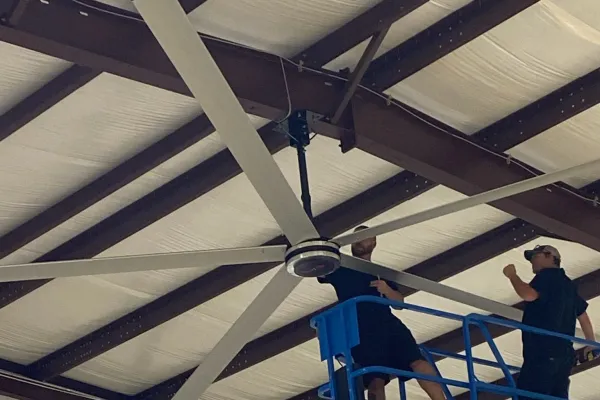
How do you choose the right fan size, ceiling height, and layout?
What do airflow, CFEI, and AMCA ratings really tell you?
Many buyers focus on diameter alone. That is not enough. Two fans can be the same size and perform very differently. What matters is verified वायु प्रवाह, how efficiently the fan moves it, and whether the ratings were tested under recognized methods.
AMCA explains that large-diameter ceiling fans should be compared using certified ratings, and DOE’s framework uses CFEI to compare efficiency at high speed and at 40% speed. AMCA’s recent guidance also notes that a fan can look fine under old cfm/W style thinking and still lag under CFEI, which is one reason smarter comparison matters in 2026.
A simple rule: do not buy from a spec sheet that cannot explain how the numbers were tested. If a supplier can show AMCA certification and clear compliance data, you are in a much safer place.
What the numbers mean for buyers
| Metric |
Why you should care |
| वायु प्रवाह |
Shows how much air the fan can move |
| CFEI |
Shows relative energy efficiency for large-diameter fans |
| Certified ratings |
Reduce guesswork when comparing suppliers |
| Sound data |
Helps manage noise levels in occupied zones |
| Control range |
Tells you how well you can adjust fan output |
For warehouse buyers, this is the heart of performance and efficiency. Better data leads to better system design, and better design helps you achieve the best results from the same electrical input.
Are smart controls and sensors worth it in 2026?
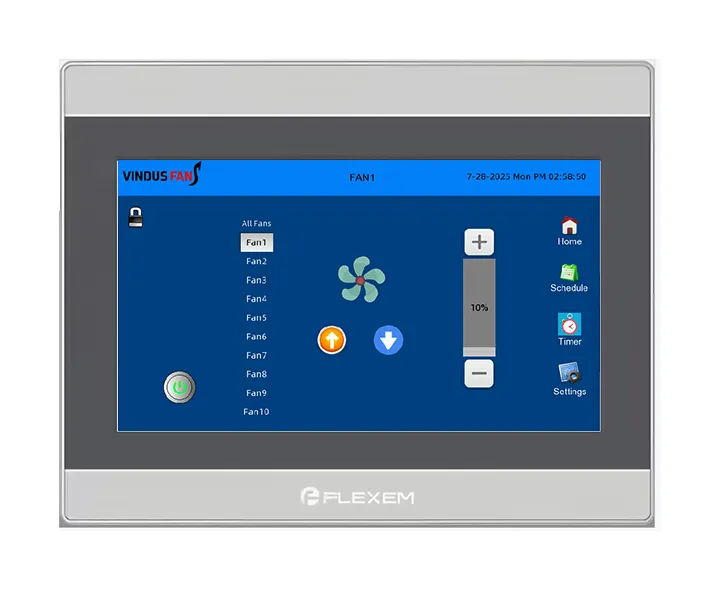
Yes, in many cases they are. A modern एचवीएलएस पंखा does more than spin. It can respond to temperature, humidity, time schedules, grouped zones, and sometimes occupancy logic. DOE’s 2023 ceiling-fan rulemaking documents and AMCA materials both point to advanced controls as an important efficiency path.
That matters because warehouse demand is not flat all day. Loading areas spike. Pick zones change. Night shifts feel different from midday. Smart control lets you tune the system so the fans run where and when they should. That is how प्रशंसकों की पेशकश real ऊर्जा बचत, not just theoretical savings.
If your site has multiple work zones, smart grouping can also save time and money for supervisors. Instead of walking the building to switch units manually, you can manage output by area. In many projects, this is the difference between a fan that gets used well and a fan that gets ignored.
How much energy can HVLS fans save when paired with HVAC systems?
A good एचवीएलएस system is not a replacement for एचवीएसी प्रणालियाँ. It is a force multiplier. In cooling season, added air speed can help people feel more comfortable. In heating season, destratification helps move heat that gathers overhead back down toward occupants and work areas. ASHRAE has documented the value of elevated air speed for comfort and has discussed HVLS fans as a practical way to reduce floor-to-roof temperature gradients in very large buildings.
From an operating standpoint, that means you may be able to run a smarter temperature strategy instead of simply pushing mechanical heating or cooling harder. That can ऊर्जा कम करना, trim ऊर्जा लागत, and sometimes let you reduce energy costs more noticeably in tall buildings than in low-roof spaces. The exact result depends on climate, envelope, door openings, and internal heat load, so I prefer to frame this as system optimization, not magic.
A practical note from OSHA also matters here: more air speed helps people only within the right temperature range. When indoor air is hotter than skin temperature, fan cooling alone is not the answer. That is why strong वेंटिलेशन, heat-source control, and a real building strategy still matter.
What installation rules matter for sprinklers, fire alarms, and safety?
This section separates serious suppliers from casual sellers. If you are installing HVLS fans in a sprinklered building, you need to review fire protection rules early. AMCA’s materials referencing NFPA provisions note that an HVLS fan should typically be centered between adjacent sprinklers, maintain a minimum 3 ft vertical clearance to sprinkler deflectors, and shut down on a waterflow alarm where required.
That is not a small detail. It affects mounting position, extension tubes, controls, and sometimes the whole layout plan. Buyers who ignore this often end up redesigning the job late.
I always recommend asking for three things before approval:
- Mounting drawings for the exact structure
- Fire-system coordination notes
- A clear sequence for shutdown integration
This is one reason the इष्टतम पंखा is not always the biggest one. The दायाँ पंखा is the one that fits the building safely and works with code-driven constraints.
Which HVLS fan setup is best for different warehouse environments?
There is no universal winner. The best answer changes with the job.
Best HVLS fan setup by application
| आवेदन |
Recommended setup |
क्यों |
| E-commerce fulfillment |
Mid-to-large fans in zones |
Balances picking, packing, and docks |
| Cold-season logistics hub |
Destratification-focused layout |
Recovers trapped overhead heat |
| Light manufacturing + storage |
Mixed fan groups |
Supports both process and people |
| Sports or gym-style warehouse shell |
Wide-coverage fans |
Strong comfort in open floor plans |
| School or large commercial multipurpose building |
Lower-noise control strategy |
Better occupant comfort |
के लिए बड़े वाणिज्यिक and industrial buildings, I usually divide projects into three buckets: comfort-heavy, destratification-heavy, and mixed-use. HVLS fan models should be compared inside the right bucket. A comfort-first project may need different blade diameter and control logic than a heat-recovery project.
This is also where buyer experience matters. प्रशंसक आते हैं in many diameters and control packages, but good selection is about matching the fan to औद्योगिक अनुप्रयोग, not forcing the building to fit the fan. The best systems for environments like warehouses are the ones that optimize airflow where work actually happens.
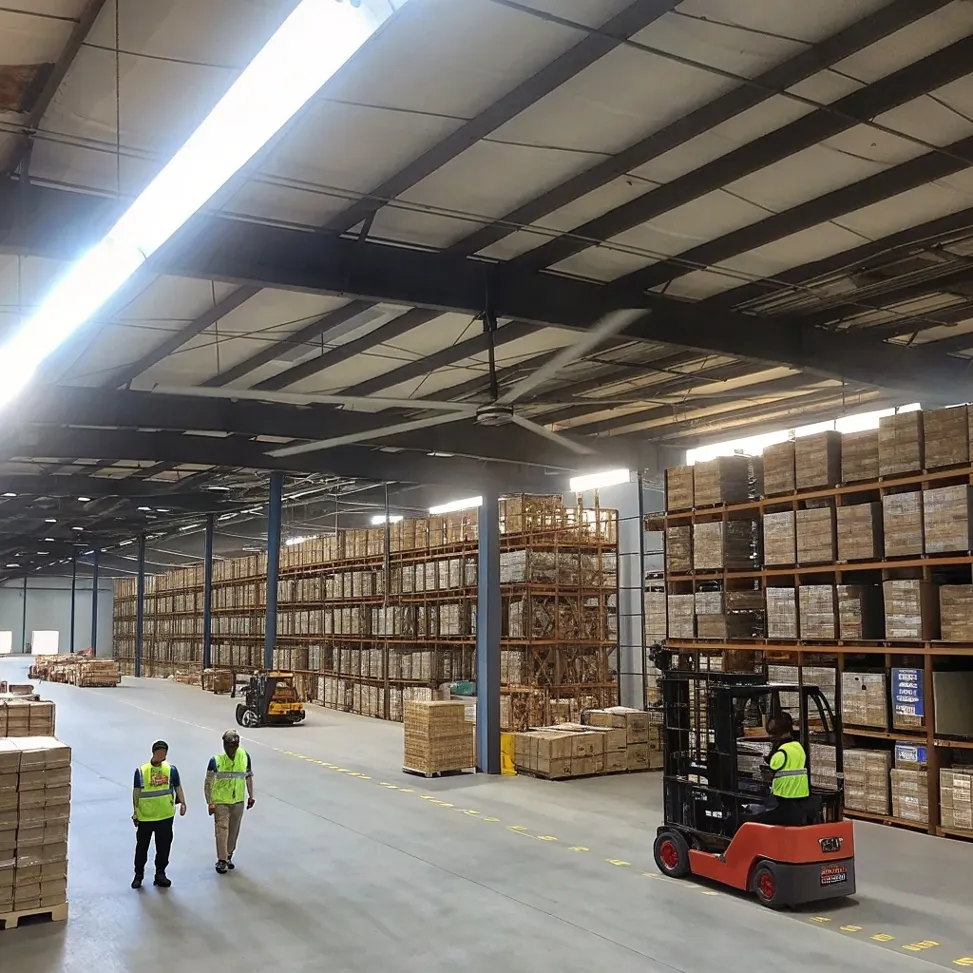
Which HVLS fan setup is best for different warehouse environments?
What mistakes hurt performance and efficiency in warehouse projects?
The first mistake is oversimplifying the spec. Bigger is not always better. The second is ignoring layout. The third is skipping verified data. The fourth is treating the fan as separate from the building system.
Here are the common errors I see:
- Buying on diameter alone
- Ignoring rack layout and door patterns
- Forgetting sprinkler clearances
- Running every fan at full output all day
- Not coordinating with एचवीएसी प्रणालियाँ
- Assuming low speed fans need no design work
The best warehouse projects take a systems view. पंखे चलने के लिए डिज़ाइन किए गए हैं broad air columns, not to fix every heat problem by themselves. Fans effectively support comfort and destratification, but they work best when the site also addresses doors, insulation, occupancy, and heat sources. That is how fans significantly improve building conditions.
Example decision path for a buyer
Step 1: Confirm building dimensions and obstructions
Step 2: Review certified performance data
Step 3: Match layout to work zones
Step 4: Check sprinkler and alarm coordination
Step 5: Add smart controls where they will actually be used
Step 6: Compare service support and long-term टिकाऊपन
That process is much safer than chasing a “cheap giant fan” strategy.
Why do many warehouse buyers now prefer AMCA-backed, direct-drive HVLS industrial systems?
में 2026, buyers are more cautious. Many have seen inflated claims online. That is why AMCA-backed comparison matters more than ever. Certified ratings give engineers, contractors, and end users more confidence that published performance is real, while DOE compliance tools make it easier to verify regulated efficiency information.
I also see growing preference for direct-drive systems because they align with simpler maintenance thinking and cleaner control integration. If you are searching for an HVLS industrial solution for बड़ी मात्रा of air in a busy गोदाम, clarity beats hype every time. The best suppliers are the ones who explain ratings, installation limits, service access, and control logic in plain language.
As a manufacturer, that is how we try to present value too: honest air-performance data, practical mounting support, and fan plans built around real गोदाम work. In short, पंखे चलते हैं air; smart engineering moves the project forward.
FAQs About HVLS Fans for Large Warehouse Spaces
Are HVLS ceiling fans good for warehouses with high ceilings?
हाँ। एचवीएलएस छत पंखे are especially useful in buildings with tall roof decks because they help mix air from floor to roof and support more even temperatures. That is a major reason they are widely used in बड़े स्थान और warehouse environments.
Do HVLS fans replace ventilation systems?
No. They improve air circulation in large spaces, but they do not replace required outside-air or exhaust design. Think of them as partners to your वेंटिलेशन plan, not substitutes for it.
How do I know whether a supplier’s airflow claims are real?
Ask for AMCA-certified ratings, test-method references, and DOE compliance information where applicable. If the supplier cannot explain the test basis, compare another vendor. (
Are smart controls really necessary?
Not always, but they are often worth it. In multi-zone sites, smart technology helps you run fans only where needed, which can improve comfort and help manage ऊर्जा की खपत more intelligently.
Can HVLS fans help reduce heating and cooling waste?
Yes, especially through destratification and better occupant comfort. They can support better seasonal control strategy, but results depend on the building, climate, and operating pattern.
What is the single biggest buying tip?
Check building fit before fan brand. The एचवीएलएस पंखों के लाभ appear only when layout, safety, controls, and performance data all line up.
Key takeaways
- एचवीएलएस पंखे work best when they are selected as a system, not as a standalone product.
- में 2026, the strongest buying signals are AMCA-certified ratings, DOE-trackable efficiency data, and smart but practical controls.
- के लिए गोदाम प्रशंसक, layout, छत conditions, obstructions, and fire-system coordination matter as much as blade diameter.
- The best systems improve वायु प्रवाह, comfort, and destratification while helping teams manage ऊर्जा लागत more effectively.
- सही चयन करो fan by building use, not by marketing claims. That is how you get long-term टिकाऊपन, safer installation, and stronger return on investment.