Factories, gyms, and warehouses often feel stuffy or uneven—hot up high, cold down low. That discomfort hurts focus, safety, and energy bills. I’ve seen teams “fight” the thermostat all day. The fix is simpler than most people think: use the right ceiling fan to move air where people work.
Commercial ceiling fans without lights are built to move steady air (not add brightness). For big rooms, the best choice is usually an industrial ceiling fan—often an hvls ceiling fan—because it covers wide zones with low-speed, high-volume airflow, helps balance temperatures, and can cut HVAC workload when paired with smart setpoints.
Outline
- What is a ceiling fan “without light,” and why do large sites prefer it?
- Industrial ceiling fan vs. standard fan: what changes in an industrial ceiling building?
- When should you choose an HVLS ceiling fan for open areas?
- How much energy efficiency can you realistically expect—and what must you do to get it?
- Why remote control matters in factories, gyms, and schools
- How to size a ceiling fan for a large ceiling and large spaces
- What about an outdoor ceiling fan for outdoor spaces and semi-open buildings?
- What does safe ceiling fan installation look like in commercial projects?
- Materials, finishes, and industrial design: black, nickel, and long-term durability
- Buyer checklist + quick case study results you can copy into your RFQ
1) What is a ceiling fan “without light,” and why do large sites prefer it?
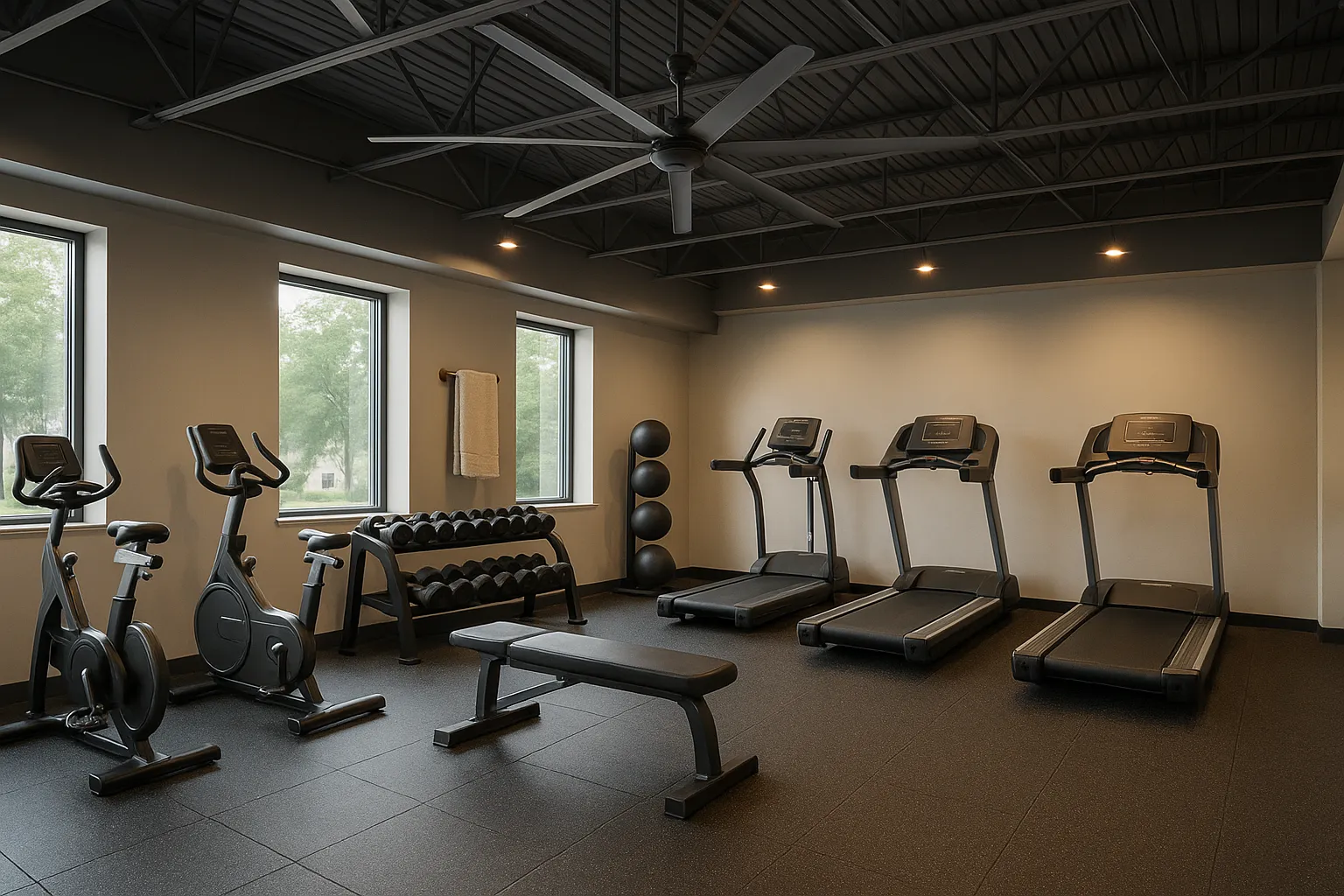
ए ceiling fan without a lamp is exactly what it sounds like: a fan that focuses on air movement, not illumination. Many facilities already have high-bay LEDs, skylights, or sports lighting. Adding a ceiling fan with light can complicate wiring, maintenance, and glare control. That’s why ceiling fans without lights are common in high-usage commercial spaces.
From my manufacturing-plant perspective, buyers often ask for “simple, strong, easy to service.” A fan without light usually means fewer parts (no light kit), fewer failure points, and faster commissioning. It also avoids the headache of matching color temperature, beam angles, and lighting controls.
Where this matters most:
- warehouse aisles and packing zones (air movement + clear lighting plan)
- gyms and sports centers (no glare during training)
- schools and assembly halls (simple maintenance, safe controls)
What is a ceiling fan “without light,” and why do large sites prefer it?
2) Industrial ceiling fan vs. standard fan: what changes in an industrial ceiling building?
In an industrial ceiling environment, you’re dealing with height, heat layers, and wide floor plates. That changes what “good” looks like.
A residential fan is made for a room. An industrial ceiling fan is built for airflow in large volumes, longer run times, and tougher conditions. In plain words: industrial ceiling fans are designed for work.
Here’s a practical comparison I use when explaining options to project buyers:
| विशेषता |
मानक सीलिंग फैन |
औद्योगिक छत पंखा |
| कवरेज |
Small zones |
बड़े स्थान / open areas |
| Typical goal |
Comfort breeze |
powerful air circulation + destratification |
| Motor duty |
Light-to-medium |
heavy-duty, long runtime |
| नियंत्रण |
basic wall switch |
remote control, automation-ready |
| Build |
light hardware |
fans are built to withstand commercial use |
A key reality: industrial ceiling fans are engineered to keep air moving gently but consistently across big footprints. That’s how you get comfort without feeling like you’re standing in a wind tunnel.
3) When should you choose an HVLS ceiling fan for open areas?
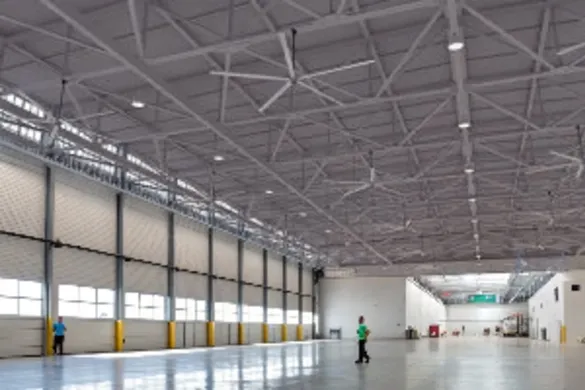
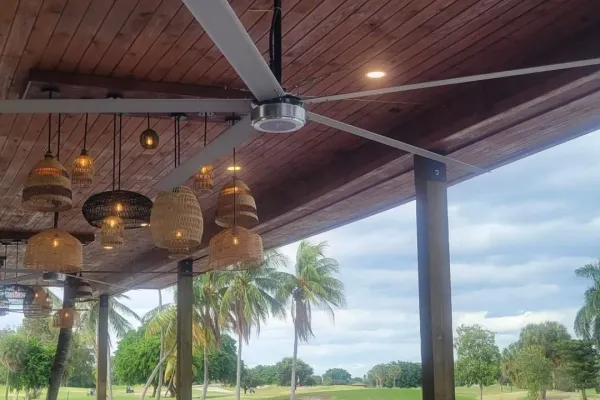
If your space feels “too big for normal fans,” that’s the sign. An एचवीएलएस छत पंखा (High Volume, Low Speed) is made for large open areas like warehouses and sports halls.
I often explain HVLS with a simple picture: small fans “stir” air; HVLS fans “push” a slow-moving blanket of air across a wide zone. Done right, it can deliver powerful airflow where people stand, pick, train, or assemble.
You’ll likely benefit from large industrial ceiling fans if you have:
- a warehouse with tall racking
- manufacturing lines with heat loads
- gyms / sports centers with big courts
- distribution bays, staging areas, and open areas
- any industrial space where temperature layers form
And yes—buyers ask about brands. You’ll hear terms like big ass fans in conversations because the category is well-known. But the real question is the engineering match: coverage, mounting height, controls, and safety.
HVLS ceiling fan for open areas
4) How much energy efficiency can you realistically expect—and what must you do to get it?
Here’s the honest answer: fans don’t “make cold air.” They make you feel cooler by moving air over skin, and they help HVAC by mixing air. That’s why energy efficiency depends on how you operate the building.
Two credible references I often share with facility teams:
- The U.S. Department of Energy notes that using a ceiling fan can let you raise thermostat settings by about 4°F without reducing comfort. That’s a big lever for energy savings.
- The U.S. GSA’s “Smart Ceiling Fans” findings emphasize a key point: savings happen when setpoints change; otherwise, costs can even rise.
And for HVLS in tall buildings, there’s published evidence on destratification benefits. A study on an airplane hangar reported the HVLS fan reduced normalized gas use by 29% during heating conditions.
A simple “setpoint + fan” rule I use
- Cooling season: use airflow so people feel comfortable at a higher setpoint
- Heating season: run slow to reduce heat pooling at the roof
Mini chart (illustrative): perceived comfort vs. air movement
Low airflow    |  Comfort drops quickly as temp rises

Medium airflow |  Comfort holds at higher temps

High airflow   |  Comfort holds longer, but avoid drafts in desk areas
5) Why remote control matters in factories, gyms, and schools
In commercial spaces, a fan isn’t a decoration—it’s a tool. If it’s hard to control, people stop using it correctly.
That’s why remote control is not a “nice-to-have.” It’s how you:
- adjust fan speed during different shifts or class periods
- reduce complaints (“too windy” / “not doing anything”)
- improve compliance with comfort plans
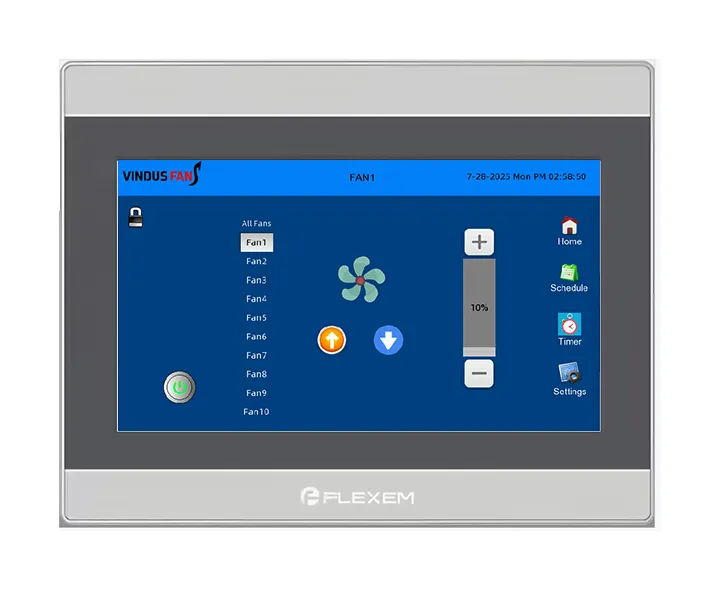
Many buyers request a ceiling fan with remote for day-to-day convenience. In larger projects, they also want a ceiling fan with remote control so supervisors can standardize settings.
What I recommend from the factory side:
- lockable presets for safety
- simple controls that floor teams actually use
- options for integration (BMS/0-10V where needed)
And yes, fan options matter. If “whether you need” a manual wall control, a handheld remote, or a centralized panel depends on your operations.
6) How to size a ceiling fan for a large ceiling and large spaces
Sizing is where most costly mistakes happen. A common trap is buying too many small fans when a few larger ones would do better.
Here’s a clear checklist I use with B2B buyers:
- ceiling height and structure type
- obstacles: cranes, sprinklers, lights, scoreboards
- target zone: workstations vs. whole floor
- required maximum airflow (comfort vs. destratification focus)
- noise expectations (gyms and schools care a lot)
If you’re shopping retail-style, you’ll see phrases like “inch industrial ceiling fan.” That can be helpful for smaller commercial rooms. But for truly big buildings, बड़े छत पंखे (and often HVLS) reduce clutter and simplify control.
Quick sizing table (rule-of-thumb thinking, not a substitute for engineering):
| Space type |
Typical need |
Best fit |
| Small commercial rooms |
local comfort |
industrial style ceiling fans |
| Big box / gyms |
wide comfort zone |
एचवीएलएस छत पंखा |
| High-bay गोदाम |
destratification + comfort |
HVLS + zoning |
7) What about an outdoor ceiling fan for outdoor spaces and semi-open buildings?
If you’re installing under canopies, loading docks, or covered walkways, an आउटडोर छत पंखा can help—but only if it’s rated for the environment.
For outdoor ceiling applications, buyers should check:
- corrosion-resistant materials
- sealed electronics
- stable operation in outdoor environments
- mounting hardware suitable for wind exposure
I’ve seen great results in outdoor spaces like covered dining areas, school corridors, and pergolas—especially when heat builds up but walls are open.
Remember: outdoor air movement competes with wind. You still want steady air circulation, but you don’t want over-promising. A fan won’t “fight weather,” but it can make a semi-open zone far more usable.
8) What does safe ceiling fan installation look like in commercial projects?
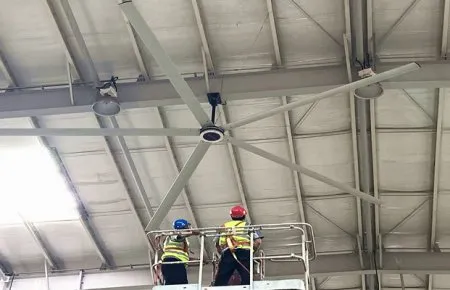
Commercial installs aren’t DIY. Your ceiling fan installation needs to match structure, load ratings, and local codes.
A clean commercial process looks like this:
- Site survey + mounting point verification
- Load calculations and bracket selection
- Clearance checks (sprinklers, lights, beams)
- Electrical routing + controls planning
- Commissioning: speed ranges, vibration checks, control training
A huge best practice: document the operational plan. That’s how facilities keep the benefits (comfort + savings) year-round.
This also matters for compliance-heavy clients—schools, public buildings, and manufacturing sites often need clear maintenance records.
What does safe ceiling fan installation look like in commercial projects?
9) Materials, finishes, and industrial design: black, nickel, and long-term durability
Looks still matter, especially in gyms, showrooms, and modern commercial lobbies. Good industrial design can match your brand while staying practical.
Common finishes buyers ask us for:
- matte black (popular in modern gyms)
- black ceiling fan aesthetics for clean ceilings
- nickel and satin nickel for a classic industrial look
If you want a black ceiling fan with remote, choose a finish that resists fingerprints and dust marks—important in high-traffic spaces.
Also pay attention to internals:
- a dc motor can improve efficiency and control smoothness (model-dependent)
- stronger fan blades and balanced hubs reduce vibration
- real-world durability depends on bearings, QC, and installation quality
In some mixed projects (like commercial and residential developments), designers still ask for a ceiling fan with light in apartments but want fan-only models in shared halls and gyms. That hybrid approach keeps style and functionality aligned across the project.
10) Buyer checklist + a quick case study you can reuse in an RFQ
A copy-paste checklist for procurement teams
- Space type: warehouse, gym, school hall, factory bay
- Ceiling height + obstructions
- Goal: comfort breeze vs. destratification vs. both
- Controls: remote control vs. centralized panel
- Finish needs: industrial style, black, nickel
- Safety: mounting spec + certifications + maintenance plan
- Logistics: lead time, spares, training
- Commercial terms: warranty, support, and (when offered) free shipping
Case study (published data point)
In an airplane hangar setting, an HVLS fan reduced normalized gas use by 29% during heating conditions—showing how destratification can cut heating waste in tall-volume buildings.
That’s exactly why large facilities treat fans as part of the HVAC strategy—not a decoration.
A quick decision table: pick the “right fan” faster
| If your space is… |
And your priority is… |
Choose… |
| Tall, wide, busy |
comfort + savings |
HVLS + smart controls |
| Medium commercial |
style + function |
industrial style ceiling fans |
| Semi-open |
comfort in heat |
rated आउटडोर छत पंखा |
| High compliance |
documentation |
engineered install + training |
This is how you avoid buying the wrong fan and then blaming the concept.
पूछे जाने वाले प्रश्न
Are ceiling fans without lights better for warehouses and factories?
Often, yes. Lighting is usually handled by high-bay fixtures, so a fan-only unit simplifies wiring and reduces maintenance parts.
Do industrial ceiling fans without lights still help in winter?
Yes—slow, steady operation can reduce hot air pooling near the roof and improve comfort at floor level. A hangar study reported meaningful heating savings under destratification conditions.
Will a ceiling fan really lower my HVAC cost?
It can—if you adjust setpoints. DOE notes you can often raise cooling setpoints about 4°F while maintaining comfort with fans.
Is remote control reliable for commercial use?
It can be, when designed for commercial duty and paired with proper commissioning. Many teams prefer a ceiling fan with remote for daily use, and central control for standardized facilities.
How do I know whether you need HVLS or a smaller industrial fan setup?
If you have a large ceiling, wide open areas, or uneven temperatures, HVLS usually wins. If zones are small and segmented, multiple smaller fans can work better.
Do you offer free shipping?
Many manufacturing-plant programs can support free shipping to specific regions or order sizes—this depends on your project volume, destination, and packaging plan.
What we do as an HVLS fans manufacturing plant (and what you should ask for)
When B2B buyers contact us, we typically support:
- selection based on layout and usage goals
- engineering guidance for mounting and controls
- production scheduling for bulk projects
- documentation for installers and facility teams
- spare parts planning and after-sales support
If you’re sourcing for a factory, school, gym, or large commercial project, send your ceiling height, floor plan, and target comfort issues. We’ll help you match the right fan strategy to your building—not just sell a product.
Key takeaways
- A ceiling fan improves comfort by moving air; savings come when HVAC setpoints change.
- An industrial ceiling fan fits tall, wide buildings better than residential models.
- An hvls ceiling fan is ideal for large spaces and open areas, especially where heat layers form.
- Remote control and smart presets turn “good equipment” into real-world results.
- For covered outdoor areas, choose a rated outdoor ceiling fan built for moisture and corrosion.
- Treat fan selection + ceiling fan installation as an engineering step—not a quick purchase.