A hot outdoor space, weak air movement, and trapped heat can make even a beautiful patio or covered venue hard to enjoy. The fix is not just “add any fan.” The real solution is choosing the right एचवीएलएस पंखा that is actually built for outdoor conditions.
Yes, an HVLS fan can be installed outdoors, but only when the product is properly rated for outdoor use and matched to the site. In most cases, that means choosing the right आउटडोर छत पंखा for moisture exposure, structure, and coverage needs, especially in large covered or semi-open spaces.
What is an HVLS fan, and why is it different from a normal ceiling fan?
एक एचवीएलएस पंखा is a large-diameter सीलिंग फैन designed to move a broad column of air at धीमी गति. AMCA notes that large-diameter ceiling fans are defined as fans with a blade span greater than 7 feet, and that they are commonly used for air mixing, destratification, and cooling effects in commercial, industrial, and agricultural settings.
That is very different from a small room fan. A standard सीलिंग फैन is usually meant for limited coverage in a smaller area. An HVLS unit is built for उच्च परिमाण air movement, broader वायु प्रवाह, and more even हवा परिसंचरण आर-पार बड़े स्थान. That is why it is often a better choice when the goal is to improve comfort over a wide footprint instead of cooling one table or one corner.
From a manufacturer’s point of view, this matters a lot. Buyers often focus on size first. I usually suggest looking at application first. The real question is not “How big is the fan?” It is “What kind of वायु प्रवाह does this एचवीएलएस पंखा create, and is it right for my space?” That is how better projects start.
Can an outdoor ceiling fan and an HVLS fan really be used outside?
Yes, but not every fan belongs outside. That is the key point. Some fans are made only for indoor locations. Others are built for moisture, humidity, and even direct rain. ENERGY STAR explains that outdoor fan selection depends on location rating, especially whether the fan is intended for dry, damp, or wet conditions.
So, if you want an आउटडोर छत पंखा, you need to check whether the fan is rated for the actual site. A covered patio is one thing. A fully exposed open structure is another. The same rule applies to an एचवीएलएस पंखा. Some models are intended for indoor use only, while others are built for outdoor use and are better able to handle changing weather conditions और नमी.
This is where many projects go wrong. People assume that a large fan is automatically suitable for fans outdoors. It is not. Outdoor products must be selected on purpose. That is especially true when the installation is in public, commercial, or mixed-use areas where durability and safety matter more than appearance alone.
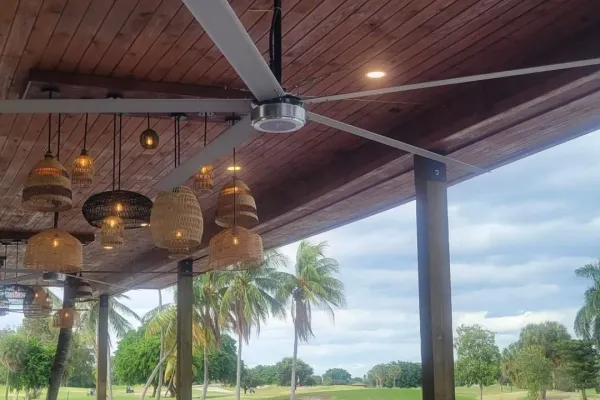
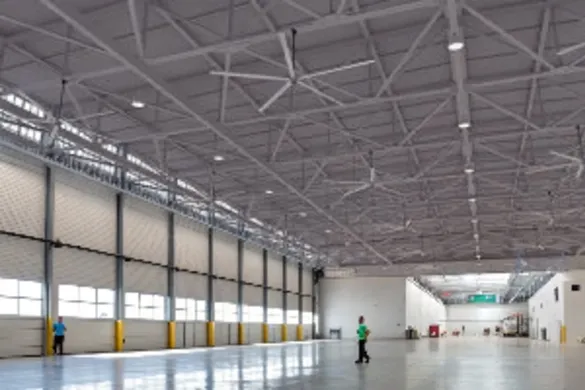
commercial hvls fans in large open space
What is the difference between damp-rated fans and wet-rated fans?
This is one of the most important buying details. According to ENERGY STAR, damp-rated fans are suitable for covered outdoor spaces where moisture is present but direct water exposure is limited. Wet-rated fans are intended for direct exposure to water.
In simple terms, damp-rated fans work best in places like a covered patio, canopy, veranda, or sheltered loading area. Wet-rated fans are the safer choice when rain, splash, or open exposure is part of daily use. If your site is fully open or only partly sheltered, this difference matters a lot.
Quick rating guide
| Rating |
Best location |
Main condition |
| Dry-rated |
Indoor only |
No moisture exposure |
| Damp-rated |
Covered patio, covered outdoor corridor, sheltered canopy |
Moist air and humidity, but no direct rain |
| Wet-rated |
Exposed pergola, open pavilion, uncovered patio |
Direct water exposure |
The reason this matters is simple. Outdoor fans are not judged only by how much air they move. They are judged by whether they can withstand outdoor conditions over time. That is one of the biggest differences between a basic सीलिंग फैन and a real outdoor fan.
Where do outdoor HVLS fans work best?
In most cases, outdoor-ready HVLS systems work best in covered or semi-covered areas rather than in a fully open field. That is partly because these fans are most effective when they can direct air from an overhead structure down into the occupied zone. AMCA explains that HVLS fans are designed for large-area effect and high-volume air movement, which makes them well suited to broad, structured spaces.
That makes them a strong fit for outdoor settings such as covered patios, pavilions, sports shelters, open-sided work areas, event structures, agricultural shelters, and other खुले स्थान with a roof or overhead support. In these cases, the fan can create more useful airflow in large spaces because the air column has a defined path and a real occupied zone below it.
I usually tell clients this: an HVLS fan works best when the project has three things—structure overhead, people or activity below, and a real need for broad हवा की गति. That is why these fans often perform better in semi-open spaces than in fully exposed, windy sites where the environment is harder to control. This is an application-based inference from how large-diameter circulating fans work.
How do outdoor HVLS fans improve airflow and comfort?
The core value of an एचवीएलएस पंखा is not refrigeration. It is controlled वायु प्रवाह. AMCA explains that HVLS fans operate with high-volume air movement and low operational speed, creating gentle air movement with minimal turbulence and a large area of effect.
That kind of movement helps break up heavy, still air and reduces the feeling of trapped heat. AMCA’s work on circulating fans also shows that air-moving fans can reduce heat strain and improve thermal conditions when properly designed for occupant airflow. While that article focuses on warehouses, the same cooling principle explains why moving air in covered outdoor zones can make people feel more comfortable.
This is why HVLS fans can help बनाना outdoor spaces more comfortable. In a covered patio or open-air venue, they can reduce the heavy feeling of स्थिर हवा, support improved air movement, and help create more stable comfort over a larger area than many small fans can handle.
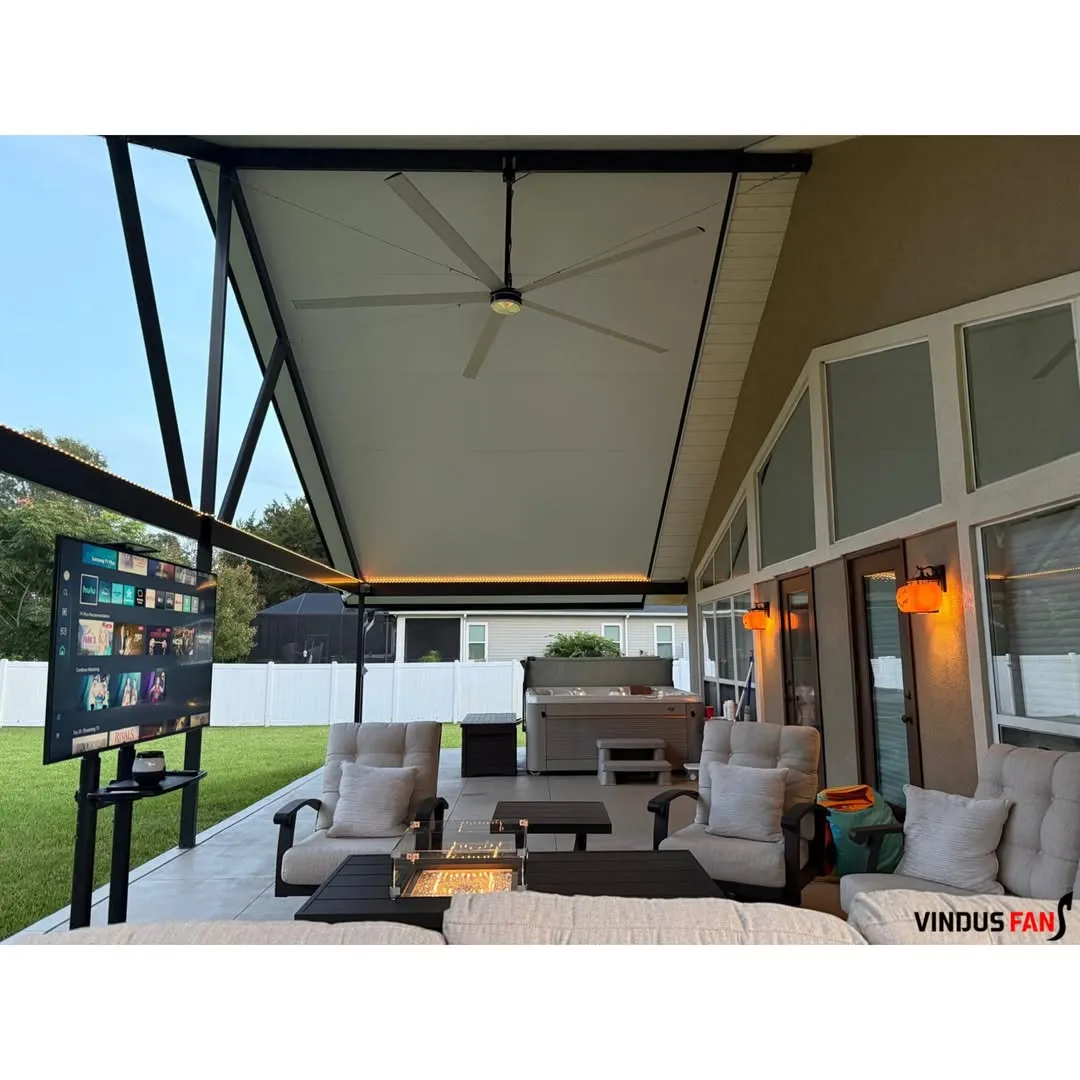
Are outdoor HVLS fans energy-efficient?
Yes, they can be, especially when compared with using many smaller fans to cover the same area. AMCA notes that HVLS fans operate at low speed with less horsepower required to operate the fan while still creating a large area of effect. That operating principle is one reason they are associated with ऊर्जा दक्षता in large-area applications.
A properly selected एचवीएलएस पंखा can often move more air across a broad zone with fewer units, which can improve comfort using less scattered equipment. That does not mean every project will produce the same ऊर्जा बचत, but it does explain why large-diameter fans are often seen as an कुशल ऊर्जा choice for large covered spaces.
For operators, the logic is practical. One well-placed fan may reduce the need for multiple small devices, simplify maintenance, and help control ऊर्जा लागत in areas where people otherwise rely on several smaller fans or nearby cooling support. That benefit is especially attractive in औद्योगिक और वाणिज्यिक locations where long operating hours matter. This is a reasoned application of AMCA’s documented HVLS operating principles.
What should you check before choosing a fan for outdoor use?
तुम से पहले एक प्रशंसक चुनें, start with the site. Ask these questions:
- Is the area fully exposed or covered?
- Is the fan subject to direct rain?
- How much नमी is present?
- Is the site coastal, dusty, or corrosive?
- What is the size of your outdoor space?
- Is there a safe overhead mounting structure?
These questions matter because outdoor fans are not just about style. They are about durability, coverage, and fit. ENERGY STAR’s damp/wet guidance makes clear that location exposure should drive the rating you choose.
Then look at airflow needs. AMCA’s guidance shows that HVLS fans are effective because of their large area of effect and their ability to move a broad mass of air. That means the size of your outdoor area, roof height, and how people use the space should shape your selection.
From our side as a manufacturing plant, this is where project quality is won or lost. A fan that looks impressive on paper may still be wrong for the site. Good selection means matching exposure, structure, and वायु प्रवाह needs—not just buying the biggest unit available.
What features matter most in an outdoor ceiling fan for large spaces?
The first feature is the rating. Without the right damp or wet rating, the rest does not matter. The second is corrosion resistance, especially in humid or semi-open environments. The third is motor protection and build quality, because पंखे बनाये जाते हैं for long-term operation only when materials and finishes match the conditions they face. This guidance follows directly from ENERGY STAR’s location-rating framework and AMCA’s emphasis on application-based fan selection.
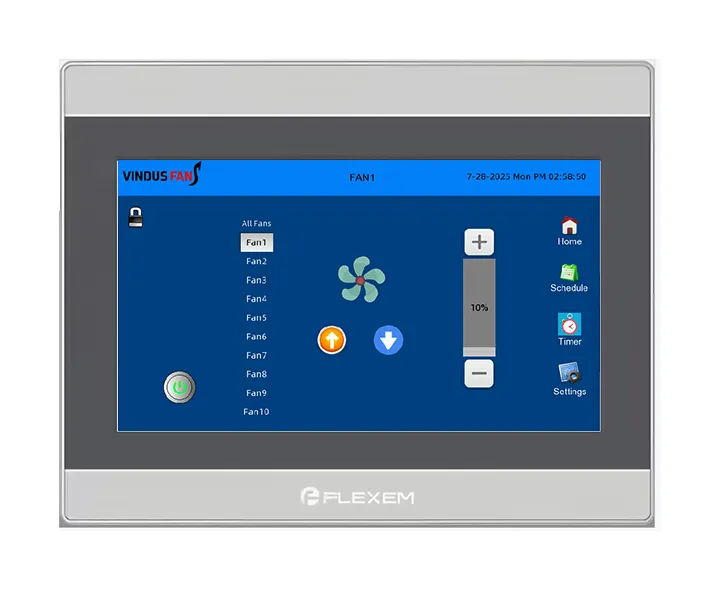
The next feature is control. Good outdoor fans often use multiple speed settings या variable speed settings so operators can adapt to crowd level, temperature, or time of day. That matters because comfort demands change. A lunch crowd, a sports event, and an evening venue do not all need the same fan output. Variable control is a logical extension of HVLS low-speed operating design.
Useful feature checklist
| विशेषता |
Why it matters |
| Damp or wet rating |
Matches the real outdoor exposure |
| Corrosion-resistant finish |
Better durability in moisture and humidity |
| Large-diameter blade design |
Broader coverage and steadier airflow |
| Variable speed control |
More flexible comfort tuning |
| Strong mounting options |
Safer use in overhead structures |
| Low-speed operation |
Better high-volume air movement with less turbulence |
These are the features I would focus on before color or decorative style. In a serious project, performance comes first.
How do outdoor HVLS fans compare with smaller outdoor fans?
Smaller fans can still help, especially in a small seating zone or a narrow work area. But once the project gets bigger, the limits show up quickly. A smaller outdoor fan may cool one section well and leave another section untouched. An एचवीएलएस पंखा is different because it is designed for airflow in large areas and broader हवा परिसंचरण.
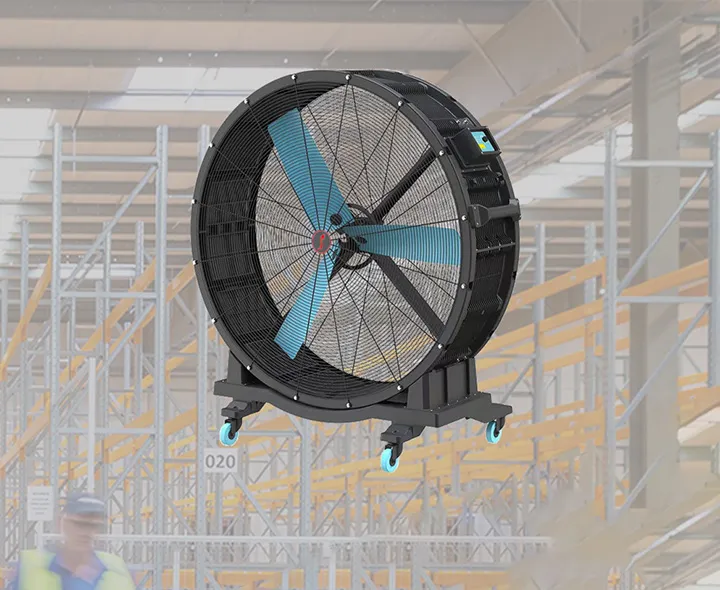
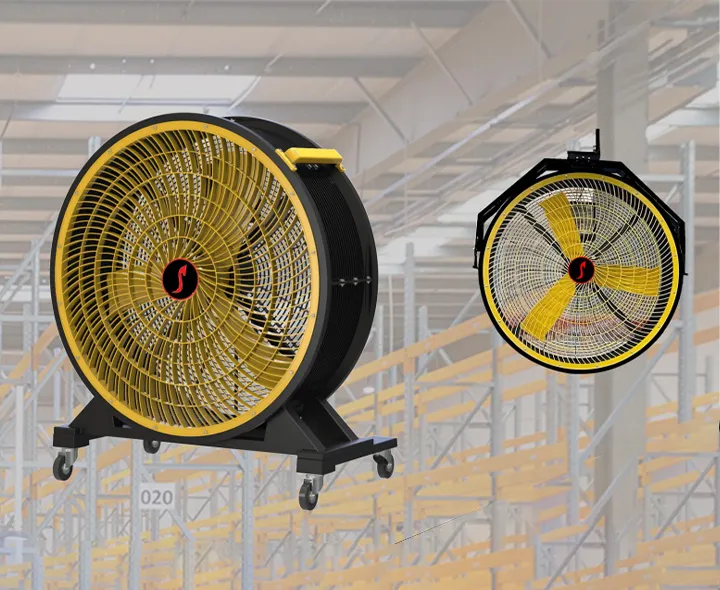
This is why fans come in different categories. Smaller fans are often better for spot cooling. Large-diameter fans are better when you want airflow in large spaces, broad comfort, and fewer overhead units. The right choice depends on whether your goal is local relief or full-zone comfort.
Put another way, the advantage of HVLS design lies in coverage. These fans are specifically designed to move large volumes of air at low speed, which is why they can be more effective than a cluster of small fans when the project is a large covered outdoor zone.
Can outdoor HVLS fans help in commercial and industrial settings?
Yes. In fact, this is where they often make the most sense. AMCA states that large-diameter ceiling fans are used in commercial, industrial, and agricultural settings for air mixing and cooling effects. That broad application is one reason एचवीएलएस औद्योगिक systems are attractive in covered working and gathering spaces.
के लिए वाणिज्यिक या औद्योगिक use, the value often goes beyond comfort. Better वायु प्रवाह can support staff comfort, improve the experience in customer-facing areas, and make semi-open spaces more usable during warm weather. In practical terms, that can matter in covered shipping aprons, outdoor reception zones, workshops, sports structures, and hospitality areas. This is a reasonable application of AMCA’s documented commercial and industrial use cases.
That is why I see real demand from facilities that are partly indoors and partly outdoors. Buyers want a fan that works in the gray area between fully conditioned space and fully exposed exterior space. For those projects, a properly rated एचवीएलएस पंखा can be one of the most practical comfort tools available.
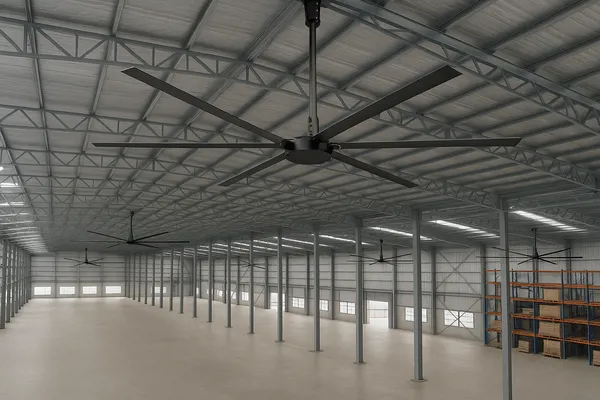
Can outdoor HVLS fans help in commercial and industrial settings?
What are the most common mistakes when installing HVLS fans outdoors?
The first mistake is choosing an indoor product for an outdoor job. The second is ignoring whether the site is damp or wet. The third is sizing the fan without checking the structure, roof height, and real occupied zone. Those are specification mistakes, not fan mistakes.
Another common problem is assuming that bigger is always better. A larger fan can be excellent, but only when the structure, clearance, and use pattern support it. HVLS performance depends on placement and application, not just diameter. AMCA’s fan design guidance makes that point clearly through its emphasis on application and large-area effect.
Finally, some buyers overlook service conditions. Outdoor products need to be selected with exposure in mind. Dust, moisture, and changing temperatures all affect long-term reliability. A good fan is not just one that moves air today. It is one that continues to do so in real outdoor conditions.
पूछे जाने वाले प्रश्न
Can an HVLS fan be installed outdoors?
Yes, but only if the specific एचवीएलएस पंखा is rated for outdoor use and matched to the site’s exposure level. Covered spaces may accept damp-rated products, while more exposed spaces usually need wet-rated products.
What is the difference between a damp-rated and wet-rated outdoor ceiling fan?
A damp-rated आउटडोर छत पंखा is for covered locations with moisture but no direct rain. A wet-rated fan is designed for direct water exposure.
Are outdoor HVLS fans good for patios and pavilions?
Yes, especially when the area is covered or semi-covered and needs broad वायु प्रवाह over a larger zone. These spaces often benefit from high-volume, low-speed air movement.
Do outdoor HVLS fans improve comfort or just move air?
They do both. Their main function is moving air, but that air movement improves perceived comfort and can reduce heat strain in occupied spaces.
Are HVLS fans better than small outdoor fans for large areas?
For large covered areas, often yes. HVLS fans are designed to move a broad mass of air over a larger footprint, while smaller fans are usually better for spot cooling.
Can outdoor HVLS fans reduce energy use?
They can support more efficient comfort delivery in large covered spaces, especially when one large fan replaces several smaller units. Actual results depend on the project layout and operating pattern.
Key things to remember
- एक एचवीएलएस पंखा can be installed outdoors only when it is properly rated for the real exposure level.
- Damp-rated and wet-rated fans are not the same, and choosing the wrong rating is a common mistake.
- Large-diameter fans are designed to move high-volume air at low speed across a broad area.
- Covered and semi-covered spaces are usually the best fit for outdoor HVLS applications. This is an application-based inference from how large-diameter ceiling fans operate.
- The best results come from matching the fan to the site, the structure, and the actual comfort goal.