Hot air, stale corners, and rising utility bills can quietly drag down output in factories, gyms, schools, and warehouses. When the wrong fan is selected, the space still feels uncomfortable, the system works too hard, and the result never matches the promise. The smart fix is to choose the right supplier and the right fan type together.
Un industrial fan company should do more than sell equipment. It should help you compare hvls, blower, and commercial fans, match the right product to your building, and support long-term performance. For most large facilities, that means looking at airflow, controls, efficiency, installation, and service—not price alone—when you evaluate industrial fan manufacturers.
Outline
Why is an industrial fan company no longer just a blower supplier?
What is the difference between an hvls fan, a blower, and other commercial fans?
How do fan manufacturers divide axial, exhauster, and HVLS products?
Why do direct drive, variable speed, and 3 speed controls matter?
How should you match fan size to a warehouse and other large spaces?
What do manufacturing facilities need from heavy-duty industrial airflow systems?
How can energy-efficient HVLS systems help reduce energy and stabilize comfort?
What should buyers compare when reviewing industrial fan manufacturers?
What does a practical retrofit look like in distribution centers, fitness centers, and service garages?
Why are Vindus Fans a practical partner for industrial and commercial projects?
Why Is an Industrial Fan Company No Longer Just a Blower Supplier?
A modern industrial fan supplier has to think beyond one product category. Many buyers still start with the word blower, but that word only covers part of the market. Today, real projects often need a mix of overhead air movement, process exhaust, spot cooling, destratification, and comfort control. In other words, one fan company may need to support both airflow comfort and process ventilation depending on the site.
That difference is easy to see when you compare official manufacturer positioning. Twin City Fan & Blower says it serves everything from heavy-duty industrial process fans to commercial supply and exhaust products, while Robinson Fans presents itself as an industrial fan manufacturer serving both pre-engineered and custom projects. Industrial Fan Co. focuses more tightly on USA-made HVLS and floor fans for hard-working spaces. That tells you a lot: not every supplier is solving the same problem, even when all of them sell fans.
As an HVLS manufacturing team, we see this every day. A customer may ask for an industrial fan, but what they really need could be one of three things: better occupant comfort, better air balance, or a true exhaust/process solution. A good supplier helps separate those needs early so the project starts with the right logic instead of a guess.
What Is the Difference Between an HVLS Fan, a Blower, and Other Commercial Fans?
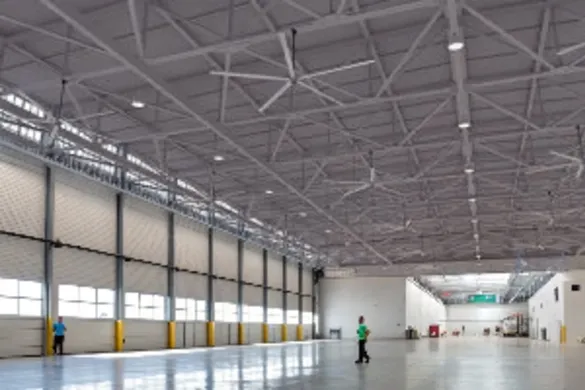
An hvls fan is designed to move a very large air mass at low rotational speed across wide floor areas. Vindus describes Ventilateurs HVLS as large-diameter ventilateur de plafond industriel products that create stable, wide-area airflow for factories, warehouses, sports centers, and large public buildings instead of relying on high RPM like smaller fans. DOE’s fan guidance supports the same core idea from a comfort perspective: moving air helps people feel cooler even though fans do not actually chill the air like air conditioning does.
A blower, by contrast, is usually about directed pressure, process handling, or exhaust duty. That is why the broader market includes fan and blower specialists, not just comfort-cooling brands. Robinson’s product range includes pressure blowers and centrifugal fans, while Twin City Fan highlights heavy industrial process models. So, if your project involves a fume source, a hot reactor area, or material handling, the correct answer may be an exhauster or process blower rather than HVLS.
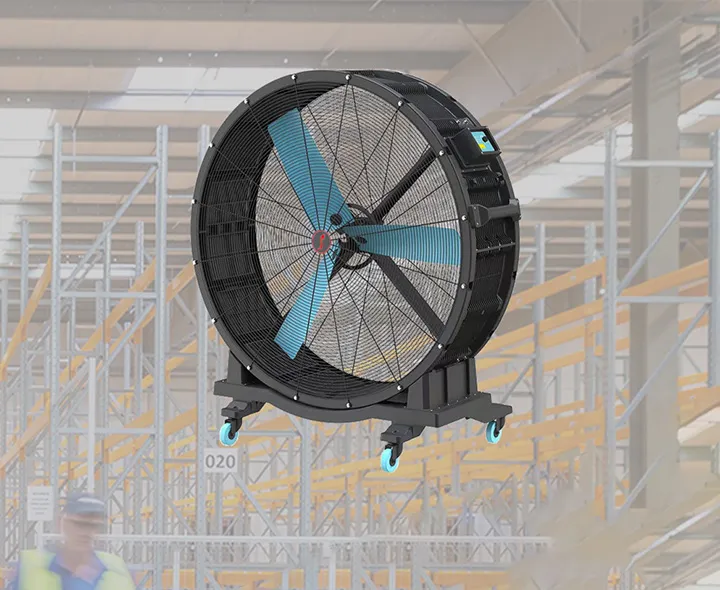
Then there are general commercial fans and smaller overhead units. These may be suitable for tighter rooms, lighter retail applications, or localized comfort zones, but they do not always solve air circulation in a tall building. That is where industrial hvls and industrial hvls fans stand apart. They are built for large spaces, long operating hours, and broad occupant-level comfort rather than narrow spot cooling.
“Fans cool people, not rooms.” That short DOE reminder is one of the clearest ways to understand fan selection.
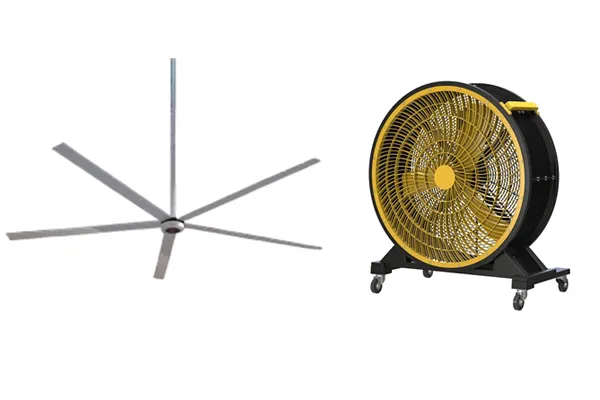
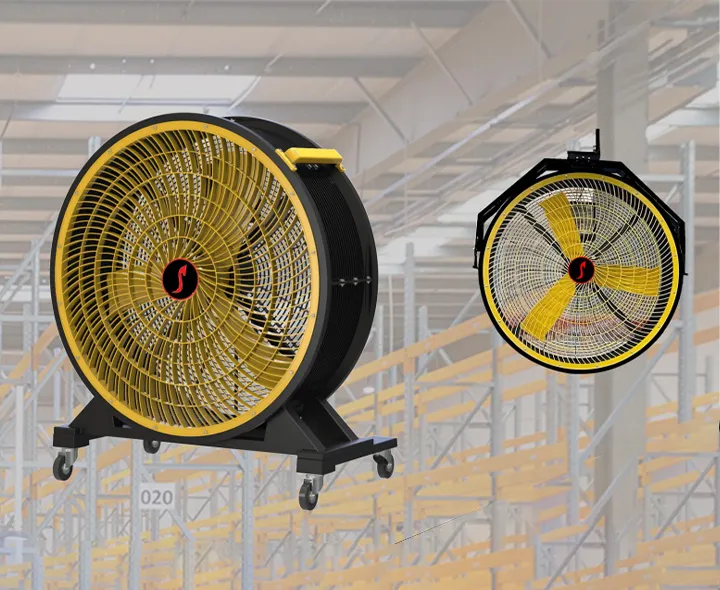
Industrial Floor Fan vs Industrial Ceiling Fan
How Do Fan Manufacturers Divide Axial, Exhauster, and HVLS Products?
When buyers compare fan manufacturers, the safest starting point is category. Twin City Fan Companies says its portfolio covers a full spectrum of air moving equipment, including centrifugal and axial fans, while Robinson Fans lists centrifugal, pressure blower, and custom industrial fan families. Industrial Fan Co. sits in a different lane, focusing on USA-made HVLS ceiling and floor fans for workplaces. These are all valid businesses, but they are built around different application priorities.
That is why I tell buyers to stop comparing every supplier as if they all do the same job. Some brands are strongest in process exhaust. Some are strongest in broad overhead comfort. Some are strongest in harsh-duty airflow support. If you need a true exhauster for dust, hot gas, or process discharge, you should be looking at industrial process specialists. If you need a quiet air circulator effect over people, pallets, sports courts, or work aisles, the search should shift toward HVLS.
A simple comparison helps:
| Type de ventilateur |
Best use |
Typical strength |
| HVLS overhead fan |
Comfort, destratification, broad coverage |
Wide, low-speed air movement |
| Floor fan / barrel fan |
Spot cooling, task zones |
Localized air throw |
| Axial or process fan |
Ventilation, exhaust, plant systems |
Directed flow and pressure handling |
| Pressure blower / exhauster |
Process duty, heat, dust, fumes |
System-level air handling |
This is the core reason many searches for shop industrial fans become confusing. Buyers are often mixing comfort products and process products in the same shortlist. The better move is to classify the job first.
Why Do Direct Drive, Variable Speed, and 3 Speed Controls Matter?
Controls are where good fan selection becomes good building performance. A fan may look impressive on paper, but if the control logic is weak, the building still feels wrong. Modern buyers increasingly want variable speed control because comfort needs change with season, occupancy, and time of day. A basic 3 speed setup may be acceptable for simpler rooms, but larger projects usually need finer tuning.
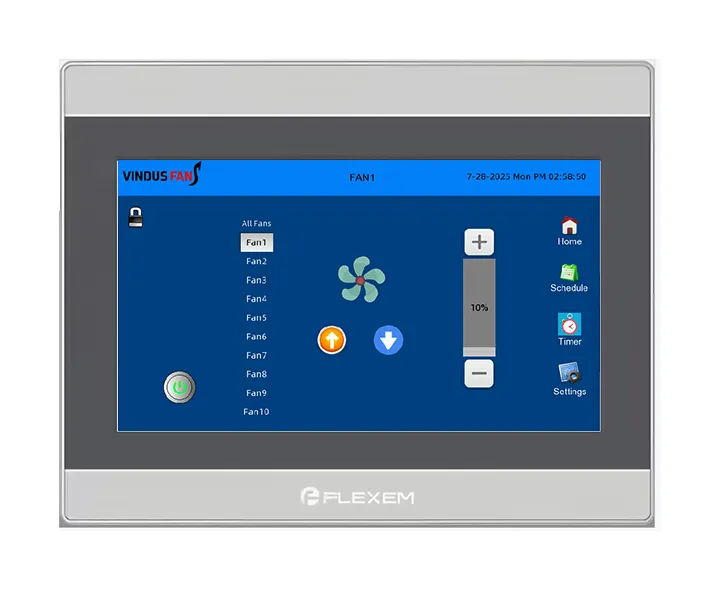
Drive type matters too. Vindus positions both its M650 and M750 lines as direct drive products and connects that to lower mechanical loss, lower maintenance, and strong torque. On its industrial/commercial buildings page, Vindus also lists group control, timer functions, direction control, emergency stop, and optional BMS integration for up to 20 fans. That is the kind of control package that makes an overhead fan system easier to manage in a real facility.
From an engineer’s view, this is not just a convenience feature. It affects comfort, service time, and energy consumption. Fans that are designed for smarter scheduling and better speed control are easier to tune for real conditions. That is how you get efficient air delivery instead of a system that feels either too weak or too aggressive.
How Should You Match Fan Size to a Warehouse and Other Large Spaces?
One of the most common mistakes is to assume bigger is always better. In reality, the right overhead fan depends on layout, mounting height, heat load, obstructions, and how people use the floor. AMCA defines a large-diameter ceiling fan as one greater than seven feet in diameter, and its guidance stresses that published data and selection should follow recognized test methods rather than guesswork.
Vindus splits this clearly across two main HVLS product lines. Its M650 is positioned for medium-size areas with heights from about 9 ft to 23 ft and diameters from 10 ft to 14 ft, while the M750 is positioned for larger buildings with heights from about 24 ft to 50 ft and diameters from 16 ft to 24 ft. That kind of range makes sense because a entrepôt and a showroom may both need overhead cooling, but they do not need the same fan scale.
Here is a practical sizing view:
| Building type |
Better direction |
| Tight retail or mixed-use room |
Smaller overhead units or lighter-duty systems |
| Mid-height gym or hall |
Medium HVLS with low-noise control |
| Tall warehouse and centres de distribution |
Larger HVLS diameter with fewer units |
| Open production bay |
Larger coverage plus layout planning |
| Hybrid retrofit |
Mixed sizes or retrofit packages where structure is limited |
Good sizing is what turns an overhead system into a comfortable environment instead of just another machine hanging from the roof.
What Do Manufacturing Facilities Need From Heavy-Duty Industrial Airflow Systems?
Installations de production almost always need more than cooling. They need a combination of worker comfort, safer air patterns, and dependable operation in demanding environments. Vindus explicitly lists manufacturing, warehouse, logistics, sports, and commercial buildings as core application areas, which matches what most plant managers already know: one factory can have heat sources, moving forklifts, dust, packaging stations, and people working in different zones at the same time.
In machinery manufacturing, heat can build up around lines, weld zones, or enclosed work cells. In these cases, a heavy-duty industrial solution may involve more than one category of air equipment. An overhead HVLS system can improve large-area comfort, while a blower or process exhaust unit may be needed near a specific machine, reactor, or hot source. That is why broad-scope suppliers like Twin City Fan and Robinson stay relevant in industrial plants, while focused HVLS makers like Vindus are strongest when broad-area comfort is the main problem.
For plant teams, the real goal is comfort and performance together. They want workers to feel better, but they also want reliable performance from equipment that runs every day. That is why fans are engineered differently for comfort spaces and process spaces, even if both are called industrial fans in conversation.
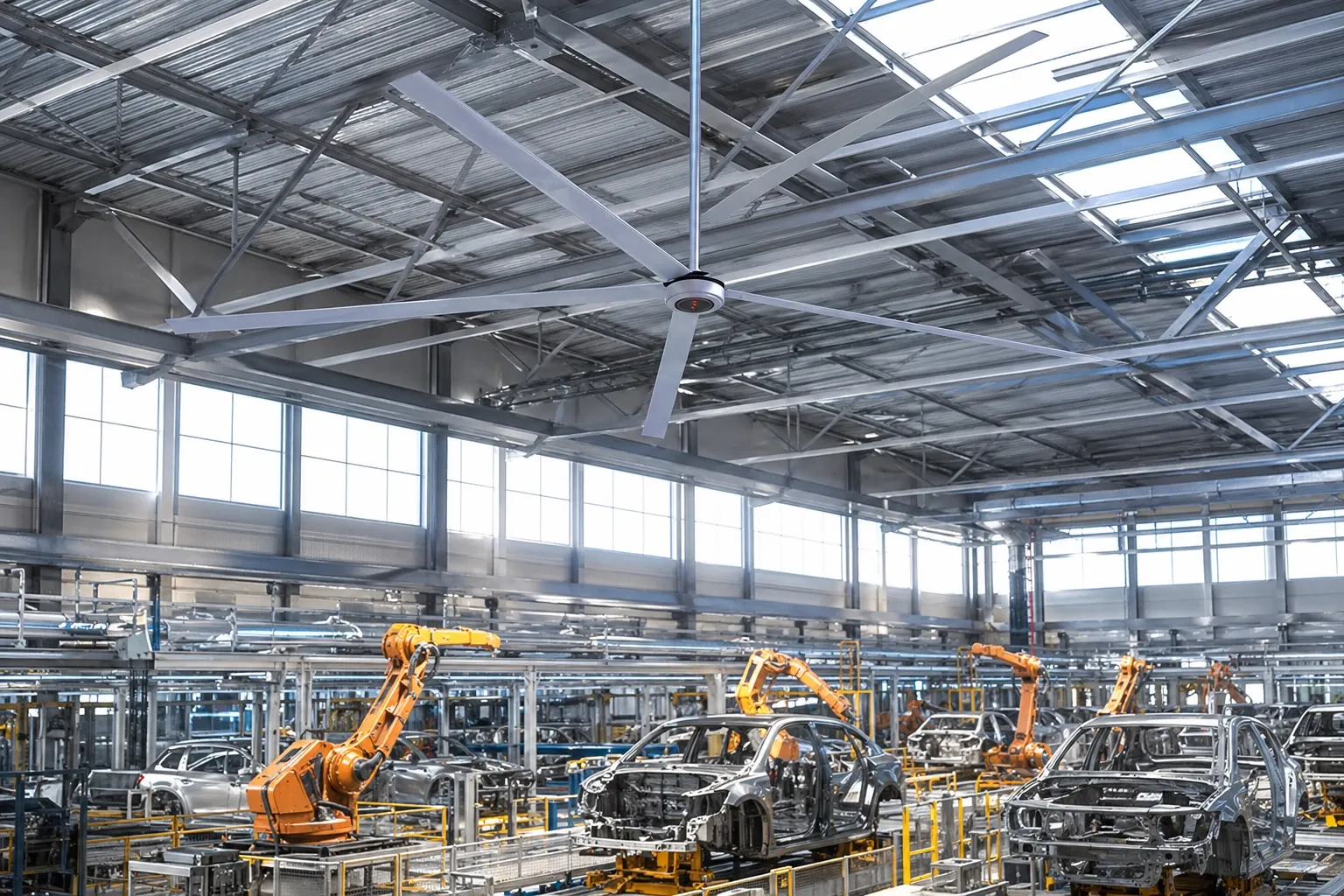
How Can Energy-Efficient HVLS Systems Help Reduce Energy and Stabilize Comfort?
This is where HVLS becomes very attractive. DOE says using a ceiling fan can let you raise the thermostat setting by about 4°F without reducing comfort. That matters because the fastest path to savings is not always colder air. It is smarter air movement. In many buildings, that means using HVLS to support comfort and help HVAC systems work with less strain.
Vindus makes a strong efficiency case on its official pages. It says the M650 uses a PMSM motor and consumes 335 watts at top speed, while the M750 consumes 835 watts at top speed, with both lines built around low power use and wide-area coverage. Its industrial/commercial buildings page also claims direct-drive efficiency, low noise, and airflow up to 730,000+ m³/h on the larger series. Those numbers show why an energy-efficient overhead system can be a serious option when the goal is to reduce energy and lower energy costs without sacrificing comfort.
The right system does not just cool. It improves mixing, reduces stagnant zones, and supports ventilation solutions across large areas. That is especially useful in commercial and industrial sites where people stay active for long shifts or long visits. Good overhead mixing can improve air quality, enhance comfort, and support measurable energy savings over time.
What Should Buyers Compare When Reviewing Industrial Fan Manufacturers?
When you compare industrial fan manufacturers, start with fit, not reputation. A supplier may be excellent at process exhaust and weak at overhead comfort, or the reverse. So I recommend a simple review list: product scope, test data, controls, mounting support, maintenance path, and project guidance. The best suppliers act like fan experts, not catalog pushers.
It also helps to look at how brands describe themselves. Twin City Fan presents itself as an industry-leading designer and manufacturer with heavy-duty industrial process capability. Robinson emphasizes both pre-engineered and custom industrial fan work. IFC, or Industrial Fan Co., positions itself around USA-made HVLS and floor models for tough workplaces. Vindus positions itself as a Scandinavian-engineered, Qingdao-manufactured HVLS specialist serving factories, warehouses, and public buildings. Those are very different business models, and the right one depends on your application.
Here is a practical review table:
| What to compare |
Why it matters |
| Product type focus |
Comfort cooling and process ventilation are different jobs |
| Published data |
Helps verify massive airflow and efficiency claims |
| Contrôles |
Determines how flexible the system is day to day |
| Support documents |
Reduces install and service risk |
| Warranty and parts |
Protects long-term value |
| quality and service |
Shapes the real ownership experience |
If you are evaluating a broad vendor list, this is where names like Twin City Fan, Robinson Fans, and IFC help you map the market instead of mixing unlike companies together.
What Does a Practical Retrofit Look Like in Distribution Centers, Fitness Centers, and Service Garages?
A good retrofit starts with the building problem, not the product catalog. In centres de distribution, the typical issue is trapped heat under the roof and weak comfort down at the pick lines. In fitness centers, it is often stale air, humidity, and uneven comfort. In service garages, the problem can be heat, fumes, and dead corners near work bays. These are different buildings, but all of them benefit when the designer thinks in terms of air movement solutions instead of one-size-fits-all hardware.
A typical retrofit pattern might look like this: larger overhead HVLS units in the open central floor, smaller support fans in tight spaces, and targeted exhaust or blower support near localized heat or fume sources. That mix respects the real job. It also avoids the common mistake of trying to solve every comfort or ventilation problem with only one fan type.
At a practical level, this is where maintenance for industrial fan systems becomes important. Buyers want fewer cables, simpler access, and easier service. Vindus highlights single-cable installation and floor-level HMI access on its M650 and M750 lines, which is the kind of feature that matters much more in daily operation than it does in a sales brochure.
Why Are Vindus Fans a Practical Partner for Industrial and Commercial Projects?
Vindus Fans fits well when the job is broad-area comfort, better mixing, and lower energy use in big rooms. Its official site says the brand’s HVLS fans are designed by Scandinavian engineers and manufactured in Qingdao, with application coverage across factories, warehouses, sports centers, logistics, manufacturing, and commercial buildings. Its product pages focus on two core lines—M650 and M750—plus the FanBrain control platform, which keeps the range focused and easy to understand.
That focused lineup is a strength. The M650 targets medium-size sites and lighter structural scenarios, while the M750 targets large industrial fans needs in taller, broader buildings. Both lines are presented as direct-drive products, and Vindus also supports OEM/ODM, multiple voltages, and grouped control options. For buyers who want high-efficiency, wide coverage, and clear manufacturing and service structure, that is a practical offer.
From our side, this is exactly where we want to help. At Vindus Fans, we are not trying to be every type of supplier in the market. We focus on HVLS overhead performance for factories, warehouses, sports buildings, and other large-use environments where ceiling fans and broader airflow design can materially improve comfort, productivity, and system efficiency. That is why we see ourselves as a leading manufacturer in our segment rather than a general reseller.
FAQ
What does an industrial fan company usually sell?
That depends on the company. Some suppliers focus on HVLS overhead fans, some specialize in process exhaust and pressure blowers, and some cover both. Official examples show this clearly: Vindus focuses on HVLS, Twin City Fan spans heavy industrial process and commercial lines, Robinson covers custom industrial fan products, and IFC focuses on USA-made HVLS and floor fans.
When is an HVLS fan better than a blower?
An hvls fan is usually better when the goal is wide-area comfort, destratification, and gentle overhead coverage in a warehouse, gym, or production hall. A blower is usually better when the job requires directed pressure, exhaust, or process handling.
Are HVLS systems really useful in commercial spaces?
Yes. Vindus specifically positions its systems for factories, warehouses, sports centers, and espaces commerciaux, and DOE guidance supports the comfort value of fans as a way to improve perceived cooling and reduce cooling pressure.
What should I ask before I buy an industrial ceiling fan?
Ask about mounting height, layout, controls, noise, power, airflow data, and after-sales support. In the U.S., large-diameter ceiling fans are also tied to standards and code references such as AMCA 230, UL 507, and related installation rules.
Are direct-drive HVLS fans easier to maintain?
They often can be, depending on the model and design. Vindus explicitly markets its direct-drive systems around low maintenance, fewer mechanical losses, and simpler installation features like single-cable layouts and floor-level access.
Can one overhead fan replace several smaller fans?
In many big buildings, yes. Vindus says one large HVLS fan can replace multiple small fans, reducing wiring and installation complexity while improving coverage. Whether that is the best answer depends on layout and building use.
Principaux points à retenir
- An industrial fan company should be judged by application fit, not by name alone.
- HVLS, process exhaust, and blower products solve different problems.
- Modern overhead systems benefit from direct drive, smarter controls, and better data.
- Good HVAC support is often about moving air well, not just adding more cooling.
- In large buildings, comfort, efficiency, and serviceability matter as much as raw size.
- Vindus Fans is strongest when the goal is broad-area HVLS comfort for factories, warehouses, sports buildings, and other big interior environments.
- The right supplier will help you match the product to the problem, then back it up with support after installation.