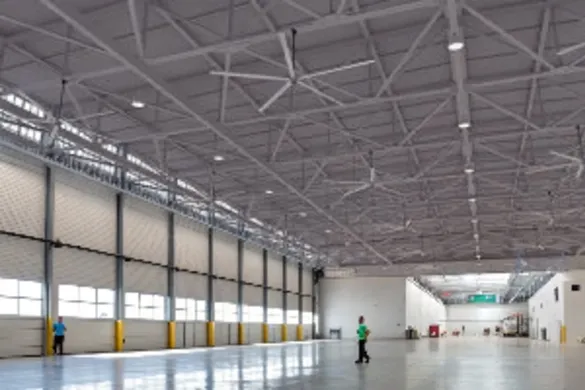
Hot air, weak airflow, and high energy costs can turn a large building into an uncomfortable workplace. Many fans only move air in one corner. A properly selected industrial ceiling fan solves the real problem: moving air evenly across the full space.
The best industrial ceiling fan for large buildings is usually a properly sized HVLS fan matched to the ceiling height, square footage, airflow target, worker zones, and HVAC system. For warehouses, factories, gyms, schools, and large commercial spaces, an HVLS ceiling fan can move a high volume of air at low speed, improving comfort and supporting better energy efficiency.
Why Most “Best Industrial Ceiling Fan” Lists Fail Large-Space Buyers
Many “best ceiling fan” articles are written for homes, small shops, or decorative commercial interiors. They often compare price, color, blade shape, light kit, or whether the fan has a remote control. That may help someone choosing a fan for a living room. It does not help a warehouse manager, factory owner, school facility team, or gym operator.
A real ventilateur de plafond industriel project is different. The buyer must think about ceiling height, square footage, fan size, blade span, motor durability, airflow coverage, HVAC coordination, installation safety, and long-term energy consumption. AMCA explains that large-diameter ceiling fans are used for air mixing, destratification, and cooling effects across commercial, industrial, agricultural, and other spaces. It also notes that the U.S. Department of Energy defines large-diameter ceiling fans as fans with a blade span greater than 7 feet.
At Vindus Fans, we look at an HVLS fan as an airflow solution, not just a product. A fan should fit the building. It should help people feel better, support daily operation, and reduce wasted air movement. That is why serious buyers should not only ask, “Which ceiling fan is best?” They should ask, “Which fan layout is right for my building?”
The Real Buying Standard: Match the Fan to the Building, Not the Catalog
A catalog can show diameter, power, fan blades, motor type, CFM, and control options. These are useful. But a catalog cannot fully understand your warehouse, factory, gym, or commercial building. The same ceiling fan may perform differently in different spaces.
For example, an Ventilateur HVLS installed in a wide open warehouse may create smooth airflow across large spaces. The same fan installed too close to high racks, lights, cranes, or structural beams may not perform as expected. A high foot ceiling also changes how air moves from the fan to the occupied area.
Before choosing an industrial ceiling fan, professional buyers should review the building first.
| Selection Factor |
Why It Matters |
What Buyers Should Check |
| Hauteur du plafond |
Affects safe mounting and airflow reach |
Low, medium, or high foot ceiling |
| Square footage |
Helps decide fan size and quantity |
Total area and key working zones |
| Heat source |
Changes airflow priority |
Machines, people, sunlight, ovens, loading doors |
| Worker zones |
Comfort must reach real people |
Packing lines, assembly areas, courts, desks |
| Système CVC |
Fan should support heating and cooling |
Cooling setpoint, heating mode, air return points |
| Obstacles |
Poor placement reduces performance |
Racks, cranes, lights, sprinklers, ducts |
| Contrôles |
Daily use must be simple |
Wall panel, remote control, smart controller |
This is where Les fans de Vindus can add real value. Instead of only quoting one model, a professional HVLS fan supplier should help the buyer think through airflow, installation, and long-term use.
Warehouse Airflow Is Not the Same as Factory Airflow
A warehouse and a factory may both need a large industrial fan, but their airflow problems are not the same. Treating them as the same space is one reason many fan projects fail.
In a warehouse, the main problems often include trapped warm air, long aisles, loading dock heat, high storage racks, and large open zones. Workers may move across the building, while forklifts and doors keep changing the indoor air condition. For this type of space, airflow coverage matters more than strong wind in one small area.
In a factory, the challenge is different. Machines, welding stations, assembly lines, ovens, or process equipment can create local heat. Workers may stand in fixed positions for long hours. In this case, the fan layout should focus on where people actually work. A ceiling fan should help improve air circulation without disturbing production.
Warehouse vs Factory Airflow Planning
| Type d'espace |
Main Airflow Problem |
Better Fan Strategy |
| Entrepôt |
Long aisles, high racks, loading doors |
Wide coverage and steady air movement |
| Factory |
Machine heat, fixed worker zones |
Target comfort around production areas |
| Gymnastique |
Body heat, odor, open courts |
Quiet, smooth airflow without harsh wind |
| School hall |
Crowded use, comfort variation |
Safe, low-noise air circulation |
| Commercial building |
Customer comfort and appearance |
Balance airflow, noise, and design |
This is why industrial ceiling fans for warehouses should not be selected with the same logic as fans for gyms, schools, or workshops. The building use changes the fan plan.
How Ceiling Height Changes the Performance of an HVLS Fan
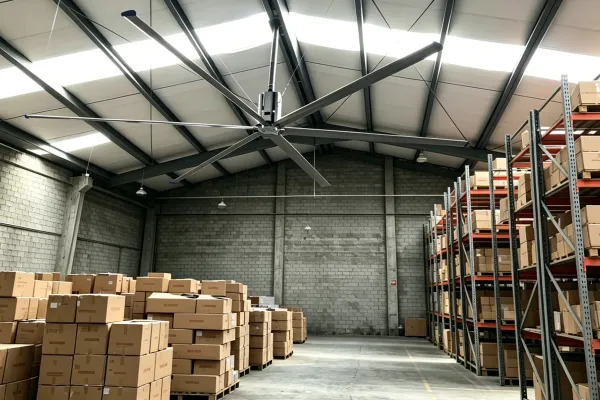
Ceiling height is one of the most important details in any HVLS fan project. A fan installed under an 18-foot ceiling does not behave the same way as a fan installed under a 40-foot ceiling. The airflow path is different. The mounting position is different. The safety requirements are different.
A larger blade span can help move larger amounts of air, but size alone is not enough. The fan also needs the right downrod length, safe clearance, and open airflow path. If the fan is installed too high without proper planning, air movement may not reach the occupied zone well. If it is installed too low, it may create safety or comfort issues.
For a high foot ceiling, fan diameter alone does not guarantee comfort. The installation height and airflow path matter just as much as the fan size. A good HVLS ceiling fan should move air in large areas, not just spin above the floor.
Ceiling Height Decision Guide
| Ceiling Condition |
Buyer Concern |
Selection Focus |
| Lower commercial ceiling |
Clearance and safety |
Smaller fan size, careful placement |
| Medium-height warehouse |
General comfort |
Balanced blade span and coverage |
| High factory ceiling |
Air reach and destratification |
HVLS fan layout and reverse mode |
| Very large open hall |
Full-area air movement |
Multiple fans or larger blade span |
| Obstacle-heavy ceiling |
Safe installation |
Beam review and customized mounting |
Vindus Fans product lines include HVLS fans for large spaces, with models listed for warehouses, factories, gyms, and industrial spaces. The Vindus HVLS fan product page shows fan diameter ranges such as 10 ft to 24 ft across product series, giving buyers options for different building sizes.
Why Airflow Coverage Matters More Than Wind Speed
Many buyers think a stronger fan is always better. In large industrial spaces, this is not always true. A fan that creates strong wind in one spot may still leave the rest of the building hot and still.
The goal of an HVLS fan is not harsh wind. The goal is wide, slow, and stable air movement. A well-designed Ventilateur de plafond HVLS does not only blow air. It helps circulate air across large spaces with steady and comfortable air movement.
This is especially important for workers. Strong direct wind can be annoying. It can blow papers, disturb light materials, or make one area uncomfortable. Smooth airflow feels more natural. It helps the building feel fresher without creating a wind tunnel.
Wind Speed vs Airflow Coverage
| Wrong Focus |
Better Focus |
| “Which fan spins fastest?” |
“Which fan covers the working area best?” |
| “Which fan has the strongest wind?” |
“Which fan creates even airflow?” |
| “How many small fans can we install?” |
“Can one HVLS fan cover the zone better?” |
| “Which fan looks powerful?” |
“Which fan improves real comfort?” |
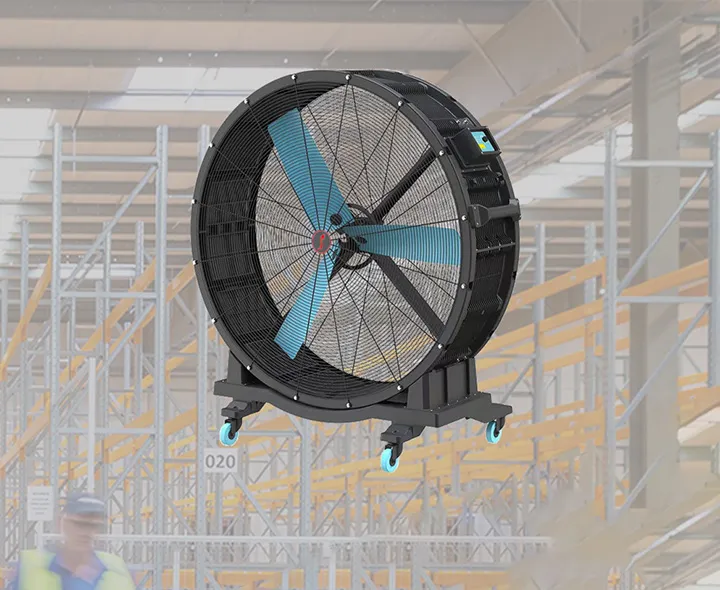
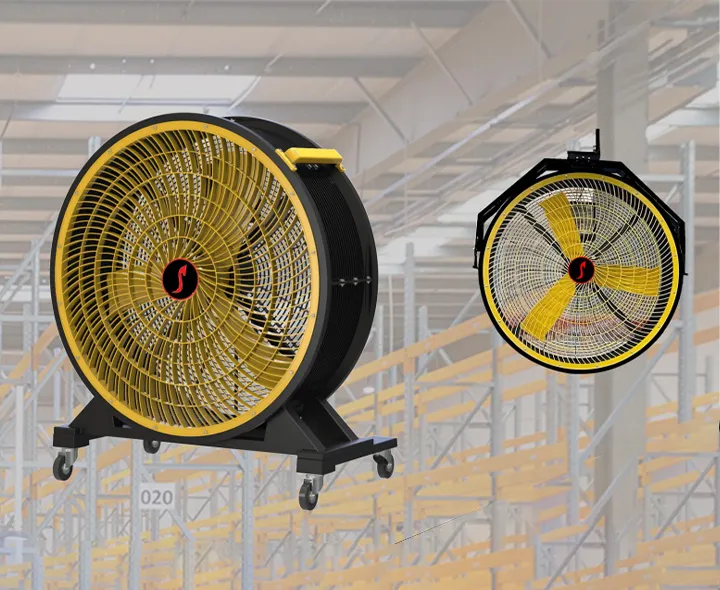
This is also why multiple small fans are not always the best solution. They may create local wind, but they often fail to move air in large open spaces. A properly selected HVLS fan can move massive amounts of air more evenly.
The Hidden Cost of Using Multiple Small Fans in Large Industrial Spaces
At first, several small fans may look cheaper than one HVLS fan. But the purchase price is only one part of the real cost. Over time, multiple small fans can create more wiring work, more installation points, more maintenance, more noise, and uneven comfort.
Small fans often need to run at higher speed to create noticeable airflow. In large spaces, this may still not solve the real problem. One worker may stand in strong wind, while another area stays hot. The building does not get balanced air movement.
A single HVLS fan, or a properly planned HVLS fan system, can often be more cost-effective for large industrial and commercial spaces.
| Hidden Cost Area |
Plusieurs petits ventilateurs |
HVLS Fan System |
| Installation |
Many mounting points |
Fewer fan locations |
| Wiring |
More cables and circuits |
Cleaner layout |
| Entretien |
More motors and parts |
Fewer units to inspect |
| Bruit |
Many fans running fast |
Low-speed operation |
| Confort |
Uneven and local |
Wide and gentle |
| Appearance |
Messy in commercial spaces |
Cleaner ceiling layout |
This does not mean every building needs only one fan. Some large commercial or industrial spaces need several HVLS fans. The point is that fan quantity should follow airflow design, not guesswork.
HVAC + HVLS Fan: How to Reduce Comfort Problems Without Oversizing Cooling Systems
An HVLS fan is not a replacement for every HVAC system. It should work with HVAC, not against it. This is a key difference between a basic fan article and a professional airflow plan.
In summer, air movement helps people feel cooler. The U.S. Department of Energy states that using a ceiling fan allows people to raise the thermostat setting by about 4°F without reducing comfort. It also says that in winter, reversing the fan direction at low speed can help circulate warm air from the ceiling down into living spaces.
In large buildings, this matters because warm air often rises and stays near the ceiling. A properly placed industrial ceiling fan can help mix the air and reduce temperature layers. This process is often called destratification.
How HVLS Fans Support HVAC
| Saison |
Fan Function |
Possible Benefit |
| L'été |
Move air across people |
Better comfort at higher setpoint |
| L'hiver |
Push warm air down slowly |
Less heat trapped near ceiling |
| All year |
Mix air in large spaces |
Fewer hot and cold zones |
| Peak operation |
Support occupied areas |
Better worker or visitor comfort |
ENERGY STAR also notes that certified ceiling fans use improved motors and blade designs and can be up to 44% more efficient than conventional fans. For B2B buyers, the key lesson is clear: efficient air movement depends on motor quality, blade design, control strategy, and correct use.
Actual energy savings depend on building insulation, climate, HVAC settings, fan layout, and daily operation. A professional supplier should never promise the same savings for every project.
Industrial Ceiling Fan Selection for Gyms, Schools and Sports Centers
A gym is not a warehouse. A school hall is not a factory. Sports centers and public buildings need airflow, but they also need low noise, safety, and user comfort.
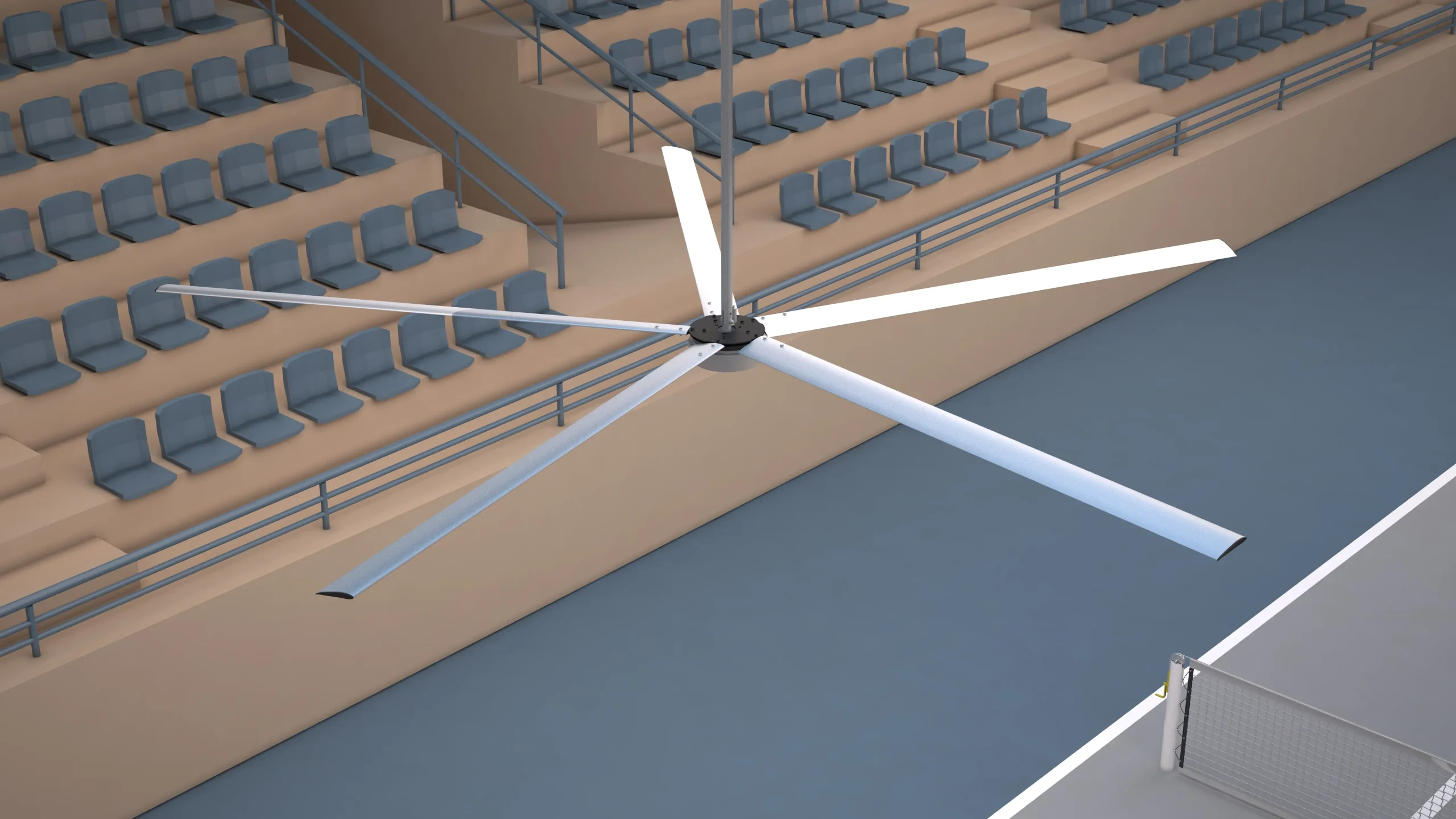
In a gym, the best ceiling fan should not create distracting wind over players. It should create smooth, wide airflow that makes the space feel fresher. In schools, safety and quiet operation matter. In sports centers, the fan should help handle body heat, odor, and crowded use.
A gym ceiling fan must also work with lighting, speakers, scoreboards, basketball hoops, and other ceiling equipment. This is why installation planning is important. The fan must be useful, but it must not interfere with the space.
Gym and School Selection Priorities
| Priority |
Why It Matters |
| Fonctionnement silencieux |
Students, players, and visitors should not be distracted |
| Smooth airflow |
Strong wind can disturb sports activities |
| Safe mounting |
Public spaces need extra safety attention |
| Simple controls |
Staff should operate the fan easily |
| Good appearance |
The fan is visible in public areas |
| Efficacité énergétique |
Large halls can be expensive to cool |
For these applications, commercial ceiling fans and HVLS fans should be selected with both performance and experience in mind. The goal is not only air movement. It is a better indoor environment.
Industrial Design Still Matters in Commercial Buildings
In factories and warehouses, performance is the top concern. In commercial buildings, appearance also matters. A ceiling fan may become part of the visual design, especially in restaurants, showrooms, event halls, retail spaces, and great rooms.
Some buyers search for industrial style ceiling fans, black industrial ceiling fans, modern ceiling fans, matte black finishes, brushed nickel finishes, or fans with lights. These terms are common in commercial design. They matter when the fan is visible to customers.
But professional buyers should follow one rule:
Performance first. Design second.
A matte black or brushed nickel ceiling fan may fit an industrial style interior, but the buyer should still check motor quality, blade balance, noise level, safety design, and airflow data first. A nice-looking fan with weak airflow is not a good solution for large spaces.
For most industrial spaces, fans without lights are usually better. Lighting should be designed separately with LED high bay lights or other fixtures. In some retail or hospitality areas, a fan with an LED light, light bulbs, or light kit may be useful, but this is not usually the first choice for warehouses or factories.
A pull chain may work for a small room. It does not make sense for a high industrial ceiling. Large commercial and industrial projects usually need wall controls, remote control, or centralized smart control.
What Professional Buyers Should Ask Before Ordering Large Industrial Ceiling Fans
A serious buyer should not ask only for a price. A better inquiry gives the supplier enough information to recommend the correct ceiling fan or HVLS fan layout.
Before ordering, prepare these details:
What is the building length and width?
What is the ceiling height?
Is the space open or divided?
Are there racks, cranes, lights, sprinklers, or ducts?
Where do workers spend the most time?
Is the main goal summer comfort, winter destratification, or both?
What HVAC system is already installed?
What power supply is available?
Do you need remote control or centralized control?
Is this a new project or retrofit project?
Inquiry Information Table
| Information |
Exemple |
| Building type |
Warehouse, factory, gym, school, commercial hall |
| Taille |
80 m × 50 m |
| Hauteur du plafond |
10 m |
| Main problem |
Hot air, poor airflow, high energy costs |
| Installation condition |
Steel beam, roof truss, obstacle details |
| Control need |
One fan, multiple fans, smart control |
| Project type |
New construction or existing building |
When customers contact Vindus Fans with this information, our team can recommend a more realistic industrial ceiling fan solution. This is better than simply quoting a random fan size.
Why Supplier Capability Matters More Than a Cheap Fan Price
A cheap ceiling fan may save money on day one. But poor airflow, vibration, weak motor performance, or limited service can cost more over time. In a B2B project, the supplier is part of the solution.
Professional buyers should look at:
Manufacturing capability
Product quality control
Conception du moteur et de la lame
Technical support
Installation guidance
Spare parts availability
Delivery stability
Warranty and after-sales service
Project communication speed
This is especially important for large industrial ceiling fans. A fan installed in a warehouse, factory, or gym is not a simple decoration. It may run for many hours per day. It must be safe, stable, and easy to manage.
Vindus Fans’ official website positions the brand around HVLS and industrial ceiling fans for warehouses, factories, gyms, schools, and large spaces. The site also presents the M750 as using a permanent magnet synchronous motor and consuming 835W at top speed. These details help B2B buyers evaluate performance, energy use, and application fit more clearly.
When Is a Vindus HVLS Fan the Right Choice?
A Vindus HVLS fan is a strong fit when the buyer needs more than a basic ceiling fan. It is suitable for projects where airflow, comfort, durability, and long-term operation all matter.
Vindus Fans may be the right choice when you need:
Airflow for a warehouse
Worker comfort in a factory
Quiet air movement in a gym
Better air circulation in a school hall
Energy efficiency support for a large commercial building
A heavy duty ceiling fan for industrial spaces
Professional fan selection support
Factory-direct communication
A scalable fan solution for multiple large spaces
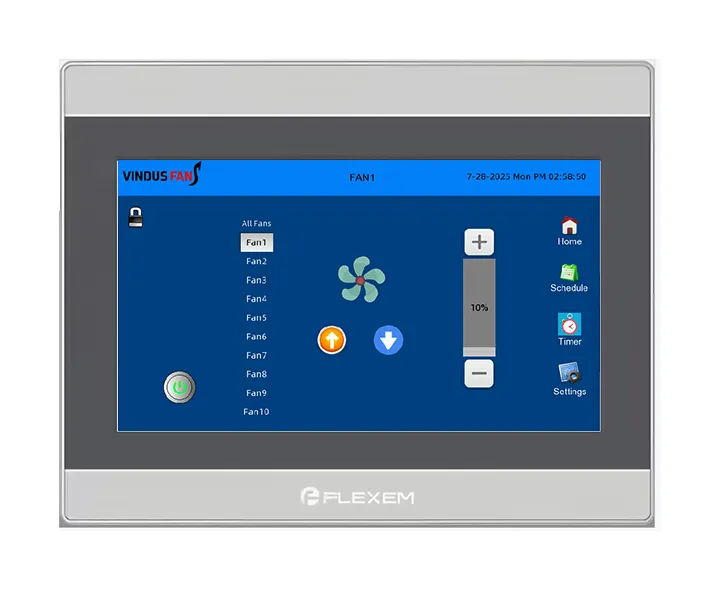
Vindus also has content around smarter HVLS fan controls. Its website discusses FanBrain as a next-generation control platform focused on automation, convenience, and energy efficiency. For large projects with several fans, control strategy can be just as important as the fan itself.
A good HVLS fan should not only move air. It should help the building operate better.
Mini Case Study: From Hot Warehouse to Better Air Movement
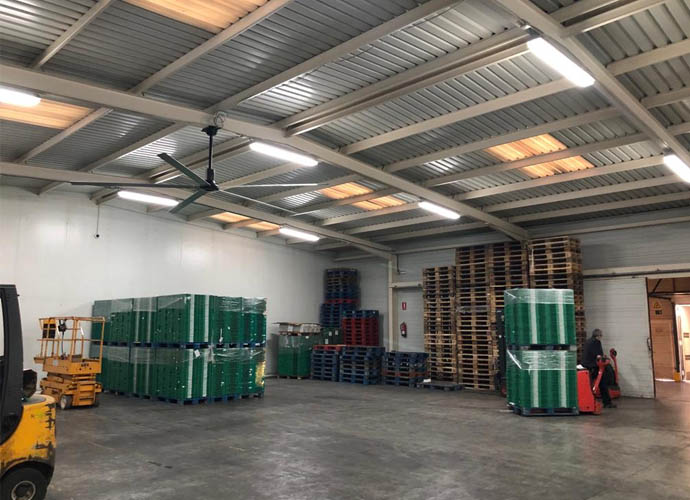
Imagine a warehouse with a high ceiling, long storage aisles, and a busy packing zone. Workers feel hot in summer. In winter, warm air stays near the roof. The facility already has several small fans, but the comfort problem remains.
The old solution is simple: add more small fans.
The better solution is different: study the airflow.
After reviewing the ceiling height, square footage, rack layout, and worker zones, the building may need o ne or more HVLS fans placed in key areas. Instead of creating strong wind in one corner, the fans move air slowly across the space. In summer, workers feel more comfortable. In winter, reverse low-speed operation helps bring warm air down.
This is the kind of thinking that makes an industrial fan project successful. The buyer is not only buying a fan. The buyer is improving the air movement strategy of the building.
Simple Industrial Ceiling Fan Selection Chart
Small commercial room
→ Standard ceiling fan or commercial ceiling fans

Restaurant, showroom, or great room
→ Modern ceiling fans or industrial-style ceiling fans

Gym, school hall, or sports center
→ Quiet HVLS fan with wide and gentle airflow

Warehouse or logistics center
→ HVLS ceiling fan designed for large open areas

Factory or production workshop
→ Heavy duty industrial ceiling fan focused on worker zones

High ceiling building with HVAC cost concern
→ HVLS fan system with destratification strategy

Multiple large buildings or facility network
→ Professional supplier with model selection and control support This chart is simple, but it helps buyers avoid the most common mistake: choosing a fan by appearance or price alone.
FAQs About Industrial Ceiling Fans and HVLS Fans
What is the best industrial ceiling fan for a warehouse?
The best industrial ceiling fan for a warehouse is usually a properly sized HVLS fan. It should match the ceiling height, square footage, rack layout, working zones, and HVAC system. The goal is not strong wind in one area. The goal is smooth airflow across the full warehouse.
Are HVLS fans better than regular ceiling fans?
For large spaces, yes. HVLS fans are designed to move large amounts of air at low speed. A regular ceiling fan works well in small rooms, but an HVLS fan is better for warehouses, factories, gyms, schools, and large commercial buildings.
How many HVLS fans do I need?
It depends on building size, ceiling height, fan diameter, layout, obstacles, and comfort goals. One fan may cover a wide zone, but larger or divided buildings may need several fans.
Can an HVLS fan reduce energy costs?
An HVLS fan can support better energy efficiency when used correctly with HVAC. It can improve summer comfort through air movement and help move warm air down in winter. Actual savings depend on climate, insulation, HVAC settings, fan layout, and operation time.
Should industrial ceiling fans have lights?
For most warehouses and factories, fans without lights are better because lighting and airflow should be designed separately. For restaurants, showrooms, and some commercial buildings, fans with lights, LED light options, or a light kit may be useful.
Why choose Vindus Fans for an industrial ceiling fan project?
Vindus Fans is suitable for B2B buyers who need HVLS fans for warehouses, factories, gyms, schools, and large commercial spaces. The brand focuses on airflow performance, energy efficiency, project selection, and industrial-grade fan solutions rather than only decorative ceiling fan products.
Final Thoughts: The Best Industrial Ceiling Fan Is the One That Fits the Building
The best industrial ceiling fan is not chosen by guesswork. It is chosen by understanding the building.
A warehouse needs wide airflow.
A factory needs worker-zone comfort.
A gym needs quiet air movement.
A school needs safe and stable air circulation.
A commercial building needs both performance and design.
A high ceiling space needs the right HVLS fan layout.
For B2B buyers, Vindus Fans offers a practical direction: choose the fan based on real airflow needs, not only fan diameter, price, or brand popularity.
Key Things to Remember
The best ceiling fan for large spaces should match the building, not just the catalog.
An industrial ceiling fan should be selected by ceiling height, square footage, airflow coverage, motor quality, and installation safety.
An HVLS fan is often the better choice for warehouses, factories, gyms, schools, and large commercial buildings.
Airflow coverage matters more than harsh wind speed.
Multiple small fans can create hidden costs, more maintenance, and uneven comfort.
HVAC and HVLS fans should work together for better year-round comfort.
Industrial design matters in commercial buildings, but performance should always come first.
Vindus Fans should be positioned as a professional HVLS fan manufacturer and airflow solution partner for B2B large-space projects.