Many industrial buildings waste money because they compare the wrong systems. An HVLS fan is built to improve internal air movement and comfort across a large area, while exhaust fans are built to remove air from the building. When these two roles are mixed up, the result is poor performance, higher energy consumption, and avoidable operating cost.
In industrial settings, HVLS fans vs exhaust fans is not a simple product comparison. It is a comparison between two different air-management strategies. HVLS fans are usually the better choice for broad air circulation, destratification, and occupant comfort in large spaces. Exhaust fans are necessary when the goal is to remove heat, fumes, moisture, or contaminated air from the building envelope.
Artikelübersicht
- Why is the comparison between an HVLS fan and exhaust fans often misunderstood?
- What technical role does each system play in industrial settings?
- HVLS fans vs exhaust fans: which one performs better for energy efficiency?
- When are exhaust fans the correct choice, even if they use more energy?
- Why do HVLS systems perform so well in warehouse and factory environments?
- How do HVLS fans work with an HVAC system and air conditioning systems?
- Fans vs conventional fans: what changes when the building becomes larger?
- What should decision-makers compare before installing HVLS fans?
- Can one project require both HVLS and exhaust systems?
- Which option is the better solution for industrial and commercial facilities?
Why is the comparison between an HVLS fan and exhaust fans often misunderstood?
The biggest mistake in this discussion is assuming both systems are meant to solve the same problem. They are not. An HVLS fan is designed to improve internal airflow by moving a high volume of air at low speed across a wide floor area. Exhaust fans, by contrast, are designed to extract air from the building and discharge it outside.
That distinction matters in real projects. If a building suffers from heat stratification, stagnant air, uneven comfort, and rising cooling costs, exhaust alone will not solve the problem efficiently. If the building has smoke, fumes, solvent vapor, or process moisture that must leave the space, an HVLS fan is not the primary answer. This is why hvls fans vs exhaust systems should be treated as a question of function, not just equipment preference.
From a professional selection standpoint, the first question is not “Which fan is stronger?” It is “What is the air-management target?” If the target is comfort, destratification, and better internal mixing, the answer often points toward an HVLS strategy. If the target is air removal, contaminant control, or pressure management, exhaust remains essential.
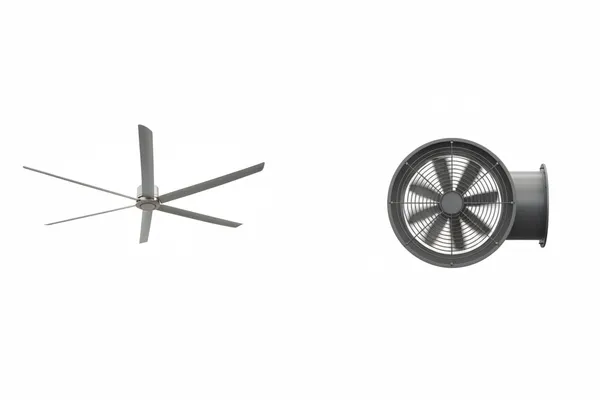
HVLS fan and exhaust fans
What technical role does each system play in industrial settings?
In Industrielle Umgebungen, every air system should be judged by the job it performs. An HVLS fan mainly addresses air circulation, thermal equalization, and comfort in large spaces. It does this by moving a massive volume of air slowly and evenly, rather than forcing narrow, aggressive streams of air like many high-speed fans or smaller fans.
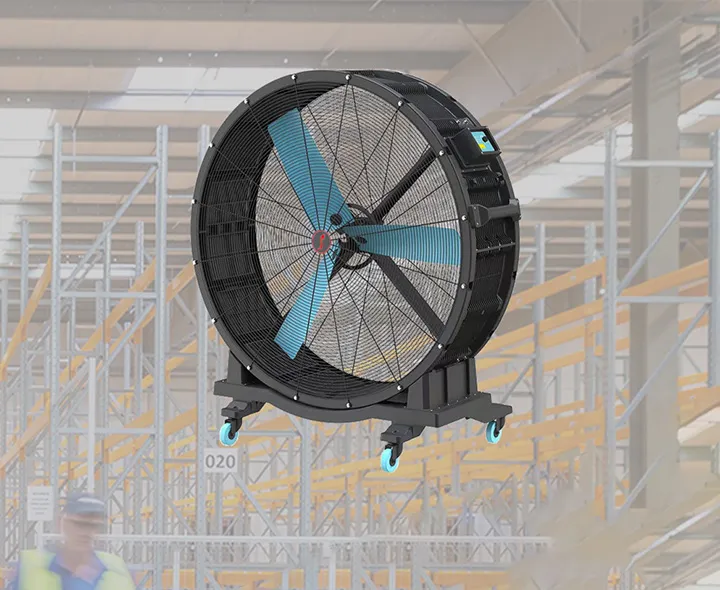
Exhaust fans serve a different engineering purpose. They support ventilation by removing unwanted air, excess heat, vapor, dust-laden air, or process emissions. In many manufacturing environments, exhaust fans are part of a compliance or process-control requirement, not simply a comfort solution. That is why exhaust fans remain critical in welding areas, paint processes, hot kitchens, chemical handling zones, and high-moisture rooms.
This is the real technical difference between hvls fans and traditional exhaust systems:
| System Type |
Primary Role |
Best Use Case |
Main Limitation |
| HVLS-Ventilator |
Internal air movement and destratification |
Lager, gym, school, Werk, logistics hall |
Does not remove contaminated air |
| Abluftventilatoren |
Air removal and ventilation |
Heat, fumes, moisture, smoke, process exhaust
|
Poor standalone solution for broad comfort |
| Conventional fans |
Local air movement |
Small work zones, temporary spot cooling |
Limited coverage in große Industrieflächen |
Professionally speaking, the two systems should not be framed as direct substitutes. They should be evaluated as separate tools within a broader building air strategy.
HVLS fans vs exhaust fans: which one performs better for energy efficiency?
When the design goal is comfort and internal air movement, HVLS-Ventilatoren usually outperform exhaust systems on energy efficiency. The reason is simple. An HVLS system does not rely on continuously throwing conditioned indoor air out of the building. Instead, it improves how the existing air mass behaves inside the space.
That matters in large commercial spaces, sports centers, schools, and industrial halls where warm air accumulates overhead and cooler air settles below. HVLS fans improve temperature uniformity by bringing air down from the ceiling and redistributing it through the occupied zone. In summer, they create a perceived cooling effect. In winter, they help circulate warm air that would otherwise remain trapped near the ceiling.
By comparison, exhaust fans can increase load on the hvac system when used as a comfort-first solution. Every time conditioned air is removed, replacement air must enter, and that new air may need heating, cooling, filtering, or dehumidification. In buildings already struggling with energy bills, this can create unnecessary operating cost if exhaust is used where air mixing would have been more efficient.
Here is the professional takeaway:
- For comfort and thermal balance, HVLS usually offers better energy savings
- For contaminant removal, exhaust is necessary even if energy consumption is higher
- For many facilities, the best result comes from using each system only for the function it is meant to perform
That is where fans vs ventilation becomes a cost-control issue, not only a mechanical issue.
When are exhaust fans the correct choice, even if they use more energy?
There are many situations where exhaust fans are the correct answer and should not be replaced by an HVLS system. If the building must remove smoke, fumes, hot process air, steam, oil mist, chemical vapor, or humidity, exhaust is not optional. It is part of safe operation.
This is especially true in manufacturing processes where air quality directly affects worker safety, product quality, or compliance. A facility may need to maintain pressure relationships, remove corrosive air, or protect sensitive equipment from vapor accumulation. In these environments, the proper question is not whether fans are better than exhaust systems. The proper question is how much exhaust is required and how it should be balanced with makeup air and internal circulation.
A professional design team should never recommend an HVLS fan as a substitute for process exhaust. That would be poor engineering. However, once required exhaust has been addressed, HVLS can still be added to improve overall air quality perception, reduce stratification, and improve comfort in surrounding occupied areas.
So yes, exhaust fans may use more energy in some buildings. But where air must be removed, they remain the right choice.
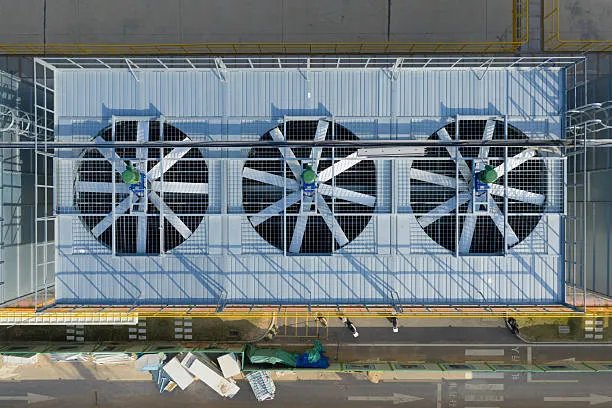
When are exhaust fans the correct choice
Why do HVLS systems perform so well in warehouse and factory environments?
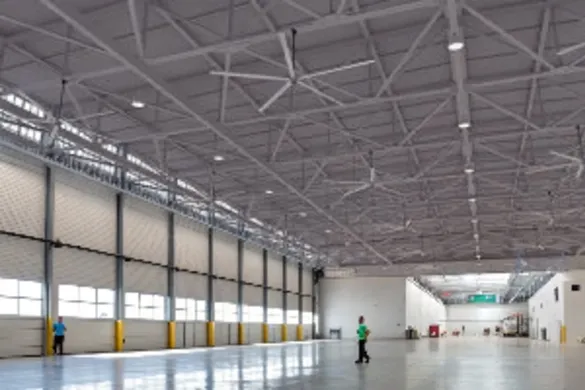
The strongest case for HVLS usually appears in a warehouse or factory. These spaces are large, open, tall, and often uneven in temperature. Heat rises. Air stagnates. Workers move across different zones. Standard ceiling fans, pedestal fans, or wall-mounted units often create patchy relief but fail to improve conditions across the full floor.
This is where hvls fans are designed to do something different. Because the fan diameter is large and the rotational speed is low, the fan can move a massive volume of air over a wide footprint. Instead of creating narrow wind streams, it produces a broad movement pattern that helps circulate air across aisles, workstations, storage zones, and loading areas.
In a typical warehouse, that means:
- better airflow across a large area
- fewer hot and cold zones
- more even comfort in pick, pack, and loading operations
- less need for scattered smaller fans
- better support for existing cooling systems
In a factory, the value goes beyond comfort. Better air movement can support comfort and productivity, especially where workers stand for long periods, where machinery generates heat, or where process heat builds up under the roof deck. For large, open buildings, few systems deliver the same broad internal effect as an HVLS layout.
How do HVLS fans work with an HVAC system and air conditioning systems?
One of the most important professional advantages of HVLS is that it works with the building’s HVAC system, rather than against it. In cooling season, the fan increases perceived comfort by moving air through the occupied zone. That allows operators to manage thermostats more efficiently without sacrificing occupant experience. In heating season, the fan helps push warm air back down from overhead, where it often accumulates in tall buildings.
This is why many buyers see HVLS not as a stand-alone product, but as a performance upgrade for air conditioning systems and existing heating equipment. Instead of forcing the heating and cooling systems to work harder in a stratified space, the fan improves how treated air is distributed.
In practical terms, HVLS can help:
| HVAC Challenge |
HVLS Contribution |
| Warm air trapped overhead |
Brings air down from the ceiling |
| Uneven room temperature |
Evenly distributes air throughout the occupied zone |
| Excessive thermostat demand |
Helps reduce energy costs through better comfort response |
| Localized discomfort |
Improves Luft im ganzen a broader floor plate |
This does not mean HVLS replaces cooling or heating equipment. It means the fan helps the building use those systems more efficiently. For many industrial and commercial facilities, that is exactly where the payback comes from.
Fans vs conventional fans: what changes when the building becomes larger?
In small rooms, many types of fans can work. Standard ceiling fans, portable drums, and pedestal fans are familiar and inexpensive. But once the building becomes taller, wider, and more open, those options become less efficient as a system.
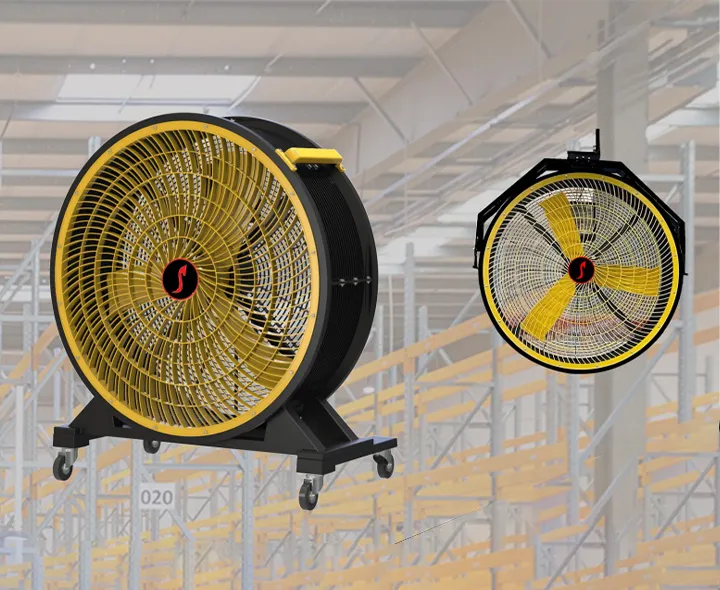
That is the real dividing line in fans vs conventional fans. A small fan may cool one workstation. It cannot effectively manage air in large open spaces or large industrial spaces. That means buyers often end up deploying many scattered units, each covering a limited zone. Maintenance grows. Noise rises. Air movement remains uneven.
By contrast, hvls fans are generally chosen for whole-zone performance. Their fan size and blade profile allow them to gently circulate air across a much broader footprint. That is why fans are commonly used in all building types, but only certain industrial fans are effective in very large environments.
So when a decision-maker asks which fans are better, the professional answer is not based on speed. It is based on scale, air pattern, operating purpose, and how the building is actually used.
What should decision-makers compare before installing HVLS fans?
Before installing HVLS fans, serious buyers should compare building conditions, operating goals, and system interaction. Selection should not begin with price or blade diameter alone.
The most important evaluation points are:
- ceiling height and structure
- occupancy density and work pattern
- heat load from process or solar gain
- whether the site needs exhaust or only internal circulation
- current energy consumption
- how the fan will interact with the existing hvac systems
- whether the target is comfort, destratification, or energy reduction
It is also important to assess whether the building is a large commercial environment, a logistics hub, a gym, a sports center, or a manufacturing site. The air objective is different in each one. The best suppliers do not simply sell a product. They help define the right fan system for the application.
As a manufacturer, we see a clear difference between projects that are engineered and projects that are improvised. Engineered projects deliver better energy efficiency, better coverage, and more predictable operating results.
Can one project require both HVLS and exhaust systems?
Absolutely. In fact, many of the best-performing buildings use both. This is especially true in mixed-use industrial layouts where one area needs comfort-focused air movement and another area needs strict ventilation control.
A common example is a manufacturing facility with a large assembly floor and a smaller welding or washdown zone. The assembly area benefits from HVLS because it needs improved air circulation, thermal balance, and occupant comfort. The process zone still requires exhaust fans because it must remove fumes, moisture, or heat at the source.
This combined approach often creates the strongest operating result:
- HVLS for broad internal mixing
- exhaust for air removal where required
- HVAC for temperature treatment
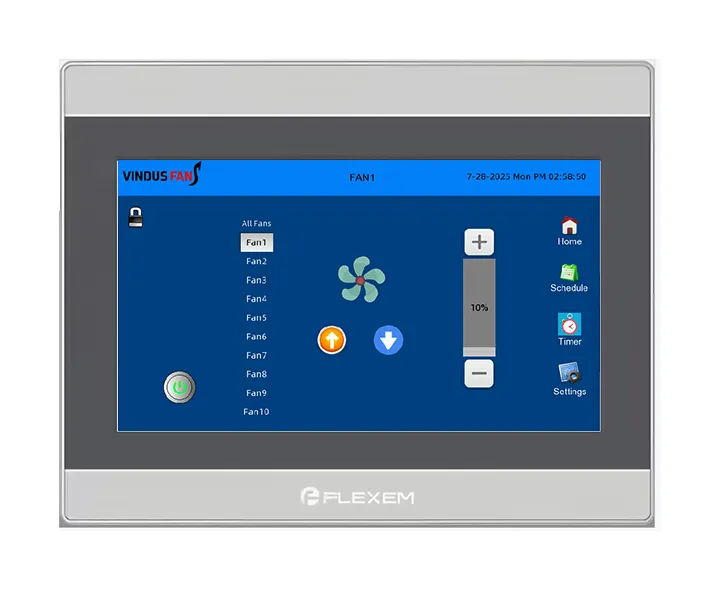
- coordinated controls for stable performance
That is why the smartest way to compare hvls is not to ask whether one system can replace all others. It is to ask how each system contributes to the full air-management plan.
Which option is the better solution for industrial and commercial facilities?
For most industrial settings, the better option depends on what the building actually needs.
If the building needs broad comfort, destratification, and better use of conditioned air in large spaces, the better answer is usually an HVLS fan. If the building must remove hazardous, humid, or process-generated air, exhaust fans are the correct solution. If the facility has both kinds of needs, both systems should be part of the design.
That is the most professional way to frame hvls fans vs exhaust fans. It is not a popularity contest. It is a matter of matching system function to operating objective.
For buyers in factories, commercial buildings, sports centers, gyms, schools, warehouses, and manufacturing facilities, the business case is clear. An effective air strategy should improve comfort, support productivity, lower waste, and help reduce your carbon footprint without compromising ventilation requirements. When applied correctly, HVLS does exactly that in the environments it is meant for.
For a buyer evaluating a long-term solution for industrial and commercial applications, the smarter question is not “Which fan is cheaper today?” It is “Which system delivers the right air outcome over the life of the building?”

HVLS-Ventilator für gewerbliche Räume
FAQs
Are HVLS fans a replacement for exhaust fans?
No. An HVLS fan improves internal air circulation and comfort, while exhaust fans remove air from the building. They serve different functions.
Which system is better for energy efficiency?
In most comfort-driven applications, HVLS offers stronger energy efficiency because it improves internal air movement without forcing as much conditioned air out of the building.
Are exhaust fans still necessary in modern industrial facilities?
Yes. They are essential when a facility must remove smoke, fumes, moisture, vapor, or process heat.
Why are HVLS fans so common in warehouses?
A warehouse usually has high ceilings and broad open floor space. HVLS performs well there because it can move large volumes of air across a large area more evenly than many conventional fans.
Can HVLS fans work with air conditioning systems?
Yes. They often improve the effectiveness of air conditioning systems by helping conditioned air circulate more evenly.
What should I focus on first when comparing options?
Focus on function first. Decide whether the building needs internal air movement, air removal, or both. That will determine whether HVLS, exhaust, or a combined design is the right answer.
Die wichtigsten Erkenntnisse
- HVLS fans vs exhaust fans is a comparison of two different system roles
- An HVLS fan is best for airflow, destratification, and comfort in large spaces
- Exhaust fans are best for removing heat, fumes, moisture, and contaminated air
- HVLS often delivers stronger energy efficiency when the goal is internal air movement
- In a warehouse or factory, HVLS can improve comfort and support better HVAC performance
- Many buildings perform best when HVLS and exhaust systems are used together
- The right decision depends on air objective, not on which product is more familiar