High ceilings, hot zones, poor airflow, and high energy bills can make a large building uncomfortable and expensive to run. A small ceiling fan cannot solve these problems. The better solution is choosing the right HVLS fan for steady, wide, and efficient air movement.
An HVLS fan is a high-volume, low-speed large ceiling fan designed for factories, warehouses, gyms, schools, sports centers, and commercial buildings. To select the optimal fan size, you should evaluate ceiling height, square footage, airflow demand, fan diameter, building layout, HVAC systems, installation conditions, and the correct placement of HVLS fans.
Article Outline
- What Is an HVLS Fan for High Ceilings?
- Why Are Large Ceiling Fans Better for Large Spaces?
- How Do HVLS Fans Work?
- How to Choose the Right HVLS Fan Size?
- How Does Ceiling Height Affect Fan Size?
- How to Plan HVLS Fan Placement for Optimal Airflow?
- How Do HVLS Fans Work with HVAC Systems?
- What Should You Know Before HVLS Fan Installation?
- How to Maintain an HVLS Fan for Long-Term Use?
- How to Choose a Professional HVLS Fan Manufacturer?
- FAQs About HVLS Fan Selection
What Is an HVLS Fan for High Ceilings?
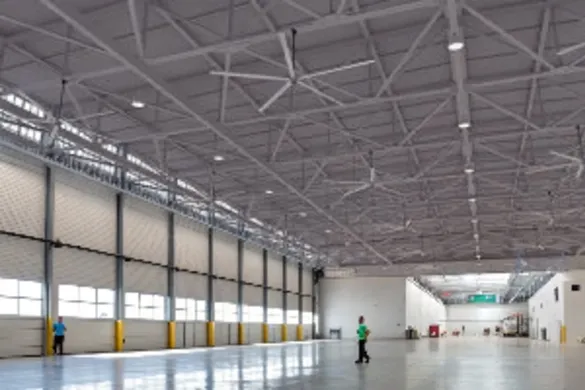
An HVLS fan is a large industrial ceiling fan designed to move a high volume of air at low speed. HVLS means high volume low speed. This type of fan is widely used in industrial and commercial buildings where normal ceiling fans or wall fans cannot provide enough air circulation.
Unlike a small ceiling fan, an HVLS fan uses a larger blade span to move large volumes of air slowly and evenly. Many HVLS fans are designed for high ceilings, open spaces, and large floor areas. They are especially useful in factories, warehouses, sports centers, gyms, schools, logistics buildings, workshops, and commercial spaces.
As an HVLS fan manufacturer, we usually look at the full building condition before recommending a model. The ceiling height, room size, fan size, airflow target, mounting position, and safety clearance all matter. A good selection is not just about buying the biggest fan. It is about choosing the right large ceiling fan for the actual site.

What Is an HVLS Fan for High Ceilings
Why Are Large Ceiling Fans Better for Large Spaces?
Large spaces often have poor air movement. Warm air rises to the ceiling. Cooler air stays near the floor. If the air does not circulate, workers may feel hot in summer and cold in winter. Some areas may feel stuffy, while other areas may receive too much direct air from small high-speed fans.
This is where large ceiling fans offer real value. An HVLS fan creates wide and gentle airflow. The air moves down from the fan, reaches the floor, and spreads across the space. This creates more consistent air circulation without strong wind pressure.
For example, in a warehouse, one small fan may only cool a small workbench. But one properly selected HVLS fan can help improve air movement across a much larger area. In larger spaces, multiple HVLS fans may be used together to reduce stagnant air pockets and improve comfort in different work zones.
Main Benefits of HVLS Fans in Large Spaces
| Benefit |
Practical Value for Buyers |
| Better airflow |
Helps move air across wide open areas |
| More comfort |
Reduces hot and stuffy zones |
| Energy efficiency |
Supports HVAC performance and may reduce energy costs |
| Better air circulation |
Helps circulate warm air and cooler air more evenly |
| Large area coverage |
Suitable for warehouses, factories, gyms, and commercial buildings |
| Low-speed operation |
Creates gentle air movement with lower noise |
For buyers managing large spaces, the goal is not only cooling. The real goal is stable comfort, better air quality, lower operating pressure, and long-term energy savings.
How Do HVLS Fans Work?
HVLS fans work by using long blades to move a large amount of air at low speed. The airflow moves downward from the ceiling and then spreads outward along the floor. This creates a large airflow pattern that can cover a wide area.
The larger the diameter of the fan, the more air it can move. This is why fan diameter is very important when choosing the right HVLS fan. A large blade does not need to rotate very fast. It can move high volume air smoothly and quietly.
In simple terms:
- Small fans move air fast in a small area.
- HVLS fans move air slowly across a large area.
- Large ceiling fans are more suitable for large open spaces.
- Correct fan placement helps create consistent airflow.
An HVLS fan is especially effective in spaces where standard fans cannot reach the full occupied area. In a factory or warehouse, people may work far away from walls or doors. Wall fans may not reach them. Portable fans may block walkways. An overhead HVLS fan solves this by using the ceiling space and pushing air downward into the working zone.
How to Choose the Right HVLS Fan Size?
Choosing the right fan size starts with understanding your building. Many buyers ask, “What size HVLS fan do I need?” The answer depends on several factors, not just floor area.
The most important factors include:
- Total square feet of the space
- Ceiling height
- Building length and width
- Fan diameter
- Airflow requirement
- Existing HVAC systems
- Worker activity areas
- Rack, crane, light, duct, and sprinkler layout
- Mounting structure
- Safety clearance
A large ceiling fan can often be available in different diameters. Some industrial HVLS fans can reach 24 feet in diameter. However, bigger is not always better. The right fan size should match the ceiling height, airflow need, and available mounting space.
General HVLS Fan Size Planning Table
| Building Type |
Common Ceiling Height |
Fan Selection Focus |
| Factory workshop |
18–40 feet high |
Worker comfort, machine heat, airflow coverage |
| Warehouse |
20–45 feet high |
Large floor area, rack layout, loading zones |
| Gym or sports center |
20–50 feet high |
Quiet operation, even airflow, comfort |
| School hall |
16–35 feet high |
Safety, comfort, low noise |
| Commercial buildings |
14–35 feet high |
Appearance, comfort, HVAC support |
This table is a planning reference. Before final selection, we recommend checking the actual site drawing. The square footage of your space tells us the coverage area. The ceiling height tells us how far the airflow must travel. The layout tells us whether one fan or multiple fans are better.
How Does Ceiling Height Affect Fan Size?
Ceiling height is one of the most important points in HVLS fan sizing. A high ceiling gives the fan more space to move air, but it also means the air must travel farther before reaching people on the floor.
If the ceiling is too low, the fan diameter and blade clearance must be carefully checked. If the ceiling is very high, a larger fan size or better fan placement may be needed to achieve optimal airflow and energy efficiency.
In high ceilings, warm air often collects near the roof. This is common in warehouses, factories, sports centers, and industrial buildings. Without proper air circulation, the lower working area may feel uncomfortable while warm air stays trapped above. An HVLS fan helps move vertical air and mix warm air with cooler air.
Ceiling Height and Selection Focus
| Ceiling Height |
Selection Notes |
| 14–20 feet |
Check blade clearance and safe mounting carefully |
| 20–30 feet |
Common range for many large ceiling fans |
| 30–45 feet |
Larger fan diameter may be needed |
| Above 45 feet |
Detailed airflow planning is recommended |
The fan is crucial for comfort, but the installation height is also important. A professional manufacturer should help confirm whether the selected fan can deliver effective airflow to the working area.
How to Plan HVLS Fan Placement for Optimal Airflow?
The placement of HVLS fans has a direct impact on performance. Even a high-quality HVLS fan may not work well if it is placed in the wrong location.
Good fan placement should consider:
- Main occupied areas
- Heat sources
- Rack rows
- Production lines
- Loading docks
- Machine locations
- Ceiling beams
- Lighting systems
- Fire sprinklers
- HVAC air outlets and returns
In large open areas, the fan is often placed near the center of the coverage zone. In long warehouse spaces, multiple fans may be placed in a line to create balanced air movement. In manufacturing facilities, the fan may be placed above production areas where workers need better air comfort.
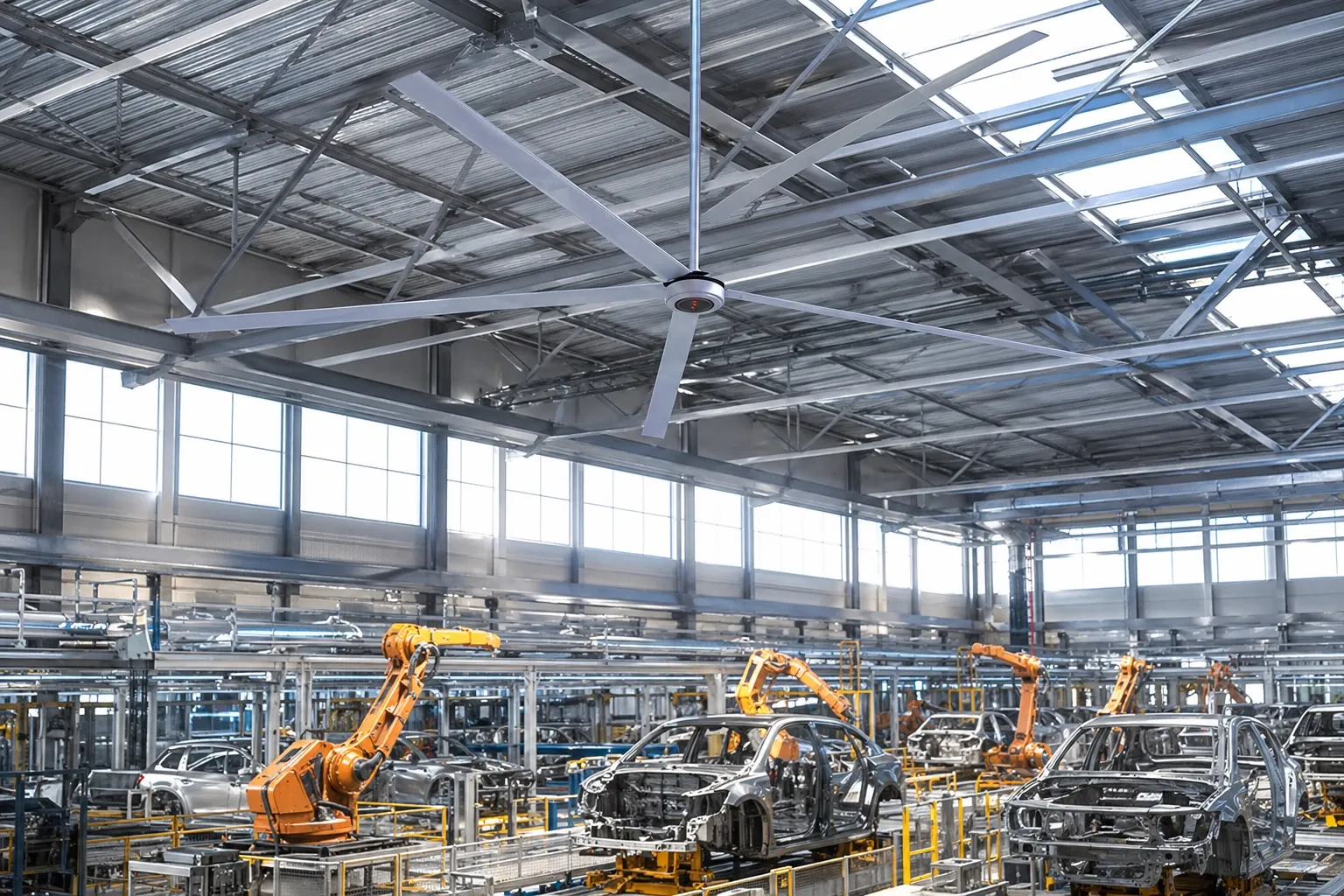
Fan Placement Planning Guide
| Site Condition |
Recommended Planning Method |
| Large open workshop |
Place fan near the center of the work zone |
| Warehouse with racks |
Avoid placing the fan where tall racks block airflow |
| Sports center |
Focus on even airflow and low noise |
| Factory with heat sources |
Support areas near machines or production lines |
| Multiple work zones |
Consider multiple HVLS fans for balanced coverage |
The number of fans required should be calculated based on the building layout. A single large fan may work well in an open space. But spaces may require multiple fans when there are walls, racks, machines, or separated zones.
As a manufacturer, we usually recommend providing a simple layout drawing before quotation. This helps us choose the right fan size, fan diameter, and fan placement.
How Do HVLS Fans Work with HVAC Systems?
HVLS fans can work together with HVAC systems to improve air distribution. They do not always replace heating or cooling systems. Instead, they help move treated air more evenly across the building.
In summer, moving air helps people feel cooler. This may allow the HVAC system to work with less pressure. In winter, the HVLS fan can help move warm air down from the ceiling and reduce temperature layering. This can help reduce heating costs in high-ceiling buildings.
In many industrial and commercial buildings, HVAC systems have one common problem: the air does not always reach the whole space evenly. Some areas may be too hot. Some may be too cold. Some may feel stale. HVLS fans help circulate air so that the indoor environment feels more balanced.
How HVLS Fans Help HVAC Performance
| Season |
How HVLS Fans Help |
| Summer |
Create moving air and improve comfort |
| Winter |
Push warm air down from the ceiling |
| All year |
Improve air circulation and reduce stagnant air pockets |
| Large buildings |
Help distribute conditioned air more evenly |
This is one reason many factories, warehouses, gyms, and commercial buildings use HVLS fans as part of their air management system. Better air movement can support comfort, air quality, and energy efficiency.
What Should You Know Before HVLS Fan Installation?
HVLS fan installation is not the same as installing a small ceiling fan. The fan is larger, heavier, and designed for commercial or industrial use. Professional installation is important for safety and performance.
Before installation, check:
- Ceiling beam strength
- Mounting point position
- Mounting hardware
- Blade clearance
- Power supply
- Control box location
- Distance from lights and sprinklers
- Distance from cranes, racks, and doors
- Safety cable or backup protection
- Final test after installation
Professional installation helps prevent vibration, noise, unstable operation, and safety risks. It also ensures that the fan operates at the correct height and angle.
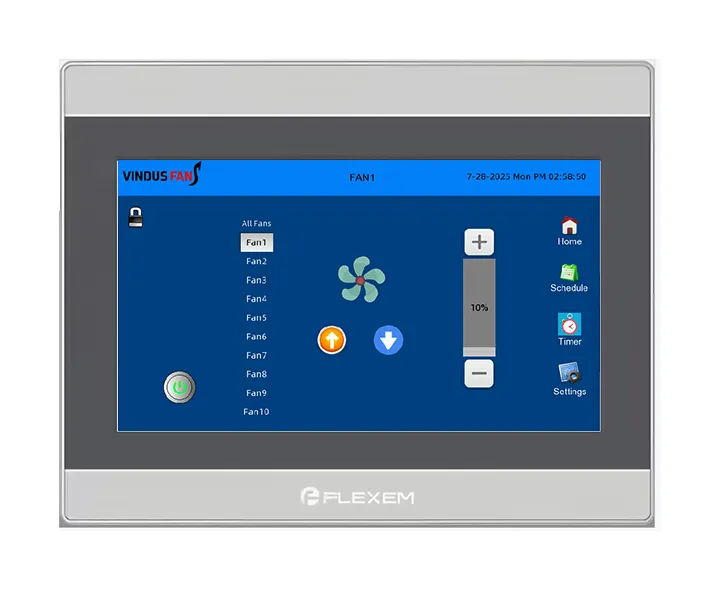
As an HVLS fan manufacturing plant, we pay close attention to the mounting structure and installation details. A strong motor, balanced blade, and reliable controller must work together with a safe installation system. Good installation protects the buyer’s investment and helps the fan work for many years.
What Blade Design Should You Consider for Large Ceiling Fans?
The blade is one of the most important components of an HVLS fan. The blade design affects airflow, noise, balance, safety, and energy use.
A good HVLS fan blade should be:
- Strong
- Lightweight
- Balanced
- Stable during rotation
- Designed for smooth airflow
- Resistant to deformation
- Suitable for long-term use
Some buyers think more fan blades always mean better performance. This is not always true. What matters more is the blade profile, blade length, motor matching, and total airflow performance.
The diameter of the fan also plays a key role. A larger fan diameter can move more air at lower speed. This helps create high-volume airflow without strong wind pressure. For large spaces, this is often more comfortable than using many small high-speed fans.
When selecting large ceiling fans, buyers should not only look at appearance. They should compare motor quality, blade structure, safety design, control system, and manufacturer support.
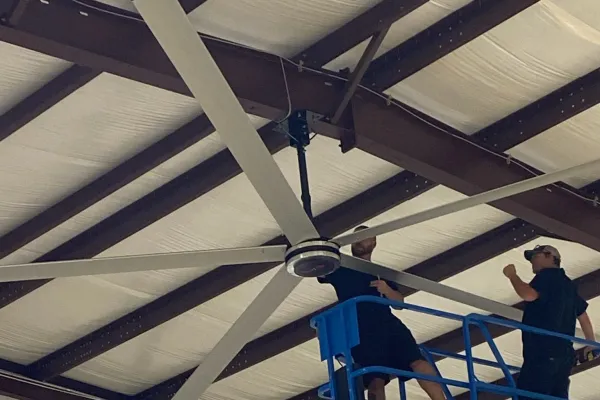
What Blade Design Should You Consider
How to Maintain an HVLS Fan for Long-Term Use?
HVLS fan maintenance is usually simple, but it should be done regularly. Good fan maintenance helps protect safety, reduce downtime, and extend product life.
Basic maintenance includes:
- Checking blade bolts
- Inspecting mounting hardware
- Cleaning dust from fan blades
- Checking motor operation
- Listening for abnormal noise
- Checking the control system
- Inspecting electrical wiring
- Confirming smooth start and stop
- Checking safety cables
- Recording maintenance results
In dusty factories or workshops, fan blades may collect dirt over time. This can affect balance and airflow. Regular cleaning helps keep the fan stable and efficient.
For warehouses, gyms, schools, and factories, we suggest creating a simple maintenance schedule. It does not need to be complicated. A quarterly inspection is usually a good starting point. Heavy-use environments may need more frequent checks.
A well-maintained HVLS fan can provide stable airflow for many years. This is why choosing a reliable manufacturer and following the correct maintenance guide are both important.
How to Choose a Professional HVLS Fan Manufacturer?
Choosing the right HVLS fan manufacturer is just as important as choosing the right fan size. A professional manufacturer should understand airflow, structure, safety, application conditions, and project requirements.
A good manufacturer should be able to help you with:
- Fan size selection
- Layout planning
- Airflow recommendation
- Ceiling height evaluation
- Mounting solution
- Fan installation guidance
- OEM or custom requirements
- Quality inspection
- Spare parts support
- After-sales service
As an HVLS fan manufacturer, we focus on practical applications for factories, commercial buildings, sports centers, gyms, schools, warehouses, and manufacturing facilities. Our goal is to help buyers select the right large ceiling fan based on real building conditions.
We do not suggest choosing only by price. A low-cost fan may look attractive at first, but poor blade balance, weak mounting design, low motor quality, or poor after-sales support can create higher long-term costs.
What Professional Buyers Should Compare
| Selection Point |
Why It Matters |
| Fan size |
Affects airflow coverage |
| Motor quality |
Affects reliability and energy use |
| Blade design |
Affects air movement and noise |
| Safety structure |
Affects long-term operation |
| Control system |
Affects ease of use |
| Manufacturer experience |
Affects project recommendation |
| After-sales support |
Affects maintenance and spare parts |
The right fan should be safe, efficient, durable, and suitable for your building. The right manufacturer should help you make that decision clearly.
Practical Example: Selecting HVLS Fans for a Warehouse
Let’s say a warehouse has high ceilings, loading doors, storage racks, and several work areas. Workers feel hot in summer, while air feels uneven in different zones. The building already has HVAC systems, but the airflow does not reach every working area well.
In this case, the solution may not be one oversized fan. It may be better to use multiple HVLS fans in carefully selected positions. The fan placement should avoid tall racks and focus on occupied areas.
Warehouse Planning Example
| Site Problem |
HVLS Fan Solution |
| Hot work areas |
Place fans near occupied zones |
| Poor air movement |
Use large ceiling fans for wider coverage |
| High ceiling |
Select proper fan diameter and mounting height |
| Uneven HVAC effect |
Help circulate conditioned air |
| Stagnant air pockets |
Create consistent air circulation |
This example shows why project planning matters. HVLS fans can help improve air comfort, but only when the fan size, fan placement, and installation plan are correct.
Buyer Checklist Before Requesting a Quote
Before asking for an HVLS fan quotation, prepare the following information:
- Building length and width
- Ceiling height
- Total square feet
- Photos of the ceiling structure
- Floor layout drawing
- Work area location
- Rack or machine position
- HVAC system position
- Power supply information
- Expected airflow or comfort goal
- Installation environment
- Quantity estimate if available
With this information, a manufacturer can recommend a more accurate fan size and layout. It also helps avoid wrong selection and repeated communication.
FAQs About HVLS Fan Selection
What is the best HVLS fan size for high ceilings?
The best HVLS fan size depends on ceiling height, square footage, building layout, and airflow needs. A larger ceiling may need a larger fan diameter or multiple fans. The safest method is to provide your building drawing and let the manufacturer recommend the correct size.
Can one HVLS fan cover a whole warehouse?
It depends on the warehouse size and layout. One HVLS fan may work well in a clear open space. But a warehouse with racks, machines, walls, or multiple work zones may require multiple fans for better air circulation.
Do HVLS fans save energy?
HVLS fans can support energy savings by improving air circulation and helping HVAC systems work more efficiently. They can help move warm air down in winter and create cooling air movement in summer. Actual savings depend on the building, climate, and operating conditions.
Are HVLS fans suitable for gyms and sports centers?
Yes. HVLS fans are suitable for gyms, sports centers, schools, and large halls. They provide gentle airflow, reduce stuffiness, and improve comfort without creating strong direct wind.
How high should the ceiling be for an HVLS fan?
HVLS fans are commonly used in spaces with high ceilings. The required height depends on the fan diameter, blade clearance, and installation structure. Before installation, the mounting position and safety distance must be checked.
Is professional installation necessary for HVLS fans?
Yes. Professional installation is strongly recommended. HVLS fans are large industrial products. Correct mounting, clearance, wiring, and safety inspection are important for stable and safe operation.
Key Things to Remember
- An HVLS fan is a high-volume, low-speed fan for large spaces.
- The right fan size depends on ceiling height, square feet, airflow needs, and layout.
- A larger fan is not always the best choice; correct matching is more important.
- Good fan placement helps achieve optimal airflow and energy efficiency.
- HVLS fans can work with HVAC systems to improve comfort and air distribution.
- Professional installation protects safety and performance.
- Regular fan maintenance helps extend service life.
- Choose a professional HVLS fan manufacturer that can support sizing, layout, installation, and after-sales service.