Hot zones, uneven temperatures, and too many small fans can make a big building hard to 凉爽的 well. That leads to weak comfort, wasted power, and frustrated teams. The smarter fix is not always more fans. It is choosing the right air strategy for the whole space.
In many large buildings, an HVLS fan is better than spot cooling for whole-room comfort because it moves a broad mass of air across a wide area at low speed. Spot cooling still matters for targeted hot workstations, but in a 仓库 or other tall facility, an HVLS 风扇 usually delivers more even 空气流动, better mixing, and stronger support for 暖通空调系统.
文章提纲
- What is the real difference between an HVLS 风扇 and spot cooling?
- Why do 大空间 就像 仓库 change the answer?
- How do HVLS 风扇工作 compared with small fans?
- 是否 HVLS fans better than small fans for full-room comfort?
- When is spot cooling still the smarter tool?
- How do HVLS fans and air conditioning work together?
- What happens to 能源消耗, comfort, and operating cost?
- How do these systems affect 空气质量 and productivity?
- What should you check before you choose a system?
- Which approach is best for your building?
What is the real difference between an HVLS fan and spot cooling?
The simplest way to explain comparing HVLS with spot cooling is this: a spot-cooling device tries to 凉爽的 one person, one machine area, or one short zone. An HVLS 风扇 is built to influence the whole room. AMCA defines an HVLS unit as a large-diameter fan that circulates high 空气量 using 低速 operation, producing a large area of effect with gentle 空气流动.
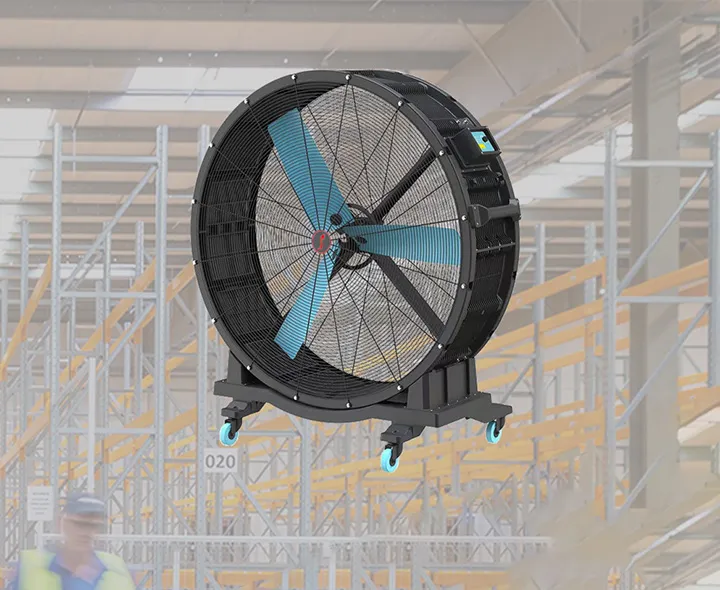
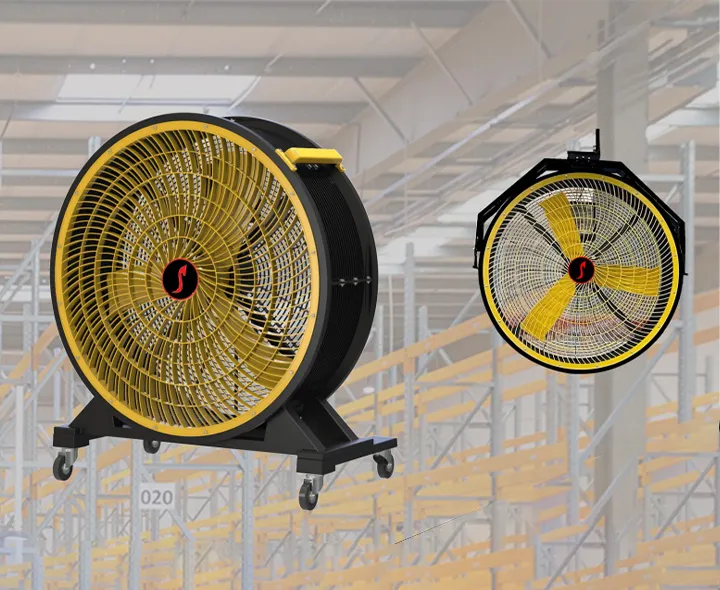
That is the key idea behind HVLS technology. Spot cooling is localized cooling. It is useful when a worker stands beside a hot process or when one station needs fast relief. OSHA notes that local air cooling can be effective in specific areas and points to methods like cool rooms or portable blowers with built-in chillers for industrial settings.
一个 HVLS 风扇, by contrast, does not try to refrigerate one small zone. It improves 空气流动, broad 空气循环, and mixing across the occupied area. In short, the difference is scale. Spot cooling solves a local problem. An HVLS 风扇 solves a building problem.
What is the real difference between an HVLS fan and spot cooling?
Why do warehouses and large spaces change the answer?
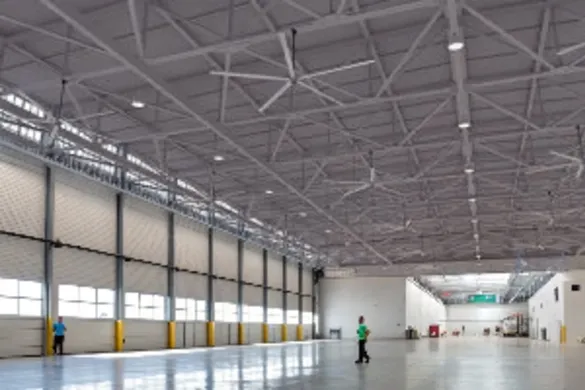
一个 仓库 changes everything because the room volume is so large. In tall facilities, heat rises and 暖空气 collects near the roof. ASHRAE explains that thermal stratification creates a floor-to-天花板 gradient, and that high-volume, low-speed fans are a practical way to reduce that gradient in tall spaces.
That is why HVLS 粉丝 vs spot cooling is not a fair one-size-fits-all fight. In a small room, a portable cooler or small fan may be enough. In a tall distribution center, gym, or factory, the problem is often not one hot desk. It is poor mixing from floor to ceiling. A few small fans may create local breeze, but they usually do not move enough air to change room-wide conditions.
OSHA even calls out the warehousing industry as a place where indoor heat stress matters and recommends air conditioning, ventilation, and air flow as part of heat-risk control. That is a strong sign that big indoor volumes need system thinking, not just a handful of devices.
Quick comparison by space type
| Space type |
What usually works best |
为什么 |
| Small workstation |
Spot cooling |
Fast, local relief |
| Hot machine cell |
Spot cooling + shielding |
Targeted control |
| Tall 仓库 |
HVLS 风扇 |
Whole-room mixing |
| Open gym or plant |
HVLS 吊扇 |
Broad comfort coverage |
| Mixed-use facility |
Pairing HVLS fans with local cooling |
Best balance of reach and precision |
How do HVLS fans work compared with small fans?
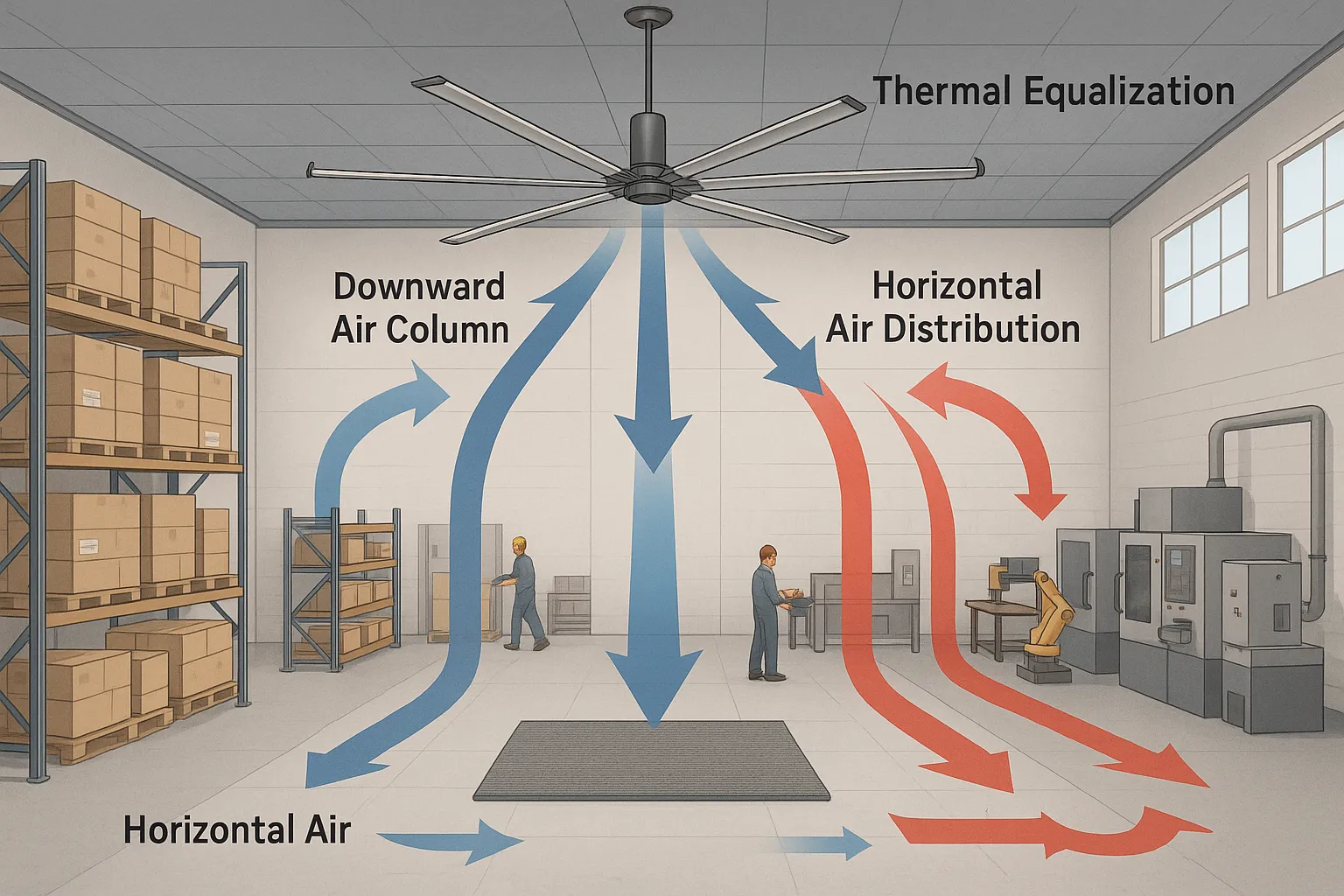
AMCA explains that HVLS 风扇设计 to create high-volume air movement with a large column of displaced air, gentle air at low speeds, and a large area of effect. That is why 高音量低速度 matters so much. The fan is not weak because it turns slowly. It is effective because it moves a massive air mass over distance.
Small fans feel strong because they throw a narrow 气流 at high velocity. But that does not always mean better room performance. In many large rooms, conventional fans 和 传统风扇 create noticeable breeze near the device and weak impact farther away. The HVLS 吊扇 uses diameter instead of force. It displaces more air, spreads it farther, and helps move air across the occupied zone more evenly.
This is one of the biggest differences between HVLS fans and small spot units. Small fans blast. HVLS fans mix. Small fans attack one location. HVLS fans move a high mass of air over a bigger footprint. That is why 粉丝动 differently even when the goal sounds the same.
Are HVLS fans better than small fans for whole-room comfort?
For whole-room comfort in big buildings, yes, HVLS fans are better most of the time. They are better than small fans when the goal is broad, even comfort instead of local relief. ASHRAE’s elevated air-speed method recognizes that increased air speed can expand acceptable comfort conditions, and DOE says 吊扇 can allow a thermostat increase of about 4°F without reducing comfort.
That does not mean small fans have no value. But if you are trying to create a 舒适的环境 across a plant, school, sports hall, or 仓库, 许多小粉丝 often mean more clutter, more maintenance points, and patchy results. In those cases, HVLS fans outperform small fans because one single HVLS fan can influence a much larger area than several scattered spot units.
This is why engineers often say fans are better than small spot devices for whole-building mixing when the room is tall and open. It is not because the small units are useless. It is because the job is different. Whole-room mixing needs fewer, larger, slower-moving air columns—not more noise and more fan heads.
HVLS vs spot cooling at a glance
| 因素 |
HVLS 风扇 |
Spot cooling |
| 覆盖范围 |
Broad room-wide zone |
Small local zone |
| Best use |
Cooling large spaces |
Localized cooling |
| Air pattern |
Gentle, wide 空气流动 |
Focused, narrow flow |
| Ceiling strategy |
Excellent for tall rooms |
有限公司 |
| Number of units |
Often fewer fans |
Often many units |
| Worker relief near hot process |
Good support, but not always enough |
Often better |
| Visual clutter |
降低 |
更高 |

Are HVLS fans better than small fans for whole-room comfort?
When is spot cooling still the smarter choice?
This is where balance matters. HVLS fans aren’t the answer to every heat problem. If one workstation sits beside an oven, furnace, compressor bank, or other intense radiant source, spot cooling may still be the smarter first tool. OSHA says local air cooling can reduce air temperature in specific industrial areas and identifies cool rooms and portable chilled-air blowers as useful methods.
This is also where 蒸发冷却 can enter the conversation in some dry climates. OSHA notes that chillers are more efficient in cooler or dry climates where evaporative cooling can be used. That does not replace the case for an HVLS 风扇; it simply shows that targeted cooling tools still matter in the right climate and process setting.
So the honest answer is this: 粉丝们不 replace every local cooling method. Spot cooling is still valuable when one person, one machine line, or one hot process needs extra help. But once the goal becomes broader 空气循环, comfort over distance, or stratification control, HVLS usually takes the lead.
How do HVLS fans and air conditioning work together?
The smartest projects rarely ask “fans or air conditioning?” They ask how to combine them. DOE says a fan allows you to raise the thermostat setting by about 4°F without reducing comfort. That means using HVLS fans 和 空调 can lower cooling demand instead of fighting the mechanical system.
这就是 ceiling fans and air systems play different roles. The cooling plant changes air temperature. The fan changes how that air feels and how well it mixes. In tall buildings, HVLS fans and air systems work best together because the fan helps spread conditioned air more evenly while also reducing stratification. ASHRAE’s hangar article notes that these fans lower average space temperature by minimizing excess heat at the ceiling, which reduces 暖通空调系统 use.
In real projects, that means pairing HVLS fans with properly controlled 暖通空调 can improve comfort without overworking the plant. It also helps in shoulder seasons, where fans may maintain comfort with less mechanical cooling. That is one reason HVLS 风扇帮助 support smarter 加热和冷却 strategy in tall buildings.
What happens to energy consumption, comfort, and operating cost?
The energy story is one of the strongest reasons to use HVLS. DOE’s guidance on fans says increased air movement can support higher thermostat settings, while AMCA explains that HVLS devices move air with less horsepower than many people expect because they operate at low speed over a large diameter.
That does not mean an HVLS 风扇 creates free cooling. It still uses power. But it can 减少能源 demand on 冷却系统 by helping occupants feel more comfortable at higher setpoints. It can also help destratify the air in winter, bringing 暖空气 down from near the ceiling. That lowers wasted heat overhead and can reduce building-level 能源消耗.
The result can be better 能源效率, steadier comfort, and sometimes measurable 节省能源. That is especially true in 工商 buildings with long operating hours and high roofs. From a cost point of view, the appeal is simple: one fan that improves broad comfort may be more practical than multiple spot devices running all day.
Where the savings usually come from
- Higher cooling setpoints through better air speed
- Less stratification in tall rooms during heating season
- Lower reliance on scattered spot coolers and small fans
- Better air mixing that supports the main 暖通空调 strategy
How do these systems affect air quality and productivity?
Air does not only have to feel cooler. It also has to feel fresher and more even. OSHA notes that heat risk depends on air temperature, 湿度, radiant heat, workload, and 空气流动. That means fan strategy affects more than comfort alone.
A well-placed HVLS 风扇 can support improved air circulation and reduce stagnant zones where air feels heavy. While fans do not replace required ventilation, they can improve how air is mixed throughout the space. Better mixing can help 空气质量 feel more stable and can reduce the sensation of hot and cold pockets across the work area.
This matters because comfort affects work. OSHA notes that heat illness can reduce performance and 生产率. In practice, that means the right air strategy is not only about temperature. It is also about keeping people effective, alert, and safer in warm conditions.
What should you check before you choose an HVLS ceiling or small fans?
First, check the room, not the brochure. Measure 天花板高度, obstructions, occupied zones, heat sources, and whether the goal is full-space comfort or spot relief. AMCA’s guidance emphasizes specification and selection based on application, performance data, and installation conditions.
Second, think about the real airflow pattern you need. If the building has tall bays and open floor area, large-diameter fans are usually the better starting point. If the problem is one person beside a hot process, spot cooling may still win. The right choice depends on the 空气量 you need to move and where that air needs to go.
Third, do not ignore installation and safety. AMCA’s guidance notes clearance, blade height, sprinkler spacing, and testing requirements for HVLS installations. A good hvls ceiling layout is about fit, not just fan diameter.
Buyer checklist
| Question |
Why it matters |
| Is the room tall and open? |
Favors an HVLS 风扇 |
| Is the heat problem local? |
Favors spot cooling |
| Are there hot ceiling layers? |
Favors HVLS mixing |
| Do workers move around? |
Favors whole-room coverage |
| Is there one fixed hot station? |
Favors targeted air |
| Do you want fewer devices running? |
Favors HVLS |
Which approach should you choose for your facility?
If your problem is broad comfort in a big room, an HVLS 风扇 is usually the better choice. If your problem is one hot workstation, spot cooling is often the better tool. If your facility has both kinds of heat problem, then hvls vs spot cooling is the wrong way to think about it. You may need both.
For tall plants, schools, gyms, and 仓库风扇 applications, HVLS 风扇工作 especially well because they improve room-wide mixing, reduce stratification, and support comfort without relying on dozens of small devices. For process heat or fixed hot jobs, local cooling still matters. That is why the best systems work in layers.
So, are 球迷更好 when you compare one big air strategy with many small ones? In many large rooms, yes. HVLS 风扇 for scale. They move massive volumes of air, create broad 空气穿过 occupied zones, and help 凉爽的 a room more evenly. Spot cooling still has a place, but for big-space comfort, fans are often at their best when they are large, slow, and designed for the whole building.
常见问题解答
Are HVLS fans better than small fans in a warehouse?
Usually, yes. In a 仓库, 一个 HVLS 风扇 is often better because it creates broad, even 空气流动 over a large area instead of only cooling one small zone. That is especially useful in tall spaces with stratified air.
Do HVLS fans replace spot cooling completely?
No. Spot cooling is still useful for hot machines, fixed workstations, or process heat. OSHA notes that local air cooling can be effective in specific industrial areas.
Can HVLS fans work with air conditioning?
Yes. DOE says fans can allow a thermostat increase of about 4°F without reducing comfort, so HVLS fans and air systems often work well together.
Do HVLS fans save energy?
They can help lower whole-building demand by supporting better comfort at higher cooling setpoints and by reducing stratification in winter. That can improve 能源效率 and reduce mechanical load.
What is the biggest difference between HVLS and spot cooling?
Scale. Spot cooling targets one area. An HVLS 吊扇 influences the full occupied zone by mixing and 流动的空气 over a wider footprint.
When should I avoid relying only on fans?
When the air temperature is extremely high, the process heat is intense, or one workstation needs colder local relief. OSHA notes that fan-based cooling is generally effective as long as air temperature is below skin temperature, usually below 95°F dry bulb.
Key things to remember
- 一个 HVLS 风扇 is usually the stronger choice for whole-room comfort in tall, open buildings.
- Spot cooling is still valuable when heat is local and needs targeted relief.
- HVLS 粉丝创造 broad air motion, while small fans mostly serve narrow local zones.
- DOE says 吊扇 can support a thermostat increase of about 4°F without reducing comfort.
- In tall spaces, HVLS fans can reduce stratification and help lower wasted heat near the roof.
- The best answer is often not HVLS alone or spot cooling alone, but the right combination for the job.