If your team is sweating, your products are warming up, and your energy bill keeps climbing, you have a heat problem—not just a comfort problem. In many facilities, trapped heat hurts safety, slows work, and raises costs. The fix is a practical cooling plan built for your building.
Cooling a large warehouse usually requires a mix of strategies: reduce heat gain (roof/insulation), improve ventilation and airflow, use fans (especially HVLS for wide coverage), apply spot cooling where people work, and add targeted air conditioning only where it delivers the best ROI. The best approach depends on layout, climate, operations, and budget.
As an HVLS fan manufacturing plant, we work with factories, gyms, schools, warehouses, and commercial buildings that need better temperature control without wasting money. In this guide, I’ll break down the best ways to cool a warehouse efficiently—step by step, with practical options and a buyer-focused decision framework.
Schema dell'articolo
- Why does a warehouse get so hot in the first place?
- What is the first step to cool a warehouse efficiently?
- How much does insulation and a cool roof really help?
- Are HVLS and warehouse fans enough without AC?
- When do you need air conditioning units in a warehouse?
- What are the best warehouse cooling solutions for staff work zones?
- How do ventilation systems remove hot air and improve airflow throughout the facility?
- How can you reduce heat from machinery and other heat sources?
- What cooling options work best for different warehouse types?
- How do warehouse owners build a practical cooling plan and control energy costs?
Why does a warehouse get so hot in the first place?
A warehouse heats up fast because it is usually a big shell with a large roof, high walls, heat-generating equipment, and frequent door openings. In summer, solar gain through the roof and walls can turn a normal building into a heat trap. Then hot air rises and collects under the warehouse ceiling, creating layers of heat.
It gets worse when forklifts, charging stations, compressors, process lines, and machinery run all day. That adds internal heat on top of outdoor weather. If your ventilation is weak, warm air stays trapped, and your team feels the heat even more on the floor.
In many facilities, the issue is not just temperature—it is poor air movement. Even when the reading is moderate, stagnant air makes people feel hotter. That is why many managers say, “We need to keep warehouse employees cool,” before they say, “We need AC.”
Key point: In most buildings, heat comes from both outside (sun/roof/walls) and inside (operations/people/equipment). A good plan must manage heat from both directions.
What is the first step to cool a warehouse efficiently?
Before buying equipment, start with a heat audit. This is the fastest way to cool a warehouse without overspending. I always recommend mapping three things:
- Heat source locations (roof zones, process equipment, dock doors)
- Worker occupancy zones (packing, sorting, staging, QC)
- Existing fan, vent, and hvac coverage
This helps you see where heat builds, where workers need relief, and where your current setup wastes power. Many sites jump straight to air conditioning units for the entire building. That often costs too much and still misses the real problem areas.
Quick warehouse heat audit checklist
- Measure temperature at floor level and near the roof
- Track conditions at different times (morning / afternoon / night)
- Identify blocked vents and dead-air zones
- Check door opening patterns and traffic
- Review roof type and wall insulation
- Note moisture/humidity sources
- Mark where employees report the most discomfort
A simple audit makes your cooling system strategy smarter. It also helps you compare cooling options by impact, not guesswork.
How much does insulation and a cool roof really help?
A lot—especially in hot climates. If you want to warehouse cool in the summer, start by reducing heat entering the building. This lowers the total load on every other system, from fans to hvac systems.
1) Insulation and sealing
Good insulation helps minimize heat transfer through the roof and walls. It also helps prevent cool air from escaping if you already run conditioned zones. In older buildings, even basic improvements—roof insulation upgrades, dock seals, weather stripping—can make a noticeable difference.
If your team plans to insulate later, prioritize:
- Roof first
- Sun-facing walls second
- Doors/openings third
This is often the foundation of insulating your warehouse properly.
2) Cool roof strategy
A cool roof reflects more sunlight and absorbs less heat, which can lower roof surface temperature and reduce building heat gain. The U.S. DOE and EPA both describe cool roofs as a practical way to reduce solar heat gain and improve indoor comfort. ENERGY STAR also notes cool roofs can reduce cooling costs and improve comfort in hot conditions.
Comparison table: Heat reduction measures
| Misura |
Vantaggio principale |
Il migliore per |
Cost Level |
Typical ROI Driver |
| Roof insulation upgrade |
Cuts heat transfer |
Older metal-roof buildings |
$$–$$$ |
Lower cooling load |
| Door seals / dock curtains |
Reduce heat leakage |
High dock traffic areas |
$–$$ |
Less hot air infiltration |
| Cool roof coating/system |
Reflects sun, lowers roof heat |
Hot/sunny regions |
$$–$$$ |
Lower indoor heat + lower HVAC runtime |
| Shade canopies at docks |
Reduces radiant heat at openings |
Loading bays |
$$ |
Worker comfort + lower heat gain |
If your goal is to keep your warehouse cool without huge operational costs, reducing heat gain is one of the most reliable first moves.
Are HVLS and warehouse fans enough without AC?
In many cases, yes—especially for general comfort cooling, not precision cooling. If your goal is worker comfort in a warehouse during the summer, fans can deliver a strong cooling effect by increasing evaporation from the skin and improving convection.
OSHA notes that increased air flow can help cool workers, especially when conditions are appropriate, and engineering controls such as increased airflow and cooled air can make workplaces safer.
Why HVLS works in large spaces
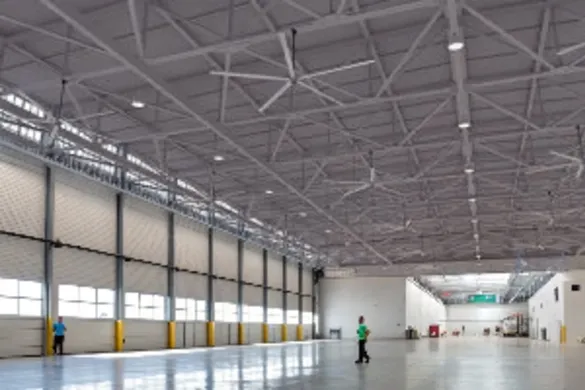
Alto livello di voltura (high-volume, low-speed) fans move a lot of air gently across a wide area. A single ventilatore hvl can support broad airflow throughout a zone and reduce stagnant air pockets. For grandi spazi, this is usually more efficient than relying only on many small high-speed fans.
As an HVLS fan manufacturer, we typically recommend HVLS when a site needs:
- Whole-zone comfort across a large area
- Meglio airflow throughout the facility
- Lower noise than many smaller fan units
- Less obstruction on the floor (vs too many portable units)
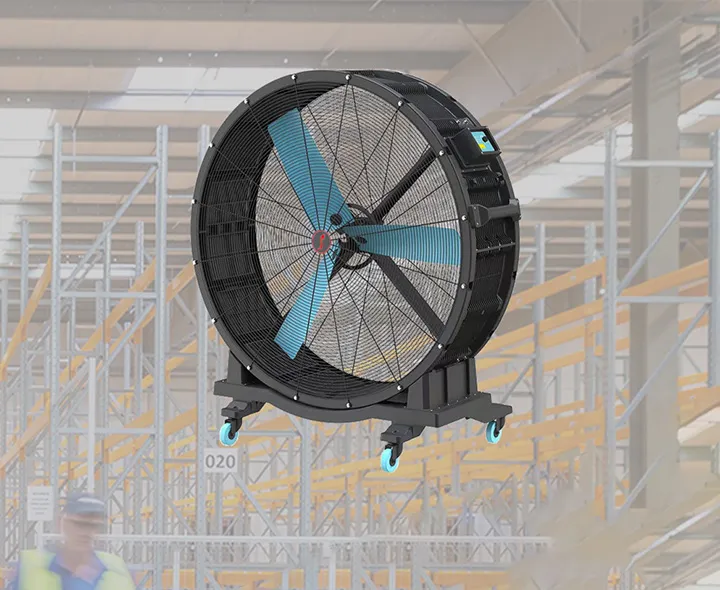
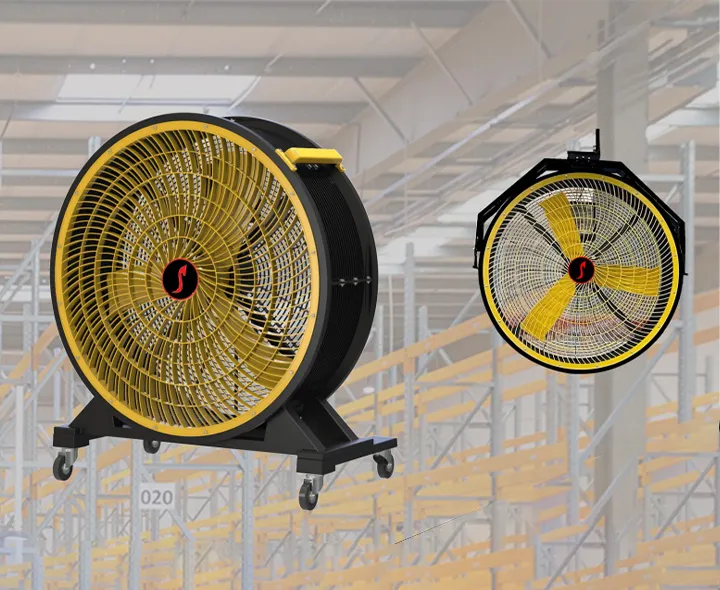
You may also use ventilatori da magazzino, grandi fan, O portable industrial fans in problem zones, but HVLS is often the backbone for cooling warehouse spaces efficiently.
Fans vs. AC (practical view)
- I fan creano perceived cooling by moving air
- AC lowers air temperature (actual cooling)
- Best outcome is often fans + targeted AC, not AC everywhere
If your question is “Can I cool a warehouse without ac?” the answer is often yes for comfort-focused applications—if the building has decent ventilation, manageable humidity, and good fan design.
When do you need air conditioning units in a warehouse?
Utilizzo proper air conditioning when your operation requires tight temperature or humidity control, not just worker comfort. Full-building AC can be expensive in an entire building with high ceilings and frequent door openings, so it is usually best reserved for specific conditions.
You likely need air conditioning if:
- Products are heat-sensitive
- Electronics/packaging quality suffers in heat
- Compliance requires stable conditions
- Offices or enclosed process rooms need consistent cooling
- Humidity control matters as much as temperature
In many projects, we recommend zoning:
- Air conditioning for offices, QC labs, control rooms
- Fans + ventilation for open aisles and staging zones
- Spot cooling for fixed workstations
This hybrid setup improves comfort while controlling costi energetici.
Common AC choices in warehouses
- Packaged rooftop units
- Ducted hvac cooling and ventilation
- Mini-splits for enclosed rooms
- Portable air conditioners / portable cooling units for temporary or changing areas
Portable air conditioners can work well for seasonal demand, but they should not replace a long-term plan in high-load areas. They are best for short-term relief or shifting production zones.
What are the best warehouse cooling solutions for staff work zones?
If your biggest issue is people—not products—focus on where people stand and work. This is usually the fastest path to better comfort and higher produttività.
OSHA and workplace heat guidance consistently emphasize engineering controls (airflow, fans, cooling, ventilation) as practical heat-risk reduction tools.
Best warehouse cooling solutions for worker zones
- HVLS + directional airflow
- Use an HVLS fan for wide coverage
- Add ventilatori direzionali where racks or walls block flusso d'aria
- Spot cooling at fixed stations
- Packing benches
- Quality check stations
- Loading paperwork desks
This is where raffreddamento spot gives strong ROI.
- Evaporative cooling (climate-dependent)
- Evaporative coolers can be effective in dry climates
- They can push aria più fresca and improve comfort in open or semi-open buildings
- In humid climates, performance drops
- Shaded/loading dock improvements
- Reduce direct sun and heat infiltration at open doors
- Help keep employees cool at high-traffic points
Simple zone design example
| Zone |
Cooling Goal |
Best Option |
| Picking aisles |
General comfort |
HVLS + balanced ventilation |
| Packing line |
Worker relief |
Spot cooling + fans |
| Shipping docks |
Heat infiltration control |
Dock seals + fans + shade |
| QC room |
Stable conditions |
AC / dedicated HVAC |
| Maintenance bay |
Flexible cooling |
Portable cooling units + fans |
This approach helps effectively cool people where they feel heat most—without overcooling unused floor space.
How do ventilation systems remove hot air and improve airflow throughout the facility?
A fan alone is not a full solution if the building cannot exhaust heat. A good sistema di ventilazione should bring fresh air in and move heat out. Think of it this way: you want air into the warehouse, and you want trapped heat to leave.
Core ventilation principles
- Exhaust high, where aria calda accumulates
- Bring intake air low and strategically
- Avoid short-circuiting (air in and out too close together)
- Support fan placement so airflow reaches occupied zones
This is how you improve airflow throughout e mantenere airflow throughout the facility rather than just spinning hot air in one area.
For some buildings, roof vents + wall louvers + fan layout can dramatically improve comfort. In others, a mechanical ventilation upgrade is needed—especially if process heat, fumes, or dust are present. OSHA ventilation standards also stress proper exhaust design for hazardous contaminants.
Practical tip
Do not place fans where they push hot inside air with cool intake streams in a way that cancels your ventilation path. Fan direction and vent placement must work together.
How can you reduce heat from machinery and other heat sources?
One of the most overlooked ways to cool a facility is to reduce the heat generated inside it. If you only add cooling but ignore process heat, your systems will run harder than necessary.
Internal heat reduction ideas
- Isolate high-heat equipment
- Add local exhaust over heat-generating processes
- Schedule heat-heavy tasks during cooler hours
- Maintain motors, bearings, and compressors (inefficiency = extra heat)
- Shield radiant heat sources where people work nearby
If you can reduce heat at the source, you need less cooling capacity to keep warehouse employees cool. California indoor heat guidance also points to isolating workers from heat sources and local ventilation as useful controls. (dir.ca.gov)
This matters in factories and manufacturing warehouses where process heat can create a constant heat building effect even on mild days.
What cooling options work best for different warehouse types?
Non tutti magazzino has the same needs. A food distribution center, sports goods warehouse, and metal fabrication facility will not use the same cooling strategy.
Cooling options by warehouse type
1) General storage warehouse
- HVLS + ventilation
- Dock sealing
- Roof/insulation upgrades
- Optional localized AC in offices
This is often enough to maintain a warehouse cooler ambiente.
2) Manufacturing warehouse
- HVLS + local exhaust + process isolation
- Additional fan coverage around hot lines
- Targeted AC in precision areas
- Evaporative systems in dry climates (if suitable)
3) Gym / sports facility (warehouse-style building)
- Strong flusso d'aria
- HVLS over activity zones
- Dehumidification / AC depending on climate and occupancy
4) Schools or multipurpose halls in warehouse-style structures
- Comfort + noise + safety balance
- Zoned ventilation and fan placement
- Limited AC for high-occupancy rooms
5) Cold storage
This is different. In cold storage, the focus is maintaining low temperatures and reducing infiltration. Here, fan strategy and door management are about preserving aria fredda, not comfort cooling. High-speed doors, sealing, and minimizing openings matter far more than general warehouse fan cooling.
How do warehouse owners build a practical cooling plan and control energy costs?
This is where strategy beats equipment shopping. Smart warehouse owners build a phased cooling plan based on risk, comfort, and ROI.
A practical phased cooling plan
Phase 1: Low-cost fixes (fast wins)
- Seal leaks and dock gaps
- Rebalance existing fans
- Improve vent operation
- Add worker-zone fans
- Measure temperature/humidity regularly
Phase 2: Heat-load reduction
- Roof upgrades / cool roof
- Insulation improvements
- Shade for loading areas
- Process heat management
Phase 3: Core airflow system
- Install HVLS or optimized ventilatori da magazzino
- Improve ventilation path
- Validate movimento dell'aria and worker comfort
Phase 4: Targeted conditioning
- Add AC to enclosed rooms or critical zones
- Utilizzo portable air conditioners as temporary support
- Tune controls for controllo della temperatura
Cost-control reminders
- Don’t oversize a cooling system
- Cool occupied zones first
- Match technology to climate (e.g., evaporative coolers in dry regions)
- Verify performance after installation
A good system should help cool the building while also improve the efficiency of existing HVAC operation (where present) by reducing stratification and hot spots.
Case example: A practical warehouse cooling upgrade path
A mid-sized distribution facility in a hot climate asked how to cool your warehouse without replacing everything. The main complaints were heavy summer heat, low comfort at packing stations, and rising bills.
What changed
- Added roof reflective coating (cool roof) and dock seals
- Repositioned exhaust and intake to improve ventilation path
- Installed HVLS for broad flusso d'aria
- Added localized fan + portable cooling at packing stations
- Kept AC only in offices and QC room
Outcome (operational impact)
- Better comfort on the floor
- Fewer heat complaints
- More stable picking/packing pace
- Lower AC runtime in conditioned zones
This is a common pattern: you do not always need full-building AC to warehouse cool effectively. You need the right combination of warehouse cooling solutions for your building and process.
Common mistakes that make a warehouse stay hot
- Installing fans without ventilation planning
- Using AC for the whole building when only a few zones need it
- Ignoring roof heat gain
- Blocking airflow with rack layout changes
- Forgetting maintenance on existing hvac systems
- Choosing equipment before measuring conditions
Se vuoi un cool warehouse, start with the building, then airflow, then zone cooling.
Domande frequenti
Is air conditioning the only way to cool a warehouse?
No. Many facilities can improve comfort with fans, ventilation upgrades, roof heat reduction, and targeted worker-zone cooling. AC is often best used in enclosed rooms or critical areas rather than across the full open warehouse.
Do HVLS fans actually lower temperature?
HVLS fans usually do not reduce the measured air temperature much on their own. They improve comfort by increasing air speed and evaporation on the skin, which creates a stronger perceived cooling effect.
What is the best option for cooling warehouse spaces in a hot, dry climate?
A combination of ventilation, fan-driven airflow, and evaporative coolers can work very well in dry climates. In humid climates, evaporative cooling is less effective, so a different mix is usually better.
How can I keep warehouse employees cool near loading docks?
Focus on dock seals, shade, airflow direction, and spot cooling at fixed stations. Docks often have high heat gain and frequent air exchange, so local improvements can make a big difference.
Can portable air conditioners cool a large warehouse?
Not efficiently by themselves. Portable air conditioners are helpful for temporary or localized cooling, but they are usually not the best solution for the full open floor of a large warehouse.
What should I check before choosing warehouse cooling equipment?
Check roof heat gain, insulation condition, airflow dead zones, worker locations, ventilation path, process heat sources, and operating hours. A short audit prevents expensive mistakes.
Final takeaway summary
- Start with a heat audit before buying equipment.
- Reduce heat gain first (roof, insulation, dock sealing) to cut cooling load.
- Utilizzo HVLS/fans + ventilation to improve comfort across wide areas.
- Apply raffreddamento spot where people actually work.
- Utilizzo aria condizionata strategically for enclosed or temperature-sensitive zones.
- Match cooling methods to your climate (especially for evaporative systems).
- Build a phased plan to improve comfort, safety, and costs over time.
- The best results usually come from a combined system, not one product alone.
If you want, I can also generate a conversion-focused version of this article for your website (with a stronger factory CTA, internal links, and product section for your HVLS fans).