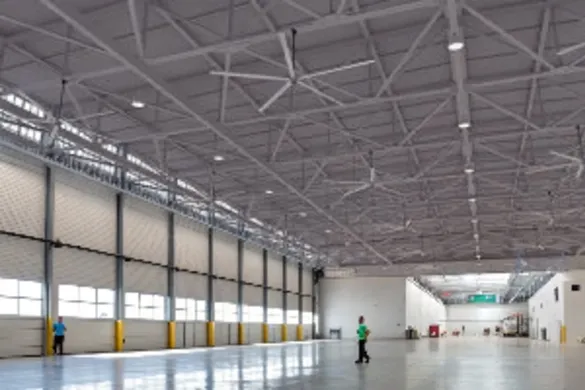
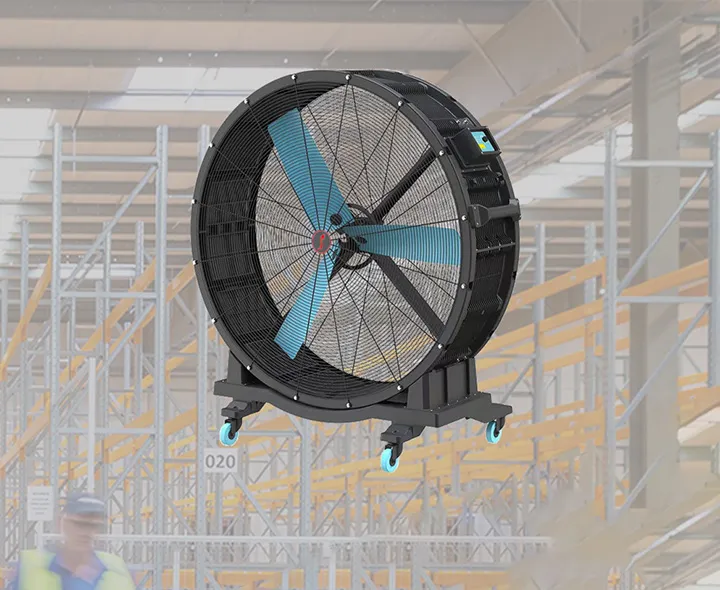
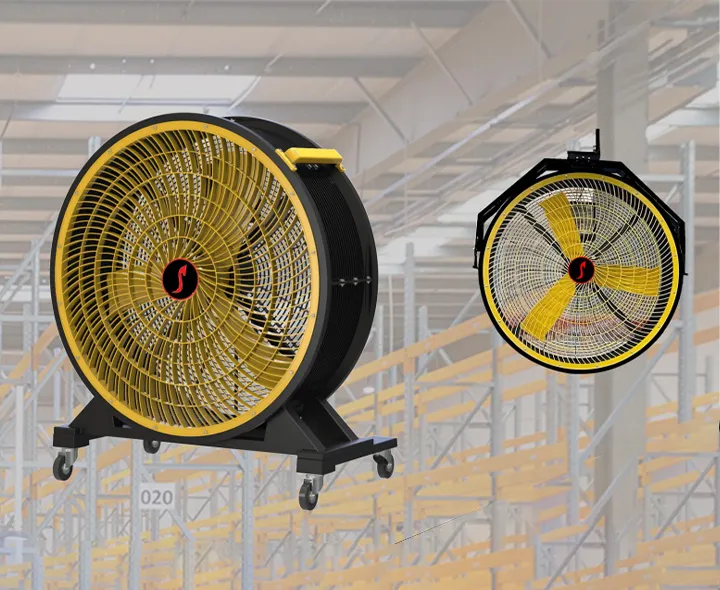
Hot bays, cold corners, fumes, and sweaty crews can turn a shop into a comfort and safety problem. Poor airflow also makes it harder to control humidity and keep temperatures steady. An hvls fan fixes this by creating consistent air movement across the work zone—without the noise and chaos of floor fans.
An hvls fan improves comfort and air quality in automotive and heavy equipment spaces by moving large volumes of air gently across the floor, mixing warm air that collects near the ceiling, supporting ventilation, and lowering HVAC workload. In large facilities, this stable airflow helps reduce hotspots, improve perceived cooling, and can cut energy costs when paired with heating and cooling systems.
Outline
- What is an hvls fan, and why do automotive shops use it?
- How does HVLS airflow actually behave in a workshop?
- Why air movement matters more than “cold air” in large bays
- Can HVLS help air quality (fumes, dust, welding smoke)?
- How to improve air quality without overloading your HVAC system
- Where should you place large fans in a service bay layout?
- What size and how many fans do you need for large facilities?
- HVLS vs conventional fans: why one big fan can beat multiple smaller fans
- What should you ask a manufacturer before investing in hvls fans?
- Real-world results: productivity, comfort, and cost savings (mini case study)
1) What is an hvls fan, and why do automotive shops use it?
An hvls fan means “high-volume, low-speed.” The idea is simple: large diameter blades rotate slowly, but they move large volumes of air across a wide area. Many units are ceiling fans built for commercial and industrial buildings, including repair bays, inspection lines, tire centers, and heavy machinery service halls.
In an automotive environment, you’re not just cooling people—you’re managing the whole room: heat from engines, radiant heat from the roof, doors opening all day, and equipment that throws off moisture and fumes. HVLS fans help because they create consistent air movement where technicians actually work—at tool height, lift height, and around vehicles.
As a factory that builds these systems for industrial clients, we focus on what you care about most: coverage, reliability, easy maintenance, and measurable reduction in HVAC strain. When hvls fans work well, you feel it within minutes: less stagnant air, fewer hot pockets, and fewer complaints from crews.
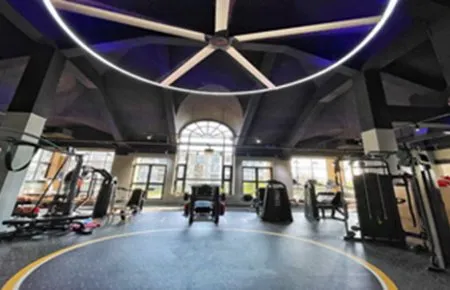
2) How does HVLS airflow actually behave in a workshop?
Here’s what happens when fan blades push air downward at low speed: a wide, slow column of air reaches the floor, then spreads outward like a gentle “floor jet.” That spreading pattern is why a single hvls fan can cover a big bay without blasting people in the face. The goal isn’t high wind—it’s steady mixing.
In practical terms, you get:
- airflow that reaches into work zones
- fewer dead zones behind lifts and parts racks
- less temperature layering (hot at the roof, cold at the floor)
This matters in open spaces like service halls because big buildings naturally stratify. Warm air rises and stays trapped up top. HVLS circulate that heat back down in winter, and in summer they help you feel cooler at a higher thermostat setting.
3) Why air movement matters more than “cold air” in large bays
A lot of facility managers chase “more cooling,” but the real win is air movement and temperature control. When you move air across skin, it speeds up evaporation of sweat. That makes people feel cooler even if the air temperature doesn’t drop much.
That’s why ventilatori hvls can help you reduce reliance on mechanical cooling. In many facilities, you can raise the thermostat setpoint a bit while keeping comfort the same—reducing energy costs and overall energy use.
In our project discussions with workshops, the “aha moment” usually happens when we map comfort complaints to airflow gaps. Once you fix the mixing, the building feels more evenly controlled—consistent air instead of “hot here, cold there.”
4) Can HVLS help air quality (fumes, dust, welding smoke)?
Yes—within the limits of what a fan can and cannot do.
An hvls fan does not “filter” air. But hvls fans help maintain better indoor air quality by preventing stagnant pockets where fumes and particulates linger. When you coordinate the fan with your ventilation plan (fresh air intake + exhaust), the fan improves distribution so your system works the way it was intended.
Vedetela così:
| Problem in the bay |
What the HVLS does |
What you still need |
| Welding smoke hangs under the roof |
Mixes layers, pushes air throughout the facility |
Local source capture + ventilatori di scarico |
| Vehicle exhaust odor lingers |
Improves circolazione dell'aria and reduces dead zones |
Proper tailpipe extraction + make-up air |
| Dust from grinding/traffic |
Keeps particles from settling unevenly; supports dilution |
Filtration, housekeeping, source control |
ASHRAE has also discussed destratification effects in large high-bay spaces, noting that reducing hot air trapped at the ceiling can reduce HVAC load.
So yes—HVLS supports air quality by improving mixing and helping your ventilation do its job “everywhere,” not just near a supply grille.
5) How to improve air quality without overloading your HVAC system
In industrial facilities, it’s common to see a tug-of-war:
- You need more fresh air for air quality
- But more fresh air can increase heating/cooling demand
A smart approach is pairing fresh air strategy with HVLS mixing:
- Use the HVAC or make-up air system for temperature and code-required ventilation.
- Use the hvls fan to circulate air so you don’t need to over-ventilate to fix “stale corners.”
- Use targeted extraction at the source: tailpipe hoses, welding arms, or capture hoods.
This is where HVLS becomes a “multiplier.” air movement from hvls fans helps the conditioned air reach the floor more effectively, so the HVAC isn’t fighting stratification all day. In winter, it also pulls warm air down from the roof zone—helping reduce wasted heat near the ceiling.
Some industry reports and case studies show meaningful heating reductions when destratification is addressed. For example, a warehouse case report (University of Leeds collaboration) observed peak savings in the ~40–45% range under certain cold outdoor conditions in tall spaces. Results vary, but it shows why mixing matters.
6) Where should you place large fans in a service bay layout?
Placement is where projects succeed or fail.
In un automotive shops layout, I look at:
- bay spacing and lift locations
- crane paths, door travel, and lighting
- obstructions like ductwork, signage, and reels
- where people stand for the longest time (diagnostics, alignment, assembly)
General placement rules we use:
- center the fan over the highest-occupancy zone
- avoid placing the fan directly above heavy obstruction clusters
- keep airflow “clean” over work areas, and coordinate with supply/exhaust direction
If your facility includes paint prep or welding zones, we usually segment airflow: HVLS for general mixing, and dedicated ventilation for hazardous processes.

applicazione ventilatori hvls
7) What size and how many fans do you need for large facilities?
This is the question procurement teams love because it turns chaos into a plan.
Sizing depends on:
- altezza del soffitto
- bay geometry
- heat sources
- whether you want summer comfort, winter destratification, or both
- how your heating and cooling systems are arranged
A quick way to think about it:
- One properly selected large ceiling fans unit can cover a wide floor area by moving massive volumes of air gently.
- Too small, and you’ll need more fans and more complexity.
- Too big, and you risk installation conflicts or uneven patterns.
Also, when you compare “air moved per watt,” HVLS often wins because it moves high-volume air at low speed rather than trying to blast a jet. (Selection and performance guidance is often tied to standardized testing; see the ASHRAE Philly presentation noting AMCA testing/certification references for HVLS performance claims: ASHRAE HVLS presentation PDF (ASHRAE Philly))
8) HVLS vs conventional fans: why one big fan can beat multiple smaller fans
A common debate is large fans vs floor units.
Here’s the field reality:
- floor fans create high-velocity jets that feel good in one spot, but don’t fix the building.
- conventional fans often add noise, clutter, and maintenance points.
- hvls fans help you mix the entire space, which is what large buildings need.
In many bays, replacing “a bunch of fans everywhere” with one or two ceiling-mounted HVLS units gives:
- fewer trip hazards and blocked aisles
- less maintenance and fewer motors to service
- smoother air throughout the facility
That’s why “one big fan” is often simpler than multiple smaller fans—especially in high-bay areas.
9) What should you ask a manufacturer before investing in hvls fans?
If you’re serious about investing in hvls fans, don’t start with price. Start with proof.
Here’s a buyer checklist I recommend:
Performance & verification
- Is airflow performance tested to recognized standards (ask for test reports and certification references)?
- Can you show volumes of air moved and expected air speed at the floor?
Design & safety
- What are the safety features (mounting, retention, controls)?
- What’s the max noise and how is it measured?
Controls & integration
- Can it coordinate with the hvac system or air conditioning systems?
- Do you offer zoning, scheduling, and seasonal modes?
Serviceability
- How often do bearings and gearboxes need inspection?
- What spare parts are stocked?
Total cost
- expected energy bills impact (not guesses—assumptions + model)
- install requirements and lead time
In short: you’re not buying a fan, you’re buying climate control stability for a production environment.
10) Real-world results: productivity, comfort, and cost savings (mini case study)
Mini case: heavy equipment workshop (high bay + long shifts)
- high ceilings, wide doors, big heat loads from machinery
- summer: crews complained of “hot pockets”
- winter: heaters ran constantly, but the floor still felt cold
What we did
- installed an HVLS system designed to circulate large volumes of air
- tuned it for summer comfort and winter destratification
- coordinated with ventilation so airflow didn’t fight exhaust
What changed
- more even temperatures at technician level (air more evenly distributed)
- fewer “move the fan over here” interruptions
- reported improvement in comfort, which supports employee comfort and reduces fatigue
Now, I’m careful with productivity claims because every facility differs. But it’s common sense: when people aren’t overheated, workflow stays smoother. That’s why many facility articles link comfort improvements to better output and fewer slowdowns.
A simple “before vs after” comfort map (illustrative)
Hotspots before: ████████ Cold corners: █████
After HVLS mix: ████ Cold corners: ██
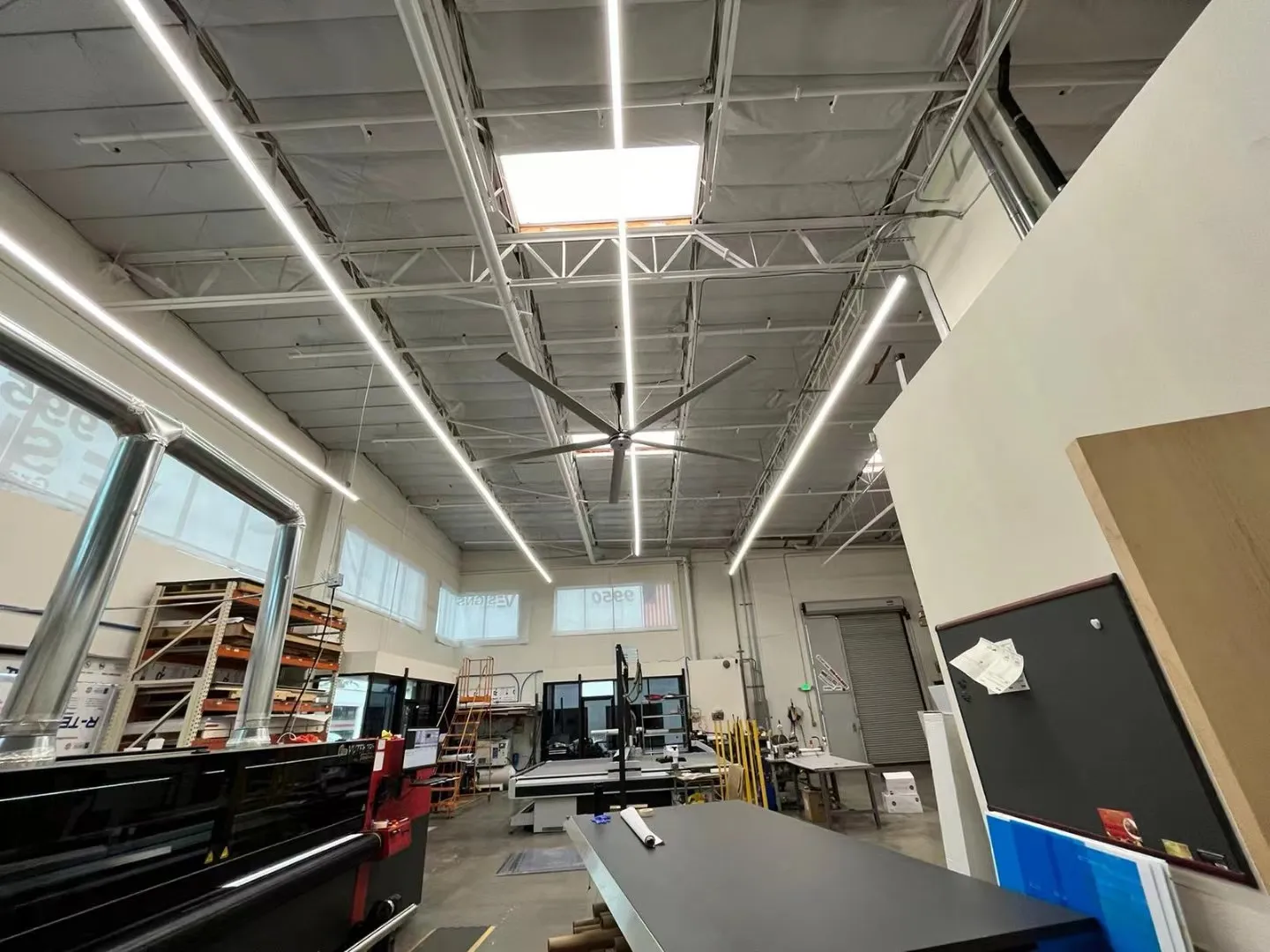
Ventilatore HVLS in un grande stabilimento industriale
Domande frequenti
Do HVLS fans replace ventilation systems?
No. An hvls fan supports ventilation by mixing air so fresh air and exhaust systems work more effectively, but it doesn’t remove contaminants by itself. Use proper extraction for fumes and dust.
Will an HVLS fan help with humidity?
Yes. Better mixing and air circulation helps manage humidity levels by reducing stagnant zones where moisture builds up, especially near doors and wash areas. It won’t dehumidify like HVAC equipment, but it can stabilize conditions.
How do I know what the best hvls fan is for my facility?
The best hvls fan is the one sized for your ceiling height, layout, and goals (comfort vs destratification vs both), with verified performance data and safe mounting. Ask for test-backed airflow specs and an application layout plan.
Can HVLS fans reduce heating costs in winter?
Often, yes—because they bring warm air down and reduce stratification. Some industry sources cite typical winter reductions (often in the 20–30% range) depending on building type and controls.
Are HVLS fans safe around cranes and lifts?
They can be, if planned correctly. We coordinate fan placement with crane travel, lift height, sprinklers, and lighting. This is why layout drawings matter as much as the fan itself.
What maintenance should I expect?
Most systems need periodic inspection (mounting, fasteners, controls) and scheduled checks for drivetrain components depending on design. A good manufacturer will provide a clear service interval and spare parts plan.
Sources (for further reading)
Punti di forza
- An hvls fan is built to move large volumes of air gently—perfect for large bays and high ceilings.
- In automotive and heavy equipment halls, stable airflow improves comfort and supports safer, cleaner air quality strategies.
- HVLS works best when paired with smart ventilation and source capture (exhaust extraction, welding capture).
- Destratification matters: pulling warm air down reduces waste and can lower heating demand.
- Don’t buy on price alone—buy on verified performance, layout engineering, and service support.
- If you want consistent comfort with less energy, use hvls fans as part of a complete heating and cooling plan.
If you want, I can also turn this into a “publish-ready” page package (Meta Title/Description, internal link anchors, image alt text, and a buyer checklist download block) aligned to your HVLS fan factory positioning.