Hot spots, sticky air, and uneven temperatures don’t just feel bad—they hurt output and push your HVAC harder. In big buildings, “more AC” often isn’t the smartest fix. The better solution is steady air movement: an Ventilatore HVLS designed for large, open spaces.
Ventilatori da soffitto industriali di grandi dimensioni Sono high-volume low-speed fans that move enormi quantità di aria gently across a large area, improving comfort and helping facilities cut energy waste. In factories, a magazzino, gyms, and other spazi commerciali, il diritto ventilatore da soffitto strategy supports controllo della temperatura, helps reduce consumo di energia, and can lower heating and cooling costs through better circolazione dell'aria and destratification.
Outline
- What is an ventilatore hvl, and why do big industrial buildings choose it?
- How does an ventilatore da soffitto hvls create powerful flusso d'aria A bassa velocità?
- Which size fits your site: 8 piedi hvls, VHS da 10 piedi, VHS da 12 piedi, and more?
- Where do fans for warehouses and other spazi industriali work best?
- Comfort science: aria circolante, destratifying aria calda, and how fans improve comfort
- Energy + HVAC: how fans reduce energy and help reduce energy costs
- What to check before buying: pale del ventilatore, safety, convertitore di frequenza control, and reliability
- Layout and installation basics for large areas, soffitti alti, and real metratura quadrata
- FAQs + a quick buying checklist (and how to request a quote)
What is an HVLS fan, and why do big industrial buildings choose it?
UN hvls industrial fan is a large-diameter ceiling fan built to move a lot of air slowly. Many experts define it as a fan over 7 feet in diameter, made for big spaces like hangars, factories, and distribution buildings.
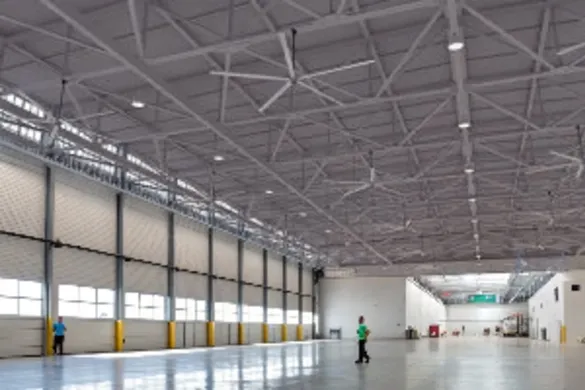
Here’s the simple reason these systems win in big industrial sites: a single large fan can cover a wide zone with smooth, even air movement—without the noise and “wind tunnel” feel you get from many fast-spinning units. That’s why planners use them in spazi industriali E industriale e commerciale projects where comfort and operating cost matter every day.
From our side as an HVLS fans stabilimento di produzione, this is exactly what we design for: consistent performance across grande industriale footprints, long run-hours, and easy control for facility teams who don’t want complexity.
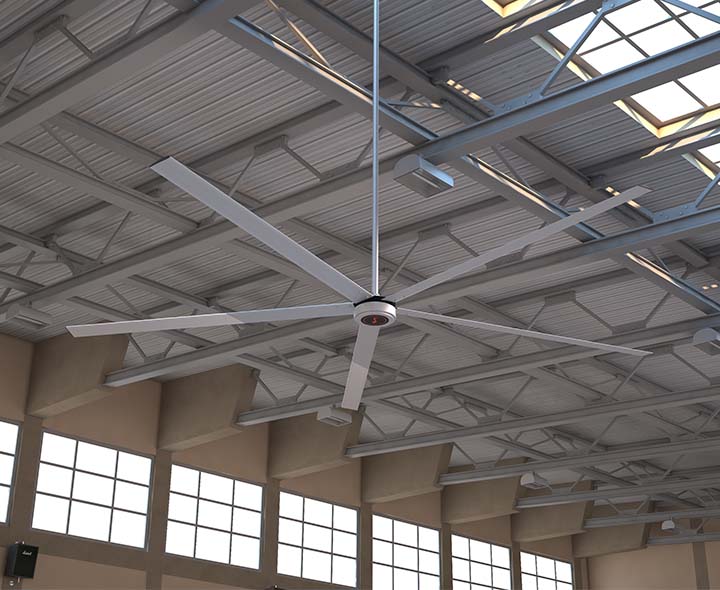
HVLS fan in a big industrial building
How does an HVLS ceiling fan create powerful airflow at low speed?
The magic is not “more RPM.” It’s grande diametro plus blade design. An ventilatore da soffitto hvls uses long pale del ventilatore to push a large column of air downward and outward. The result is a gentle, wide flusso d'aria pattern that reaches people and equipment across large zones.
You’ll often hear the phrase:
“High-Volume, Low Speed.”
That name fits. These low-speed fans muoversi volumi d'aria and keep the environment feeling cooler through steady movimento dell'aria (your body sheds heat faster when air moves across the skin). They don’t need to “blast” to work.
In practice, the fan provides the most value when your building has soffitti alti and uneven temperatures. In these sites, industrial ceiling fans move air where it needs to go—down to the occupied zone—so people feel the benefit, not just the roof.
Which size fits your site: 8 foot HVLS, 10 foot HVLS, 12 foot HVLS, and more?
Sizing is where most projects succeed—or struggle. A typical HVLS diameter range is roughly 7–24 feet, and larger diameters generally cover more space.
Here’s a usable “starting point” table (always confirm with a layout plan and obstructions):
| Fan size (diameter) |
Typical coverage (open area) |
Best-fit examples |
| 8 piedi hvls |
~2,000–3,000 sq ft |
smaller production zones, corridors, light assembly |
| VHS da 10 piedi |
often ~3,000–4,500 sq ft (site dependent) |
mid-size work cells, loading zones |
| 12 piedi / VHS da 12 piedi |
~4,000–6,000 sq ft |
standard factory bays, many warehouse aisles |
| 16–20 ft |
~8,000–16,000 sq ft |
large commercial floors, big production lines |
| 24 piedi |
~18,000–20,000 sq ft |
extra-large bays and open hubs |
A quick way to think about it:
- Start with metratura quadrata and ceiling height (foot ceiling constraints matter).
- Then check obstacles (cranes, lights, sprinklers, racks).
- Then model the spacing and speed range.
Also, don’t assume “one giant fan” is always best. Sometimes single hvls coverage is perfect. Other times, two smaller units fit the structure better and give smoother control zones.
Where do HVLS fans work best in industrial spaces and commercial spaces?
If you manage a magazzino, you already know the pain: hot aisles, cold corners, and workers who feel it first. HVLS units are popular as fans for warehouses because they improve mixing without creating dust storms or annoying drafts.
Common high-return locations include:
- Manufacturing halls and assembly floors (steady comfort helps output)
- Distribution and a storage facility (helps reduce humidity pockets and mold and mildew risk in stagnant zones)
- UN palestra or fitness center (comfort + perceived cooling with lower HVAC load)
- Schools and large halls (quiet, wide-area comfort)
- sports facilities (even air movement over wide courts)
Yes—even a fienile environment often uses HVLS-style airflow for animal comfort and air quality improvement in agricultural settings.
Per industrial hvls projects, we usually map zones by function: people density, heat sources, door traffic, and any process that needs stable conditions.
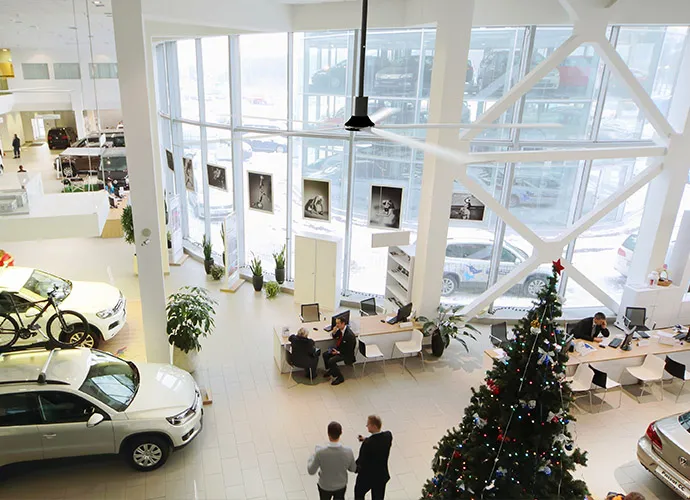
Applicazione dei ventilatori in grandi edifici commerciali
Comfort science: circulating air, destratifying warm air, and how fans improve comfort
Big buildings often stratify: hot air rises and collects under the roof while the floor stays cooler (or the opposite in summer near large doors). HVLS helps by aria circolante through the full volume of the building, which supports better controllo del clima and helps eliminate hot spots.
In winter, the key idea is destratifying. You’re not “making heat.” You’re bringing aria calda down where people work. ASHRAE has published research and professional discussions showing HVLS destratification can reduce heating energy in large high-bay buildings under the right conditions.
In summer, moving air makes people feel cooler, even if the thermostat stays the same. That’s why facility managers report i fan aiutano keep teams more comfortable and workers cool in high-activity zones—without needing to over-chill the whole building.
Energy + HVAC: how fans reduce energy and reduce energy costs
Here’s the blunt truth: HVAC is expensive in big-volume buildings. And when you fight stratification with HVAC alone, you often pay twice—once to heat/cool, and again because the air sits in the wrong place.
HVLS supports your riscaldamento, ventilazione e condizionamento sistema instead of competing with it. When air mixes better, you can often:
- Raise cooling setpoints slightly while maintaining comfort
- Reduce heater runtime in winter because heat reaches the floor
- Improve temperature uniformity, which cuts complaints and rework
Industry presentations and case studies commonly report meaningful savings (for example, ASHRAE chapter materials often cite heating/cooling reductions in some scenarios). Your exact result depends on run-hours, building envelope, and controls strategy—so treat savings as a modeled target, not a promise. A simple visual: “before vs after” energy waste (concept chart)
Heating/Cooling Waste (relative)
Before HVLS: ██████████
After  HVLS: ██████
The goal is meno energia lost to stratification and uneven zones—especially in facilities with tall roofs and frequent door openings.
What to check before buying: fan blades, VFD control, safety, and reliability
When you compare Opzioni del ventilatore, don’t stop at diameter. Check the build and the control system.
Key items procurement teams should validate:
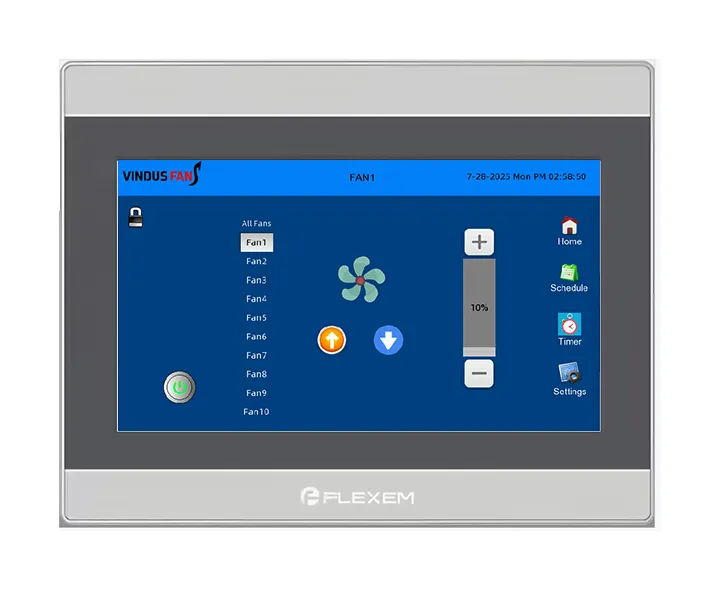
- convertitore di frequenza speed control: smoother ramp-up, better tuning for seasons and zones
- Blade design + balancing: stable operation, low vibration, consistent flusso d'aria potente
- Safety features: secondary retention, mounting engineering, compliance docs
- Serviceability: parts availability, clear maintenance steps
- Durability: for us, this is where “factory thinking” matters—materials, coatings, fasteners, and QC checks
In plain words: hvls fans are built for long duty cycles. The best ones are costruito per durare, because industrial sites don’t want frequent downtime. When we say fans are built to last, we mean the entire lifecycle—mechanical design, controls, and after-sales support.
Also consider your environment: dust, humidity, chemical exposure, and cleaning practices all affect coating selection and IP requirements.
Layout and installation basics for large areas and high ceilings
Great products can still underperform if placement is wrong. Layout should follow how air actually travels in your building.
A practical layout process:
- Measure real metratura quadrata and identify obstructions
- Confirm ceiling height and structure (trusses, beams, slab)
- Decide whether you want one large unit or multiple zones
- Plan seasonal strategy (summer comfort vs winter destratification)
- Integrate with riscaldamento, ventilazione e condizionamento controls where possible
One common mistake is installing too close to racks or blocking the downwash path. Another is treating HVLS like “multiple small fans.” The whole point is to replace più piccoli ventilatori with fewer, smarter units that move air broadly and smoothly.
If your site is designed for large open bays, HVLS is usually straightforward. If you have mixed ceilings, mezzanines, or cranes, we recommend a quick engineering review and a layout drawing before you buy.
HVLS vs multiple small fans: what’s more cost-effective?
This is the decision many teams face: “Should we install a few HVLS units or lots of smaller high-speed fans?”
Here’s a clear comparison:
| Topic |
HVLS approach |
Many small fans |
| Copertura |
Moves air across large areas |
Local zones, often uneven |
| Comfort |
Smooth, low draft |
Can feel harsh or noisy |
| Controllare |
Central + speed tuning |
Many devices to manage |
| Manutenzione |
Fewer units |
More motors, more points of failure |
| Energy |
Often more ad alta efficienza energetica for whole-space mixing |
Can add up fast in total kW |
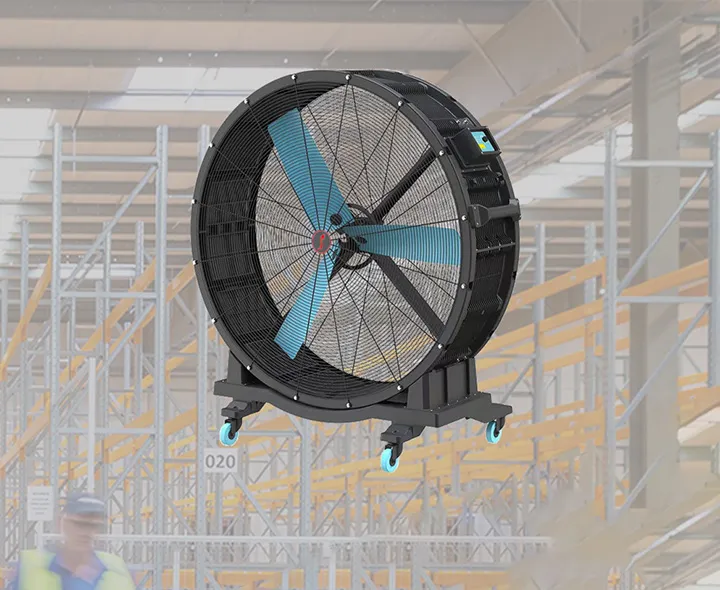
HVLS shines when you need to move large air patterns across a grande spazio. Smaller fans can still make sense for tight corners, machine enclosures, or areas with very low ceilings.
If your goal is to improve comfort for the whole floor, HVLS is usually the most conveniente path—especially when paired with a smart HVAC strategy.
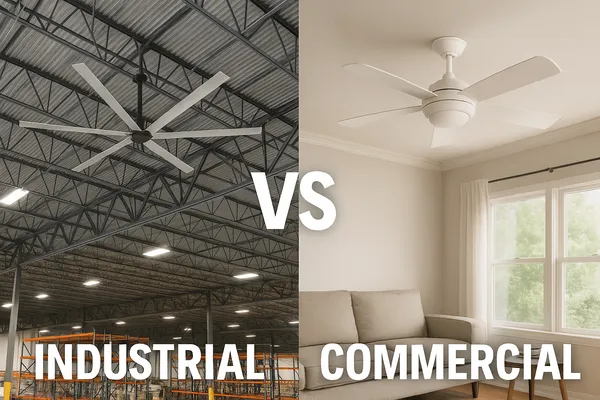
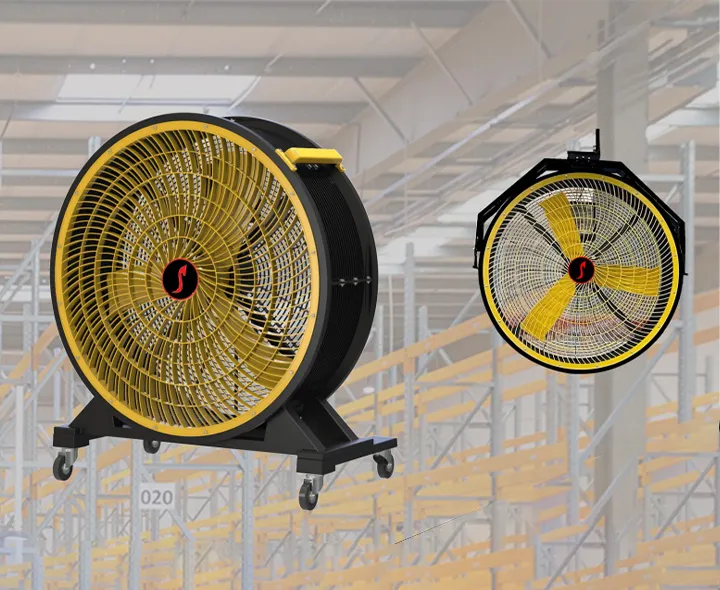
HVLS vs multiple small fans
FAQs about industrial HVLS fans
How many HVLS fans do I need for my warehouse?
Start with your metratura quadrata, ceiling height, and obstructions. Many projects use coverage ranges like 4,000–6,000 sq ft for a 12-ft class fan, but layout and racking change the result. A quick plan drawing is the fastest way to get the right count.
Will an HVLS fan make the building colder in winter?
If set correctly, no. In winter you usually run it slowly for destratification, pushing trapped aria calda down. That supports comfort and can reduce heating waste.
Do HVLS fans work with HVAC?
Yes—HVLS supports riscaldamento, ventilazione e condizionamento by improving mixing. Better mixing often lets you reduce over-conditioning and improve temperature consistency across zones.
What ceiling height do I need?
It depends on diameter and local codes, but HVLS is most common in soffitti alti where stratification is a real problem. Always confirm clearance from lights, sprinklers, cranes, and walking paths.
How loud are HVLS fans?
Most are quieter than fast-spinning fans because they run at bassa velocità rotation. Noise still depends on motor type, balancing, and installation.
What data should I send for a quotation and layout?
Send: building length/width, ceiling height, beam layout, obstructions, rack height, door locations, heat sources, and your goals (comfort vs destratification vs ventilation). That lets us recommend the right ventilatori da soffitto commerciali strategy for your site.
Quick checklist before you request pricing
- Your building’s dimensions and metratura quadrata
- Ceiling height and structure notes (soffitti alti vs mixed levels)
- Any cranes, sprinklers, lights, or ductwork conflicts
- The problem you’re solving: comfort, hot spots, humidity, or energy
- Your preferred control approach (manual vs automation + BMS)
- Target areas: magazzino aisles, loading docks, assembly lines, public halls
If you want, share your floor plan and goals. As a manufacturing plant for HVLS products, we can propose sizing, layout, and a clear spec package that your contractor and safety team can approve.
Sources and further reading
Key takeaways to remember
- Ventilatore HVLS systems move quantità di aria smoothly at bassa velocità to improve comfort in big buildings.
- Sizing depends on real layout, not just diameter—use a coverage plan tied to your metratura quadrata.
- Better mixing can support riscaldamento, ventilazione e condizionamento, reduce hot/cold zones, and help risparmiare energia.
- Focus on the full sistema di ventilazione: controls (convertitore di frequenza), safety, blade design, and serviceability.
- A quick layout drawing is the fastest path to a high-performing installation.