The heat builds up, workers drag, and energy bills skyrocket — and nothing seems to fix it. The problem: poor air circulation + inefficient cooling in large spaces. The agitation: uncomfortable conditions, hot spots, high HVAC costs, unhappy staff, low productivity. The solution: high-volume, low-speed fans — big commercial ceiling fans that transform airflow and cut energy waste.
Big commercial ceiling fans — especially HVLS fans — move huge volumes of air at low speed, efficiently circulating air across large spaces like factories, gyms, warehouses, and commercial buildings to improve comfort and reduce energy costs.
Schema dell'articolo
- What is an HVLS fan and how does a big commercial ceiling fan work?
- Why do industrial ceiling fans outperform multiple small fans I might already use?
- How do HVLS ceiling fans reduce energy costs and lower HVAC load?
- In what types of commercial space does a HVLS fan shine — warehouses, gyms, manufacturing facilities?
- Can an HVLS fan improve air circulation and comfort in winter as well as summer?
- What ceiling height and fan size (8 foot, 10 foot, 12 foot or larger) do I need for my space?
- Are HVLS fans quiet, safe, and reliable enough for industrial and commercial environments?
- What are the long-term financial benefits and ROI for installing HVLS fans?
- How do HVLS fans integrate with existing HVAC systems in large commercial buildings?
- What should you consider when selecting the right fan options for your facility?
- Domande frequenti
What is an HVLS fan and how does a big commercial ceiling fan work?
When you think of a standard ceiling fan, you imagine something small — made for a living room or office. A big commercial ceiling fan, on the other hand, is a different beast. These are often referred to as Ventilatori HVLS — alto volume, bassa velocità fans. They come with long pale del ventilatore and a large diametro del ventilatore, and they rotate slowly but move massive volumes of air.
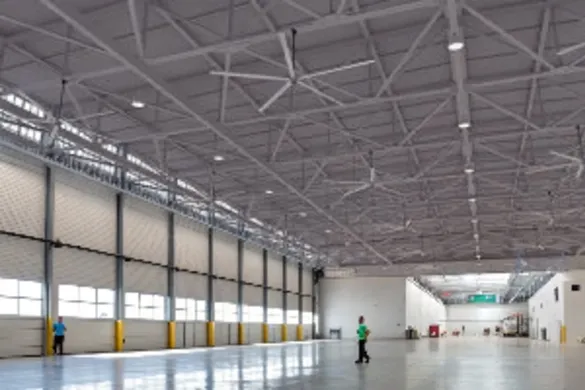
Because the blades are large and the motor is engineered for efficiency, an HVLS fan pushes air gently downward. This airflow sweeps across the floor, then rises along the walls in a continuous loop. Over time, the fan mixes the air in the room so that all corners — even behind racks or machines — get refreshed air. That’s the magic of circolazione dell'aria, movimento dell'aria, E destratificazione combinati.
In effect, a single HVLS fan can replace multiple smaller fans or even reduce reliance on HVAC systems — offering comfort, efficiency, and coverage over grande industriale O spazi commerciali that standard fans can’t handle.

What is an HVLS fan
Why do industrial ceiling fans outperform multiple small fans I might already use?
If you’ve tried lining a warehouse or gym with many small fans, you know the results: lots of spot-cooling, but still hot spots, uneven airflow, and inconsistent comfort. Industrial ceiling fans — especially HVLS — beat that by:
- Covering huge square footage with one unit. Because of their large-diameter blades, a single Ventilatore HVLS can move air across tens of thousands of square feet.
- Consistent and gentle airflow. High-speed small fans create drafts and noise. In contrast, HVLS fans deliver a smooth, even breeze at low speed — comfortable and stable even for long working hours.
- Lower energy consumption. Many small fans, or high-speed fans, draw more collective power. But HVLS fans are designed for efficienza energetica, moving air with minimal wattage while delivering maximum coverage.
- Less maintenance and longer life. Because HVLS fans spin slowly and are built for heavy-duty use, they suffer far less mechanical stress. That reduces maintenance needs and downtime compared to multiple smaller, high-velocity fans.
In short: fewer units, less power, more comfort. That’s a win for any commercial or industrial facility manager.
How do HVLS ceiling fans reduce energy costs and lower HVAC load?
One of the most compelling reasons to invest in big commercial ceiling fans is efficienza energetica E risparmio sui costi.
- Reduced cooling costs by 20–50% in many warehouse or commercial environments.
- Cut heating costs by up to 30–45% during colder months, thanks to destratification — mixing the warmer air that naturally rises with cooler air below.
- Less reliance on HVAC systems. When airflow is more uniform and efficient, you need fewer or lower-power HVAC units. That reduces both consumo di energia and wear on heating/cooling infrastructure.
- Rapid return on investment (ROI). Many facilities see payback periods of 12–24 months — thanks to ongoing savings on utility bills and faster amortization of installation costs.
Because HVAC systems often account for a large portion of a facility’s energy costs (especially In grande industriale O edifici commerciali), replacing or supplementing them with efficient overhead solutions like HVLS fans delivers tangible long-term savings.
“HVLS fans are a powerful solution for air circulation, cutting cooling and heating costs while keeping staff comfortable.”
In what types of commercial space does a HVLS fan shine — warehouses, gyms, manufacturing facilities?
HVLS fans are remarkably versatile. They’re engineered for industriale e commerciale environments where standard fans or HVAC struggle. Common applications include:
- Magazzini e centri di distribuzione — where large open areas and high ceilings make airflow tricky. HVLS fans help eliminate hot/cold spots and improve air freshness.
- Impianti di produzione — where machines generate heat, and air quality matters due to dust, fumes, or humidity. HVLS fans circulate air gently, improving comfort for workers and reducing contaminant buildup.
- Gyms, sports centers, and auditoriums — where many people gather and ventilation is crucial. The large overhead ceiling and high foot traffic benefit from the steady airflow and temperature control provided by industrial ceiling fans.
- Commercial buildings, retail or public spaces — large retail spaces or assembly areas benefit from uniform air movement, making customers or occupants more comfortable.
- Agricultural or livestock facilities — where air circulation can impact animal welfare, temperature, humidity, and overall environmental control. HVLS fans help regulate climate and reduce stagnant air.
Because I manufacture HVLS fans intended for such industrial and commercial customers, I understand that no two facilities are the same — layout, ceiling height, usage patterns, and climate needs vary. That’s why these fans are often customized or sized to match each space’s requirements.
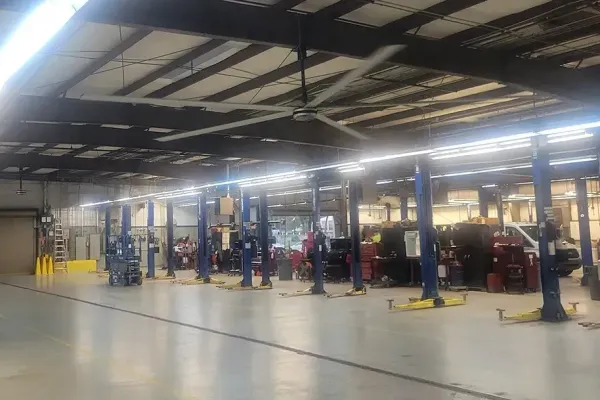
Giant HVLS industrial ceiling fan in a large warehouse
Can an HVLS fan improve air circulation and comfort in winter as well as summer?
Yes — and that seasonal versatility is a key advantage of big industrial ceiling fans.
During summer (or hot periods), HVLS fans create a gentle breeze. This moving air accelerates evaporation of sweat on workers’ skin — making them feel cooler, even if the ambient temperature stays the same.
In inverno (or colder months), the same fans help destratify the air. Warm air naturally rises and tends to collect near the ceiling. HVLS fans push that warm air down, mixing it with cooler air at floor level — giving a more uniform temperature, reducing cold spots, and cutting heating costs.
Beyond temperature, the improved airflow reduces humidity buildup, condensation, E stagnant air pockets. That helps prevent mold, protects stored goods, preserves air quality, and fosters a healthier workspace.
So whether summer or winter, HVLS fans support comfort, energy savings, and healthy air circulation.
What ceiling height and fan size (8 foot, 10 foot, 12 foot or larger) do I need for my space?
Scegliere the right fan size and installation setup matters — a wrong choice can lead to poor airflow, inefficiency, or even wasted budget.
Here are key considerations:
| Altezza del soffitto |
Diametro consigliato del ventilatore |
Why It Matters |
| ~10-15 ft (e.g. small gyms, offices) |
Smaller commercial ceiling fan (e.g. ~8–10 foot) |
Lower ceilings may not safely accommodate large fan blades; smaller fans help circulate air without hitting floor-level zones. |
| ~15-25 ft (typical warehouses, mid-size factories) |
12 foot HVLS or larger |
Larger diameter increases coverage; fan moves more air across the floor uniformly. |
| >25 ft (large warehouses, big industrial, sports arenas) |
Big commercial or big industrial HVLS (up to 24–30 ft diameter) |
High ceilings require larger fans to push air downward effectively and circulate air across wide spans. |
Per industriale e commerciale buildings with high ceilings or large floor space, a 12 foot HVLS or larger fan is usually ideal. In many warehouses or factories, a single HVLS fan can cover thousands of square feet efficiently.
Ricorda: air circulation effectiveness depends not just on fan size, but on placement, blade design, motor quality, and room layout. As a manufacturer, I often advise clients to evaluate ceiling height, square footage, obstacles (racks, machinery), and airflow goals before selecting a fan option.
Are HVLS fans quiet, safe, and reliable enough for industrial and commercial environments?
Yes — modern HVLS fans are engineered for quiet performance, durata, E safety, making them suitable for even demanding industrial settings.
- Funzionamento silenzioso: Because they rotate at low speed, HVLS fans produce far less noise than multiple high-speed fans or noisy HVAC blowers. This improves comfort — especially in gyms, public spaces, or working areas where noise matters.
- Built for industrial conditions: High-quality industrial ceiling fans are typically built with robust motors (e.g. direct-drive, BLDC), strong fan blades, and safety features suitable for long-term continuous operation.
- Low maintenance and long lifespan: Because of the gentle, low-speed operation, wear and tear are minimal compared to high-speed fans. Less mechanical stress means fewer repairs and a longer lifespan — a big advantage for factories and warehouses.
In short: a well-chosen HVLS fan is not just powerful — it’s a reliable long-term investment for businesses that need consistent, safe, and quiet airflow across large spaces.
What are the long-term financial benefits and ROI for installing HVLS fans?
Investing in big commercial ceiling fans pays off — often quickly. Here’s how:
- Reduced energy bills — by lowering HVAC load and improving air circulation, many facilities report 20–50% savings on cooling, and 20–30%+ on heating.
- Lower maintenance and equipment costs — less strain on HVAC units extends their lifespan, reduces repair or replacement costs, and lowers operational downtime.
- Improved productivity and employee comfort — comfortable air circulation means fewer hot spots or stuffy zones, which leads to better worker focus, fewer heat-stress issues, and more consistent output.
- Fast payback periods — many companies see a return on investment within 1–2 years, thanks to energy savings and lower operating costs.
A case study from a distribution center, for example, showed annual savings of 25% on energy costs and an ROI in under 18 months after installing HVLS fans.
For facility owners, managers, or procurement decision-makers in factories, gyms, warehouses, or commercial buildings, that kind of financial return — combined with reduced maintenance and improved comfort — becomes a strong business case.
How do HVLS fans integrate with existing HVAC systems in large commercial buildings?
You might wonder: if I already have an HVAC system, do I still need HVLS fans? The answer is: very likely yes — and often they complement each other perfectly.
- Supporting HVAC — not necessarily replacing it. In many facilities, HVLS fans are used alongside HVAC systems. The fans ensure even air distribution, reducing hot or cold spots that HVAC alone often can’t address. This means you can run HVAC less intensively, saving on energy and reducing wear.
- Reduced number of HVAC units needed. Better air mixing can lower the number of HVAC units required, or allow smaller units to cover the same area, reducing capital and operational costs.
- Extended HVAC lifespan. Since HVAC runs less often and under less strain, maintenance intervals lengthen and overall system life improves.
- Seasonal synergy. In summer, HVLS fans enhance cooling by improving airflow and perceived temperature. In winter, they help distribute heat evenly — assisting HVAC heating and improving climate control.
For industrial, commercial, or large-scale operations — where HVAC energy use and maintenance are major expenses — integrating HVLS fans offers a smarter, more sustainable climate control strategy.
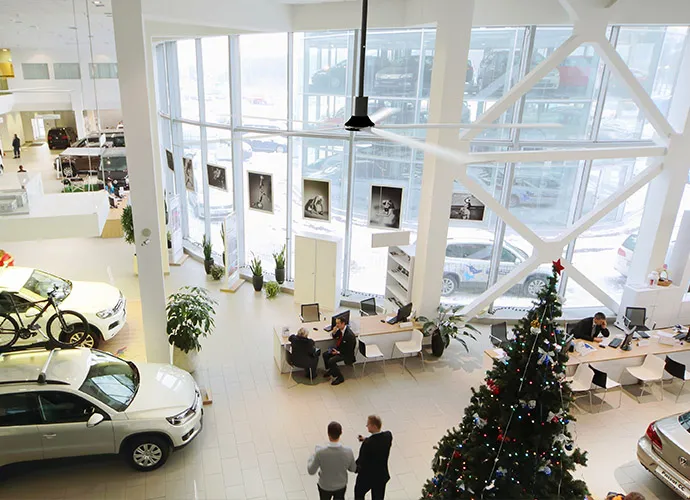
HVLS FAN with HVAC In Large Commercial Buildings
What should you consider when selecting the right fan options for your facility?
Not all big commercial ceiling fans are the same — choosing the right one depends on space, purpose, and budget. When selecting an HVLS or industrial ceiling fan, consider:
- Ceiling height and square footage — to pick appropriate fan diameter (8 ft, 10 ft, 12 ft, or larger) and coverage.
- Layout and obstacles — racks, machines, mezzanines can block airflow; fan placement must ensure unobstructed circulation.
- Airflow needs and usage patterns — continuous operation vs intermittent use; summer cooling vs all-year ventilation; air quality vs temperature control.
- Energy goals & sustainability targets — if reducing energy consumption and HVAC carbon footprint is a priority.
- Durability, maintenance, and reliability — especially in harsh industrial environments or dusty factories.
- Integration with HVAC and building systems — whether the fan will complement or partially replace your existing system.
- Budget and ROI expectations — initial cost, installation, potential savings, payback periods.
As a manufacturer of HVLS fans, I often help clients analyze these aspects — recommending customized fan options and configurations to match their facility’s unique demands.
Domande frequenti
How much area can one HVLS fan cover effectively?
A well-sized HVLS or big industrial ceiling fan can circulate air across thousands to tens of thousands of square feet — sometimes up to 20,000 square feet or more — depending on fan diameter, ceiling height, and layout.
Will installing HVLS fans alone be enough, or do I still need HVAC?
HVLS fans often work best as a complement to HVAC. They improve air circulation, even out temperatures, reduce HVAC load, and can lower operating costs — but for extreme climates or precise temperature control, HVAC usually remains part of the solution.
Are HVLS fans noisy compared to smaller, high-speed fans?
No — one of the big advantages of HVLS fans is quiet performance. Because they operate at low speed and move air gently, they create a comfortable breeze without the noise or draught typical of high-speed fans.
How long does it take to recoup the cost of installing HVLS fans?
Many facilities report a return on investment within 12–24 months, thanks to energy savings, reduced HVAC costs, and lower maintenance.
Can HVLS fans help with air quality and ventilation (not just cooling)?
Yes. By circulating large volumes of air and preventing stagnant zones, HVLS fans help improve ventilation, reduce humidity, minimise condensation, and support better air quality — important in warehouses, factories, gyms, or public buildings.
Are HVLS fans suitable for high-ceiling gyms or sports arenas?
Absolutely. In high-ceiling commercial spaces, gyms, or sports centers, HVLS fans’ large-diameter blades and air circulation capacity make them ideal for distributing air evenly, reducing stuffiness, and improving comfort for many occupants.
Conclusion — Key Takeaways
- Big commercial ceiling fans (HVLS) use long blades and low-speed rotation to move massive volumes of air — ideal for industriale e commerciale spaces like warehouses, gyms, factories, and distribution centers.
- loro consegnano flusso d'aria costante, even temperature distribution, E circolazione dell'aria that small fans or spot cooling cannot match.
- HVLS fans significantly reduce energy costs, lower HVAC load, and often pay for themselves within 1–2 years.
- They improve worker comfort, productivity, and air quality, while requiring meno manutenzione and offering quiet, reliable performance.
- For the best results, match fan size and installation to ceiling height, space layout, and airflow needs — and consider integrating with existing HVAC for maximum efficiency.
Right now, if you manage a warehouse, manufacturing plant, gym, school, or any large commercial facility, investing in HVLS ceiling fans could deliver lasting comfort, energy savings, and operational stability. Want me to help you calculate how many fans you might need based on your building’s square footage and ceiling height? Just drop me your specs — I’m happy to help.