Choosing the wrong Ventilateur HVLS can risk people and property. Confusing rules and marketing claims make it worse. Here’s a clear path to safe, code-aligned selection and installation—so your spaces stay comfortable, compliant, and efficient.
The essential Ventilateur HVLS safety and certification stack is: UL 507 pour electrical safety, AMCA’s Certified Ratings Program for verified flux d'air performance (look for the AMCA seal), U.S. DOE efficiency rules for large-diameter ventilateurs de plafond, NFPA 13 sprinkler clearances, ASHRAE guidance for ventilation et qualité de l'air intérieur, and (in the EU) CE certified compliance. Always verify documentation and third-party listings before purchase.
Outline
- What makes an HVLS fan safe? Core safety features and electrical safety
- AMCA & the Certified Ratings Program: how airflow is measured—and why it matters
- UL 507 for industrial equipment: what does UL actually test?
- Do HVLS fans improve ventilation and indoor air quality per ASHRAE?
- How big can an HVLS fan be? Large diameter ceiling fans, clearances, and placement
- DOE rules for large-diameter ceiling fans: understanding CFEI and compliance standards
- Reading spec sheets: CFM, input power, RPM, air speed—how to judge fan performance
- Installation, inspection, and training programs for safe operation
- Procurement checklist for commercial and industrial building systems
1) What makes an HVLS fan safe? Core safety features and electrical safety
A safe Ventilateur HVLS starts with design. Look for safety features that protect people, equipment, and structures: redundant blade restraints, stable mounting hardware, and controls that prevent unsafe grande vitesse operation in sensitive zones. Design should reduce safety concerns and foreseeable safety issues in busy facilities.
Électrique Ventilateurs de plafond HVLS must meet electrical safety requirements and use compliant components. In our plants, we emphasize direct drive with a high-efficiency magnet motor for fewer moving parts, lower consommation d'énergie, and quieter rotational behavior versus gear drives. Add lock-out-tag-out, interlocks to shut down during fire events, and commissioning checks. This builds a safe environment for people and assets in commercial et industriel espaces.
“Safety is a system choice.” Pair the fan with building Chauffage, ventilation et climatisation controls and clear safety guidelines for operators. Prioritize adherence to codes and document inspection records as your assurance trail.
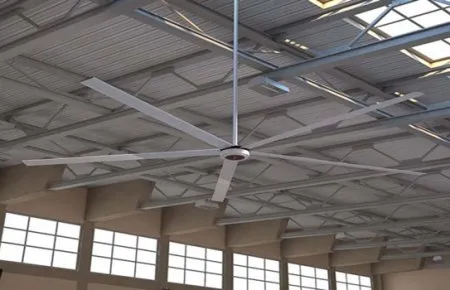
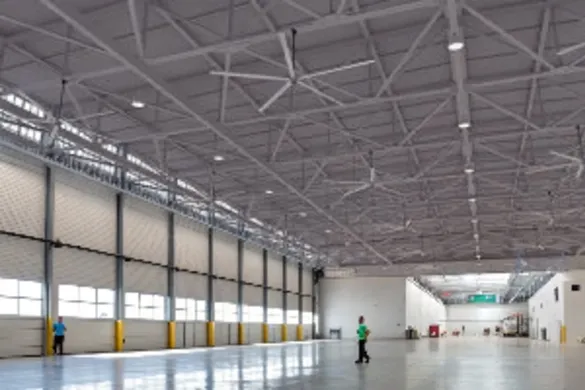
Ventilateur HVLS en action
2) AMCA & the Certified Ratings Program: how airflow is measured—and why it matters
Le association de mouvement et de contrôle de l'air (AMCA) operates a certified ratings program that verifies the published flux d'air and efficiency claims of air movement products. Because AMCA is a not-for-profit association, its aim is consumer protection: comparable, accurate performance data à travers fabricants de ventilateurs. Products that pass are allowed to bear the AMCA seal.
Pour Ventilateur HVLS buyers, AMCA’s role is critical. It confirms the volume d'air (often expressed as CFM) and other test methods against a recognized test standard (e.g., ANSI/AMCA 230) so you can compare like for like. When you see amca certified ratings, you’re looking at a certified product backed by third-party verification and periodic check testing—what AMCA calls “trustable” ratings.
3) UL 507 for industrial equipment: what does UL actually test?
UL 507 is the U.S. test standard for electric fans. It covers construction, electrical safety, grounding, abnormal operation, markings, and more—so a listed ventilateur industriel won’t present unreasonable shock or fire hazards. Seeing “UL 507 Listed” means the product has been evaluated against rigorous requirements and factory surveillance to help keep users safe.
In practice, UL complements AMCA: UL covers hazards; AMCA covers performances du ventilateur. For Ventilateur HVLS projects in factories, warehouses, and gyms, specifiers typically require both—UL for safety and AMCA for honest flux d'air ratings. This dual path helps ensure safe operation and predictable results on site. (UL 507 source and historical references are widely published.)
4) Do HVLS fans improve ventilation and indoor air quality per ASHRAE?
Le american society of heating (ASHRAE) states that ventilation and filtration strategies reduce airborne exposure risks and supports operating the Système CVC to lower transmission in pandemics like COVID-19. Ventilateur HVLS mixing can support qualité de l'air intérieur by distributing fresh air and preventing stagnant zones—when applied with proper outdoor air and filtration.
ASHRAE’s resources emphasize keeping airflow and efficiency balanced with comfort (temperature and humidity). Practically, an Ventilateur HVLS does not add outdoor air; it improves distribution and évaporatif cooling at faible vitesse, which often yields significant économies d'énergie when paired with smart Chauffage, ventilation et climatisation controls. For residential contexts, ASHRAE notes when to increase or limit exhaust; in non-residential settings, follow applicable standards and your engineer’s plan.
5) How big can an HVLS fan be? Large diameter ceiling fans, clearances, and placement
Large diameter ceiling fans move lots of air at à faible vitesse. Beaucoup Ventilateur HVLS lines reach 24 pieds de diamètre, but the right size depends on the space, obstructions, and the distance from the ceiling. Proper mounting height and blade-to-floor clearance are essential to get smooth flux d'air without draft complaints.
Where sprinklers are present, compliance standards (NFPA 13) require minimum vertical clearance between the fan and sprinkler deflectors, and interlocks that shut the fan down upon alarm. Typical guidance calls for at least 3 ft (0.9 m) vertical clearance and defined spacing from sprinklers. Always confirm with your AHJ and manufacturer spec sheets pour votre HVLS fan model.
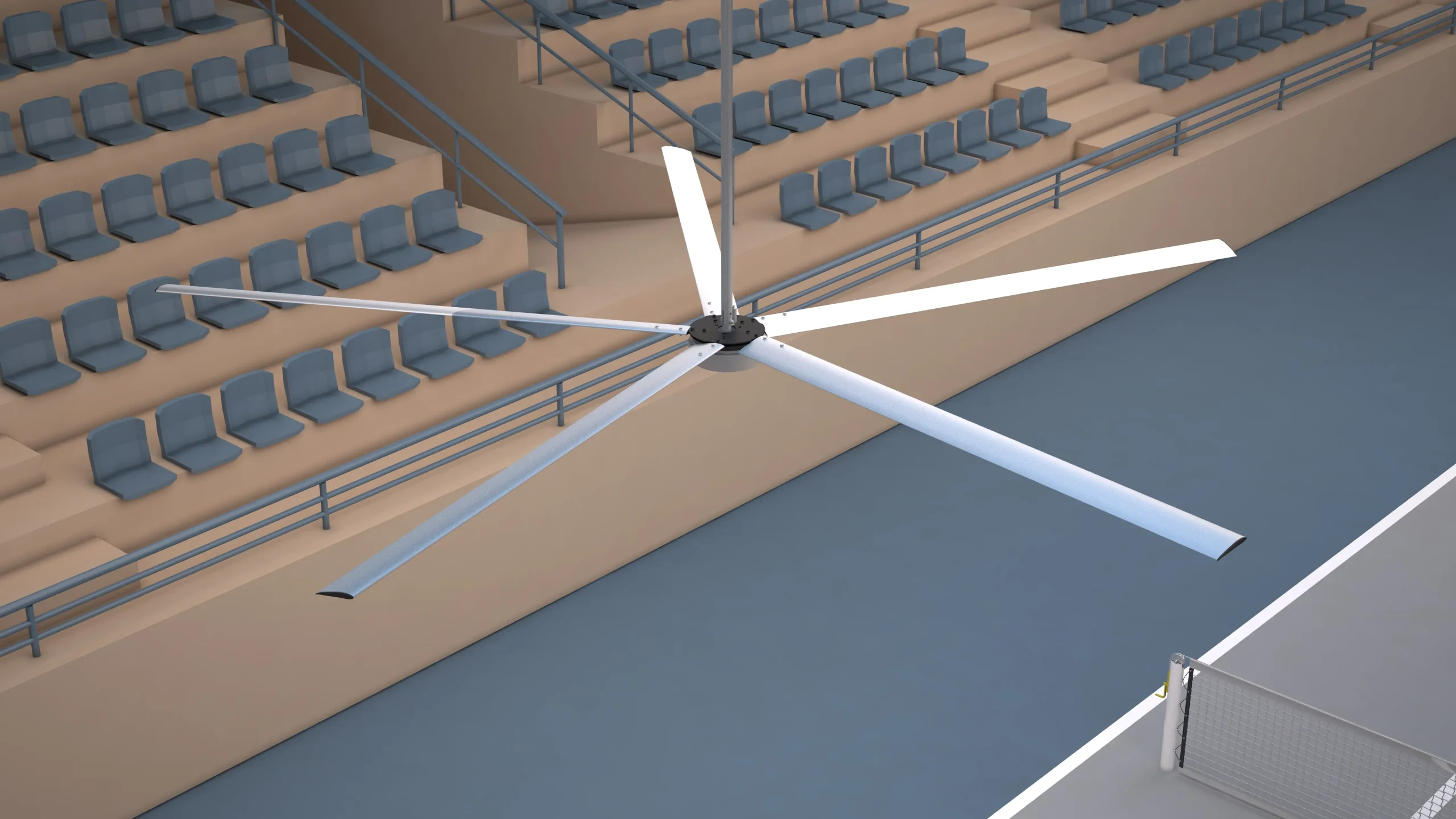
How big can an HVLS fan be?
6) DOE rules for large-diameter ceiling fans: understanding CFEI and compliance standards
In the U.S., the Department of Energy regulates grand diamètre ceiling fans (LDCF). Products must meet minimum efficiency using the Ceiling Fan Energy Index (CFEI) at different speeds and be listed in the DOE Compliance Certification Database. AMCA’s recent presentations outline key thresholds: CFEI ≥ 1.00 at high speed et CFEI ≥ 1.31 at ~40% speed. Buyers should verify compliance and documentation.
Critically, “DOE-compliant” doesn’t replace AMCA or UL. Think of DOE as baseline Consommation d'énergie rules; AMCA as flux d'air truth in labeling; and UL as hazard control. When these three align, selection is straightforward and your Ventilateur HVLS will comply with efficiency compliance standards while actually delivering the promised comfort on the floor.
7) Reading spec sheets: CFM, input power, RPM, air speed—how to judge fan performance
A good Ventilateur HVLS spec sheets page tells you CFM, input power, RPM, vitesse de l'air at set points, and test references. Compare CFEI and CFM/W where available. The ANSI/AMCA 230 test methods define how the volume d'air is measured for rating—so two listings tested to the same method are directly comparable. Always check that the product is certified by AMCA and the listing is current.
Handy reading order: (1) scope and diamètre, (2) required distance from the ceiling and mounting kit, (3) controller logic and alarms, (4) power and controls wiring, (5) sound, (6) maintenance intervals. If a vendor will not share test references for test standard et test methods, that’s a red flag for safety concerns and under-delivery.
Text-only mini-chart: Energy & Airflow example
Model A: 15k CFM | 150 W | CFEI 1.40 | ██████████
Model B: 14k CFM | 165 W | CFEI 1.20 | █████████
Model C: 17k CFM | 190 W | CFEI 1.10 | ███████████
8) Installation, inspection, and training programs for safe operation
Installation quality is as important as product choice. Your team should follow formal training programs, keep an inspection log, and verify interlocks with fire alarms. Many codes require shutdown on alarm and sprinkler separation rules. Written safety guidelines reduce human error and keep building systems reliable.
Our plants recommend commissioning checklists: torque checks on hardware, controller tests, and vibration balance passes at faible vitesse and at grande vitesse. Schedule periodic inspections and refresh operator training to suit staff turnover typical in the HVAC industry. The goal is simple: quiet, predictable Ventilateur HVLS operation for years.
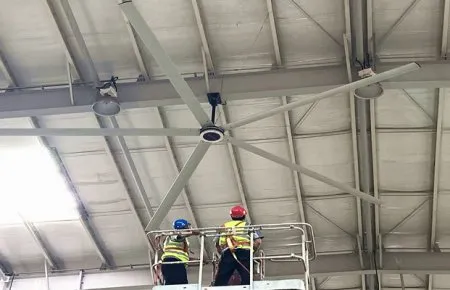
Installer un ventilateur HVLS
9) Procurement checklist for commercial and industrial building systems
Use this buyer’s checklist when choosing ventilateurs industriels hvls:
Standards & Listings
- UL 507 listing shown? (Safety) https://www.vindusfans.com/m750-series-hvls-fans/
- AMCA listing number current? (Look for the AMCA seal et certified ratings program entry.)
- DOE LDCF (CFEI) documents attached?
- EU project? Require CE certified documentation.
Performance & Integration
- AMCA 230 test standard referenced on the datasheet?
- Verified performance data: CFM, input power, CFEI, sound.
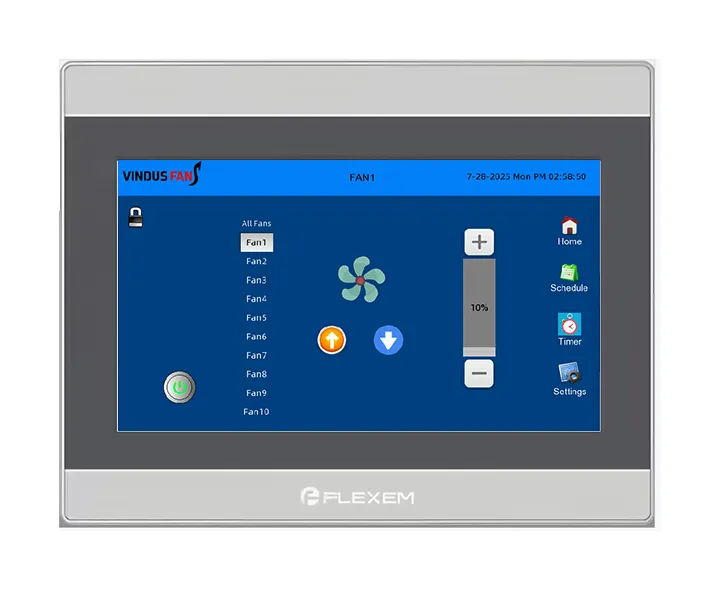
- Controls: interlocks with Système CVC and fire alarm.
Application & Safety
- Sprinkler clearances and spacing satisfied; shutdown on alarm implemented.
- Mounting meets the site structure; finish and color options meet project requirements.
Quick reference table: who covers what?
| Area |
What to verify |
Why it matters |
Where to check |
| Electrical hazards |
UL 507 Listing (UL) |
Prevent shock/fire; code & insurance |
UL mark, file number |
| Performance honesty |
AMCA Certified Ratings Program |
Comparable flux d'air ratings; amca oversight |
AMCA directory; amca seal |
| Efficiency rules |
DOE large diameter ceiling fans (CFEI) |
Federal minimums; database listing |
DOE CCD; AMCA guidance |
| Sprinkler interaction |
NFPA 13 spacing, shutdown interlock |
Avoid sprinkler shadowing & hazards |
Manufacturer instructions; AHJ; Rite-Hite FAQ |
| IAQ context |
ASHRAE statements |
Risk reduction; mixing & ventilation |
ASHRAE resources |
A practical case study (composite)
A distribution center adopted seven Ventilateur HVLS units (some 24 pieds de diamètre) across docks and picking aisles. With DOE-compliant models and AMCA-listed ratings, they documented comfort improvements and économies d'énergie after reducing AC runtime. Pairing faible vitesse mixing with economizer modes cut Consommation d'énergie while stabilizing temperatures near the floor. Inspection and staff training programs kept uptime high. (Approach aligned with AMCA/UL/NFPA guidance.)
Notes for specifiers (and where your manufacturer fits)
As an Ventilateur HVLS manufacturer (manufacturer’s responsibility matters), we publish transparent spec sheets, list test methods, and provide documentation for AMCA/UL/DOE/CE where applicable. That helps engineers confirm adherence et comply with the project’s code pathway. When evaluating any hvls brand, ask for third-party listings, controller I/O maps, and integration notes with building systems. (AMCA is the movement and control association international; AMCA is also widely known as the Air Movement and Control Association International.)
Buying tips: simple language, solid choices
- Start with the room: size, obstacles, people density, and target flux d'air.
- Pick a Ventilateur HVLS size to match. Don’t over-specify grande vitesse si à faible vitesse mixing gets the job done.
- Verify UL 507, AMCA listing, DOE database. If the fan isn’t certified by amca, reconsider.
- Consider motor type (we favor direct drive), blade profile (stable hvls fan blades), and controller logic for safe operation.
- Coordinate with fire protection early to avoid rework.
- For schools or public venues, consider finish and color options to match interiors.
Frequently asked questions
Which certifications are non-negotiable for HVLS fans?
In North America: UL 507 for electric safety, AMCA Certified Ratings Program for verified flux d'air, and DOE LDCF compliance for efficiency. For EU projects, require CE certified documentation. Verify the AMCA seal and current listing before purchase.
How do HVLS fans help with indoor air quality?
They don’t add outside air, but they mix and distribute existing air uniformly, helping ventilation strategies work better. ASHRAE supports operating Chauffage, ventilation et climatisation to reduce airborne exposure; Ventilateur HVLS mixing complements that when applied correctly.
What clearances do we need around sprinklers?
Follow NFPA 13 guidance and manufacturer instructions (e.g., 3 ft vertical clearance to sprinkler deflectors; fan shutdown on alarm). Always confirm with your AHJ.
How can I validate the airflow claims on a datasheet?
Check the AMCA directory for the certified ratings program listing, confirm ANSI/AMCA 230 test standard, and verify the listing covers your exact model and configuration.
Sources
Key takeaways (bullet summary)
- For any Ventilateur HVLS, verify UL 507, AMCA listing, and DOE LDCF compliance standards.
- Utiliser spec sheets avec CFM, input power, CFEI, and references to ANSI/AMCA 230 test methods.
- Respect NFPA 13 sprinkler clearances and implement shutdown interlocks for safe operation.
- Apply ASHRAE guidance to boost qualité de l'air intérieur and comfort; mixing helps, especially in warm seasons via mild évaporatif effects.
- Compare established hvls brand options (e.g., Fans de gros cul, Greenheck) and insist on third-party documents.
- Plan installation with training, periodic inspection, and controller integration into building systems for durable results.