Hot bays. Heavy fumes. Slow, tired techs. In many automotive shops the air just sits still, and everyone feels it. The simple fix is not “more AC” but better flux d'air. A well-chosen automotive ceiling fan can turn a hot, stale shop into a cooler, safer, faster place to work.
Industrial automotive ceiling fans use large, low-speed blades to create high-volume air movement across big service bays. They improve air circulation, support HVAC systems, reduce hot spots and fume build-up, and help your team stay focused and productive with less energy and lower operating costs.
Why every automotive service center needs a powerful ceiling fan
If you run an automotive service center or auto shop, you know how fast heat builds up. Engines idle. Lifts go up and down. Doors stay open. Without strong ventilation, the whole workspace can feel heavy and uncomfortable by midday.
As an Ventilateurs HVLS manufacturing plant, we work with factories, entrepôt facilities, garages, and automotive shops every day. We see one pattern again and again: when owners need a ceiling fan, they often start with small units that only cool one spot. The rest of the shop still feels hot. Techs move slower. Tools feel slippery. Tempers rise.
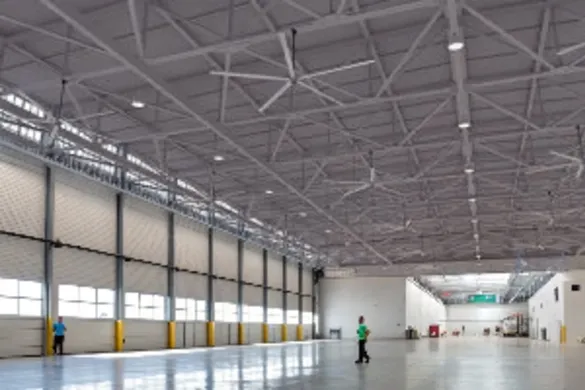
A properly sized ventilateur industriel changes that. A big, low-speed HVLS unit spreads air en mouvement evenly over cars, people, and equipment. This creates a more environnement de travail confortable, helps prevent surchauffer stress, and supports OSHA and HSE guidance about safe indoor conditions de travail and indoor temperatures.
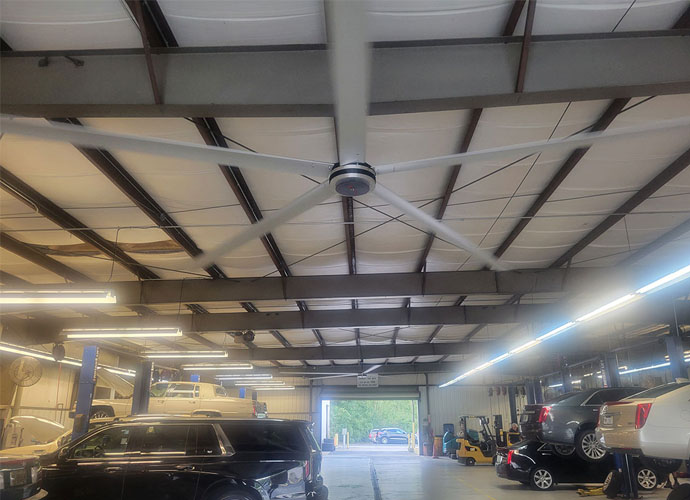
Why every automotive service center needs a powerful ceiling fan
What is an automotive ceiling fan and how is it different from a normal ceiling fan?
A normal home ventilateur de plafond is built for a bedroom or living room. It is small, light, and made for short duty cycles. An automotive ceiling fan for industrial and commercial spaces is very different.
- It has a much larger diamètre (often several meters).
- It runs at à faible vitesse but moves a volume élevé de l'air.
- It is designed for long hours with less noise and less wear.
In our plant we manufacture Système de levage à grande vitesse (High-Volume, Low-Speed) and ventilateurs de plafond industriels that are truly commercial-grade. One study shows a single 24 pieds de diamètre HVLS fan can move up to about 375,000 cubic feet of air each minute, helping buildings cut HVAC energy use by 20–30%.
These fans are perfect for industriel et commercial sites because they keep circulation d'air dans les grandes rooms steady and smooth. Instead of a strong blast at one point, HVLS fans provide a gentle, wide breeze that feels cool without blowing paperwork off the counter.
How do HVLS industrial fans improve air circulation in automotive shops?
In tall shops, hot air rises and cooler air stays near the floor. This “thermal stratification” wastes energy and makes staff uncomfortable. HVLS les fans fournissent a smart way to mix the air and améliorer la circulation de l'air.
Here is what happens when an HVLS fan starts turning:
- Large blades create a slow, steady mouvement de l'air column.
- Air spreads across the floor, then gently rises back up.
- The loop repeats, smoothing temperature from floor to ceiling.
This loop supports your Chauffage, ventilation et climatisation system. Research shows that when fans improve circulation d'air, buildings can often raise the cooling setpoint by 3–5°F and still feel comfortable, which can cut HVAC energy use by roughly 4% per degree.
For automotive facilities, this means les fans aident move away light fume, engine heat, and odors. Your team feels a pleasant breeze, not a blast. Your ventilateurs en marche quietly in the background support safe conditions de travail rather than becoming one more annoyance.

How do HVLS industrial fans improve air circulation
What ceiling fan size and diameter is right for your garage or automotive shop?
Choisir le ventilateur droit starts with your space. A small residential-style unit will not handle a large garage ou automotive shop. You need a fan for your needs that is built for high roof lines, open bays, and constant use.
Key factors to check:
- Ceiling height and clearances above lifts and vehicles
- Bay length and width
- Column spacing and overhead doors
- Power supply and control locations
We design a diverse range of HVLS models with diameters from 7 feet up to very large industrial rotors. For small alignment bays, a compact unit may be the perfect fit. For big service halls or paint prep areas, you might need one or two large industrial fans to cover each zone.
A simple rule:
- Un large HVLS fan can often replace many small fans today.
- Larger diameter means fewer units, fewer wires, and moins d'énergie used overall.
Because every building has unique needs, we always ask for drawings or rough measurements before we suggest sizes and styles.
How automotive ceiling fans boost productivity and reduce energy costs
Comfort and worker productivity are closely linked. If your team works in hot, stuffy air, their pace drops. Their focus slips. Mistakes increase. Good flux d'air is a simple way of boosting productivity without changing your process.
Studies on workplace comfort show that keeping indoor temperatures in a reasonable range improves performance and reduces errors. When HVLS fans support your Chauffage, ventilation et climatisation system, you can often:
- Keep staff more alert and comfortable and productive
- Reduce complaints about heat and surchauffer fatigue
- Cut coûts énergétiques by 20–30% through better efficacité énergétique et économies de coûts on heating and cooling
From our own projects, we see two main money gains:
- Lower operating costs – less strain on air conditioning and heating year-round.
- Higher productivity – faster jobs, fewer breaks, and more accurate work.
This is why so many smart shops now treat an HVLS system as a core part of their comfort and safety plan, not just “extra fans”.
Comparing HVLS fans and traditional industrial fans for automotive service bays
Many owners start with several small units and later switch to HVLS. Here is a quick comparison:
| Fonctionnalité |
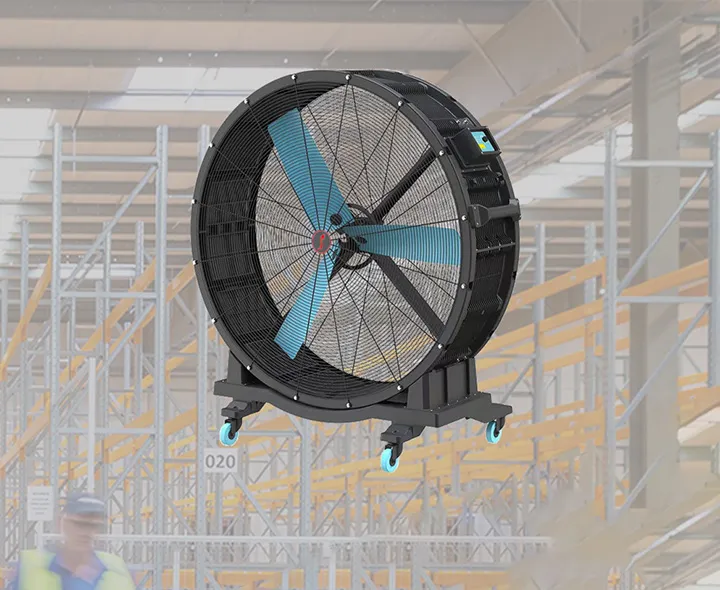
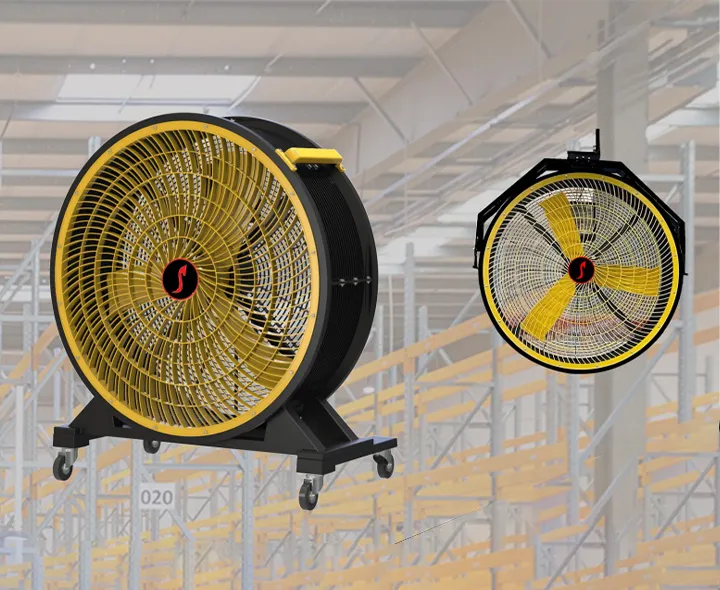
Ventilateur industriel traditionnel |
HVLS Automotive Ceiling Fan |
| Blade diameter |
Small (0.75–1.5 m) |
Large (up to 24 feet in diameter) |
| Couverture |
One spot or single bay |
Multiple bays / whole service center |
| Vitesse |
Haut |
Basse vitesse |
| Bruit |
Can be loud |
Quieter direct drive or gearbox systems |
| Energy use |
More watts per m² cooled |
High-volume air with moins d'énergie |
| Confort |
Strong local draft |
Gentle, circulation d'air optimale across the floor |
All of these are built for industriel et commercial duty, with rugged blades and coatings that resist corrosion and dust. They are fans for auto facilities, not living rooms.
How ceiling fans and HVAC work together for year-round comfort
Some people think “I already have AC, I don’t need a ceiling fan.” In a big automotive building, that idea leaves a lot of money on the table.
HVLS units and ventilateur de plafond commercial lines do not replace HVAC. They support it:
- In summer, they spread cool air, making people feel cooler at the same thermostat setting.
- In winter, they run in reverse to push trapped warm air down from the ceiling.
Industry data shows that with good destratification and fan control, buildings can often save 20–30% on HVAC-related coûts énergétiques while keeping comfort standards.
This is a year-round benefit. Instead of fighting hot and cold layers, your system works with smooth circulation d'air, more even temperatures, and less cycling. That means better économe en énergie operation and longer life for your HVAC equipment.
Installation, safety, and hassle-free integration
Big fans need smart planning. That is why our services d'installation and engineering team take time to understand your besoins spécifiques before the first bolt goes in.
We look at:
- Roof structure, beams, and bracing
- Clearance above lifts and tall vehicles
- Fire sprinkler patterns and lights
- Power routes and control locations
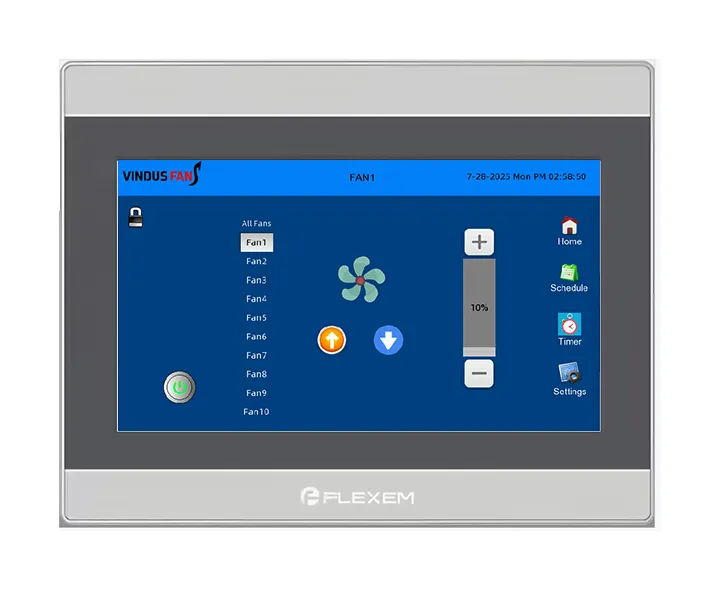
Then we design fans to meet those conditions. Many of our models use a direct-drive motor or modern direct drive motor with fewer moving parts and less maintenance. We also provide control options so you can slow the fans down, group fans, or switch modes with one touch.
Because we manage design, supply, and install, most of our customers experience truly hassle-free installation. With the right brackets, controls, and safety systems, fans are perfect partners for your existing HVAC and electrical systems.
And since OSHA recommends comfortable temperatures and good indoor air quality, using destratification and ventilation fans is a practical way to support those guidelines in real life.
Real-world example: fans help keep an automotive workspace comfortable
Let’s look at a simple case from one of our clients.
The site:
- A busy service center with eight bays
- One tire and alignment lane
- A small parts room and a customer lounge
Before the upgrade, the manager tried several floor fans. They were noisy, took up space, and did little for the rear bays. Staff often complained, and the owner worried about compliance with new indoor heat rules.
The solution:
We installed:
- Two large HVLS units over the main bays
- One medium commercial ceiling unit over the alignment lane
- A narrow trak fan near the parts counter
The result:
- Staff reported a much more comfortable and productive environnement.
- Customers noticed the fresh, steady flux d'air when they walked in.
- The owner raised the cooling setpoint by 2–3°F but kept comfort levels, cutting coûts d'exploitation and seeing real économies de coûts on bills within the first season.
This is how fans make a shop feel better and perform better at the same time.

fans help keep an automotive workspace comfortable
Frequently asked questions: common questions about ceiling fans in automotive facilities
Many owners share the same worries when they first talk to us. Here are some Questions fréquemment posées and answers, including some of the most common questions about ceiling fans in auto facilities.
What are the best ceiling fans for automotive workshops?
Le best ceiling fans for automotive environments are large HVLS or heavy-duty industrial ceiling fans designed for garages and service bays. These fans are perfect for high ceilings and open floors because they move a huge volume of air at low speed, keeping your team cool without strong drafts.
Will industrial ceiling fans really improve air quality and working conditions?
Yes. Good fans provide steady mouvement de l'air, which dilutes light fume, pulls heat away from people, and améliorer la circulation de l'air across the bays. When les fans fournissent more even temperatures and fresher air, conditions de travail feel better, and staff comfort and worker productivity both improve.
How do I choose the perfect fan for your needs?
Start with a sketch of your building, including heights and equipment. Share it with our engineering team. We look at layout, HVAC, and job types to recommend the perfect fan for your needs. We then match models, diamètre, and controls so each zone has a perfect fit.
Do I need professional installation, or can my electrician do it?
For safety, we strongly recommend installation professionnelle by a team that knows large fans. Our crews understand structure, sprinklers, and codes. They deliver hassle-free installation while making sure all brackets, cabling, and safety systems are correct for every automotive building.
Are these fans only for big shops, or can smaller garages use them too?
We support every automotive customer, from small two-bay garages to dealer-scale campuses. For smaller spaces we might suggest shorter diameters from 7 feet or compact models, while large dealer hubs may need several units. Either way, we design fans to meet your real-world layout.
How our HVLS fan manufacturing plant supports every automotive customer
We are not a simple reseller. We are a ventilateurs hvls manufacturing plant focused on industriel et commercial buildings like factories, sports centers, gyms, schools, and—most important here—automotive facilities.
Here is what we offer:
- Diverse range of HVLS products for different ceiling heights and bay layouts
- Custom control options to keep your ventilateurs en marche at the right speed for each zone
- Advice on efficacité énergétique, économe en énergie settings, and integration with HVAC
- Full design and services d'installation, from first sketch to final test
Whether you run a body shop, quick lube lane, detail bay, or multi-story automobile entrepôt, we can supply fans to meet your demands and help you keep your team cool and focused all day.
If you are ready to talk about ceiling fans for automotive environments, reach out with a drawing or even a simple phone photo of your shop. We will help you pick the ventilateur droit and design a system that truly fits your besoins spécifiques.
Bullet-point summary: key things to remember
- Automotive spaces need more than small fans; they need large Système de levage à grande vitesse et ventilateurs de plafond industriels for real coverage.
- Big fans with wide diamètre déplacer volume élevé air gently, keeping people cool without strong drafts.
- HVLS and commercial ceiling units work with your Chauffage, ventilation et climatisation to cut coûts énergétiques and deliver long-term économies de coûts.
- Bon circulation d'air reduces heat, light fume, and hot spots, supporting safer conditions de travail and higher productivité.
- Notre ventilateurs hvls manufacturing plant offers commercial-grade models, services d'installation, and designs that fit every automotive facility, large or small.