Industrial buildings are under more pressure than ever. Operators need cleaner air, lower energy use, safer workplaces, and ventilation systems that can adapt in real time. This article is worth reading because it explains where ventilación industrial is heading, what is changing inside the HVAC industry, and why HVLS fans now play a bigger supporting role in modern air strategies.
The short answer is this: the future of the industrial ventilation system is smarter, more data-driven, more energy-aware, and more focused on measurable air quality outcomes. In that future, HVLS fans do not replace outdoor-air ventilation or source capture, but they do help improve air mixing, comfort, and system efficiency in large buildings.
Esquema del artículo
- Why is the sistema de ventilación becoming a strategic business priority?
- Why is calidad del aire driving the future of ventilación industrial?
- How are smart ventilation systems y real-time monitoring changing decisions?
- Why is energy recovery ventilation becoming a core design choice?
- What role do HVLS fans play in a modern industrial ventilation system?
- Why do escape and source capture still matter?
- How does demand-controlled ventilation help optimize energy and air quality?
- Why are retrofit-friendly factory ventilation systems gaining ground?
- How do building management systems and modern HVAC technologies connect it all?
- What does high-performance ventilation look like in the next phase of industrial design?
Why is the ventilation system becoming a strategic business priority?
A modern sistema de ventilación is no longer treated as a background utility. It is now tied directly to worker health, comfort, uptime, and operating cost. ASHRAE states that Standards 62.1 and 62.2 are the recognized standards for ventilation design and acceptable indoor air quality, while OSHA says ventilation is one of the most important engineering controls for improving or maintaining workplace air conditions.
That shift matters because air quality is crucial in real industrial operations. Poor air can affect comfort, concentration, and exposure risk. EPA also notes that ventilation, filtration, and source control are core strategies used to improve indoor environments. In other words, ventilation isn’t just a code checkbox anymore. It is a performance issue.
Para building owners and plant managers, this changes how budgets are set. The question is no longer, “How do I install the cheapest ventilation equipment?” The better question is, “How do I build a sistema de ventilación that supports better air, lower energy use, and a stronger entorno laboral over time?” That change in mindset is one of the clearest future trends en el ventilation industry.
Why is air quality driving the future of industrial ventilation?
The strongest force behind the future of industrial ventilation is simple: people expect cleaner indoor air, and standards are becoming more explicit. EPA says indoor air quality can be improved through source control, improved ventilation, and air cleaning or filtration. ASHRAE 62.1 also defines minimum ventilation rates and other measures intended to provide acceptable calidad del aire interior and minimize adverse health effects.
That focus has widened since ASHRAE Standard 241 introduced minimum requirements for controlling infectious aerosols in new and existing buildings. Even when a plant is not designing for healthcare-style risk control, the direction is clear: the future of ventilation is moving toward measurable, documented, and performance-based air quality planning.
This is why concerns about indoor air quality are now shaping design choices in both edificios comerciales and industrial settings. Better IAQ is no longer treated as a “nice extra.” It is linked to occupant trust, compliance, resilience, and day-to-day comfort. That is one of the major key trends now shaping the future of air system design.
How are smart ventilation systems and real-time monitoring changing decisions?
One of the biggest emerging trends is the move from fixed ventilation to responsive ventilation. DOE explains that demand-controlled ventilation systems use occupancy or CO2 sensors to adjust ventilation automatically as occupancy changes, which helps maintain air quality while saving energy during low-occupancy periods.
EPA also explains that indoor air sensors can detect and report pollutants or environmental factors such as particulate matter, carbon dioxide, temperature, and humedad. That means today’s smart ventilation systems can do something older systems often could not: they can monitor air quality en real-time and react instead of waiting for complaints.
This is a major change in ventilation technology. Older mechanical systems were often sized once and then left to run on fixed settings. Newer systems use sensors, automation, and analytics to optimice fresh-air delivery, fan speed, or system timing. In practice, smart ventilation is becoming one of the most useful ways to balance air quality with energy control.
What smart ventilation changes in practice
| Old approach |
New approach |
| Fixed schedules |
Sensor-based control |
| Complaint-driven responses |
Real-time data and alarms |
| Manual balancing only |
Continuous tuning through automation |
| One-size-fits-all airflow |
Ventilation matched to occupancy and use |
This table is a practical summary based on DOE, EPA, and ASHRAE guidance on DCV, sensors, and modern ventilation control.
Why is energy recovery ventilation becoming a core design choice?
Fresh air is essential, but conditioning fresh air costs money. That is why energy recovery ventilation keeps showing up in modern design guidance. DOE explains that energy recovery ventilation systems transfer heat, and in ERVs also moisture, between outgoing indoor air and incoming outdoor air to reduce heating and cooling losses.
This matters because one of the hardest parts of any industrial ventilation system is balancing air exchange con Eficiencia energética. Operators want more outside air, but they do not want heating and cooling bills to spike. Energy recovery helps solve that tension by reclaiming energy from exhaust air before it leaves the building.
That is why energy recovery ventilation is moving from optional upgrade to mainstream best practice. It is especially attractive in larger facilities with long runtimes, large outside-air volumes, or aggressive IAQ goals. In short, this is one of the clearest trends and innovations en modern ventilation because it supports both cleaner air and lower consumo de energía.
What role do HVLS fans play in a modern industrial ventilation system?
This is where our product category fits into the bigger picture. HVLS fans are not a substitute for outdoor-air ventilation, and they are not a replacement for local source capture. Health Canada states clearly that effective ventilation must bring in outdoor air and exhaust indoor air, and that air movement alone is not sufficient. OSHA makes the same distinction by treating ventilation as a control strategy, not just recirculation.
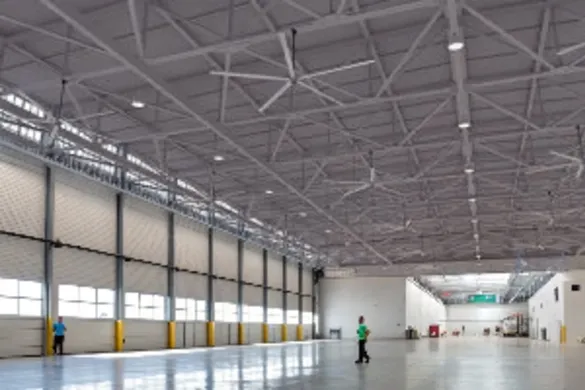
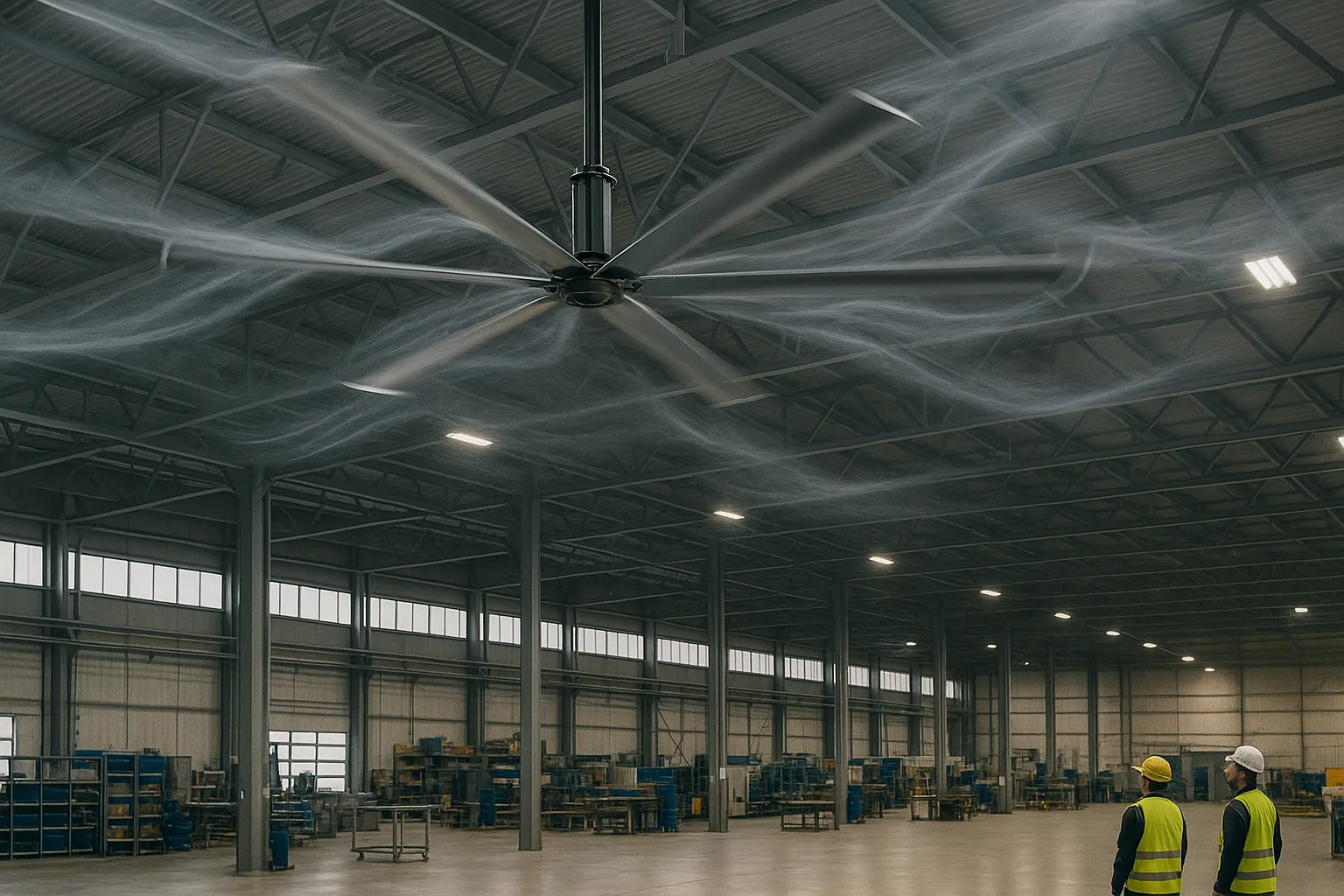
But HVLS fans still matter. AMCA explains that large-diameter ceiling fans provide air mixing, destratification, and cooling effects, and that their large diameter creates a large column of displaced air with gentle movement and low horsepower demand. In a big plant, that means better circulación de aire, more even temperature layers, and improved support for the main Sistema HVAC.
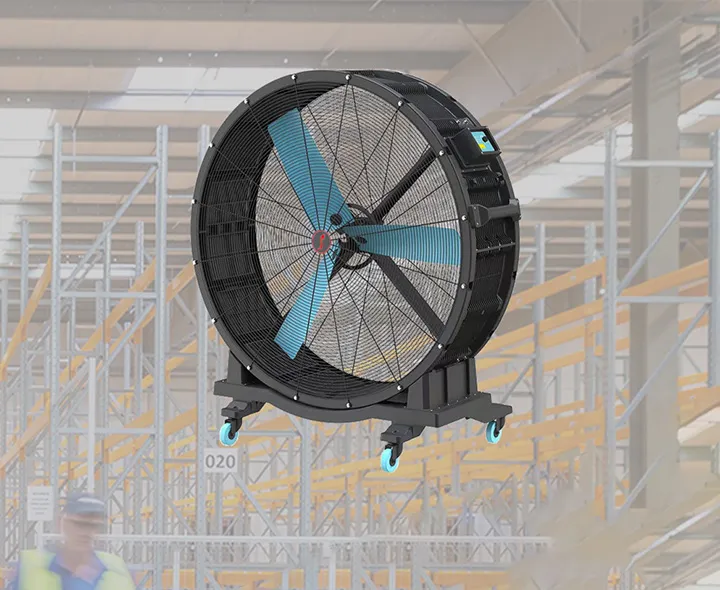
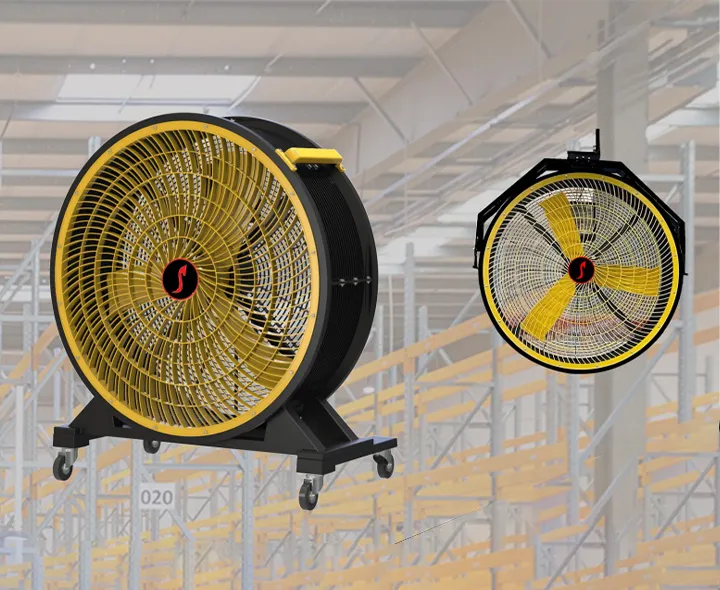
This is why HVLS fans are becoming more important in entornos industriales y commercial and industrial facilities. They support ventilación general, help reduce stratification, and improve how air is distributed through large open zones. In many buildings, that translates into better comfort, more even conditions, and a more efficient platform for the rest of the ventilation strategy.
Why do exhaust ventilation and source capture still matter?
Because air mixing is not the same as contaminant control. OSHA’s Technical Manual explains that local exhaust ventilation is designed to capture an emitted contaminant at or near its source, before it disperses into workplace air. NIOSH guidance makes the same point: local exhaust works best when capture happens close to the source.
That means a strong industrial ventilation system usually needs layers. It may include exhaust ventilation, ventilación general, filtration, and air mixing. But if a process creates dust, fumes, vapors, or other hazardous emissions, source control still comes first. This is one of the most important things to remember when talking about the future of industrial ventilation.
So yes, HVLS fans can improve room-level air distribution. But they should be treated as support equipment, not as a replacement for properly designed capture hoods, ducts, and escape points where contaminants are generated. That distinction is essential for both performance and regulatory compliance.
How does demand-controlled ventilation help optimize energy and air quality?
Demand-controlled ventilation is one of the clearest examples of how smart HVAC is changing building operation. DOE says DCV automatically adjusts ventilation rates based on occupancy or CO2 levels and can maintain air quality while saving energy when occupancy falls.
This matters because most industrial buildings do not use all zones in the same way all day. A packaging area, cafeteria, training room, office block, and storage bay may all have different load patterns. DCV lets the sistema de ventilación respond to those changes rather than over-ventilating empty or lightly used zones.
From an operating standpoint, that helps optimice both IAQ and Eficiencia energética. It is also one of the most practical ways to connect air quality monitoring, occupancy data, and control logic inside one Sistema HVAC. That is why DCV is one of the most important últimas tendencias en HVAC practices hoy.
Why are retrofit-ready factory ventilation systems gaining ground?
Because many facilities are not starting from scratch. DOE’s HVAC retrofit guidance highlights DCV as one example of an upgrade that can be added to improve building performance without replacing every major component. That matters because many existing HVAC systems in factories and warehouses still have usable structure, even if controls or air strategy are outdated.
This is why retrofit projects are such a strong part of current market trends. Building owners want practical upgrades that improve IAQ, support better temperature and ventilation, and reduce operating waste without forcing a full rebuild. In many projects, that means layering smarter controls, better filtration, energy recovery, and better air movement into the existing framework.
Para factory ventilation systems, this is a big opportunity. The most valuable ventilation solutions are often the ones that work with current building geometry, ventilation units, and installed systems while still moving the site closer to high-performance ventilation.
How do building management systems and modern HVAC technologies connect everything?
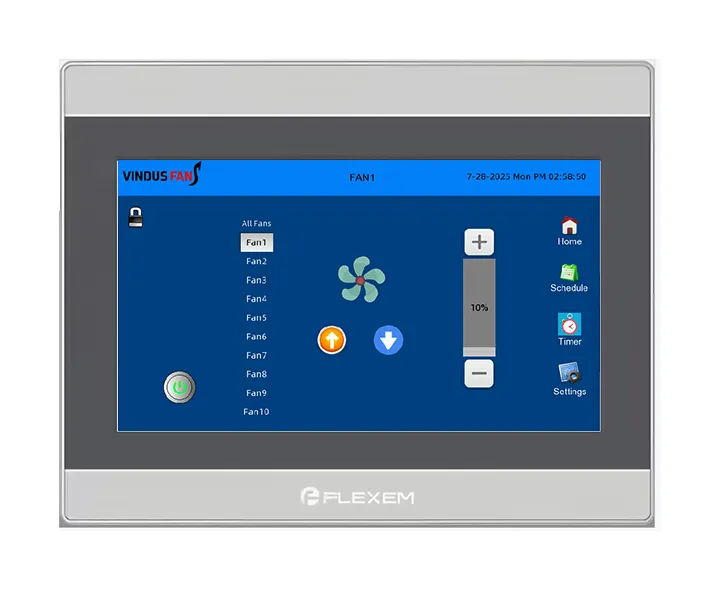
A modern sistema de ventilación works best when it is not isolated. It should be tied into building management systems, alarm logic, sensors, and control dashboards. DOE and EPA both point toward a more connected model where sensors, setpoints, occupancy data, and performance feedback shape how systems run.
This is where HVAC technologies are moving fast. The system is no longer just fans, coils, and ducts. It is also software, data, trend logs, and remote decisions. That is one reason management systems are becoming so important across espacios comerciales and industrial buildings alike.
For engineers and operators, the big win is visibility. When systems use sensors and control platforms well, teams can see drift, track ventilation rates, and confirm whether the building is really delivering the specific air quality needs it was designed to meet. That is how modern HVAC becomes more than hardware. It becomes an operating strategy.
What does high-performance ventilation look like in the next phase of industrial design?
The next phase of high-performance ventilation will likely combine five ideas: measurable IAQ, flexible control, lower energy waste, smarter integration, and application-specific design. ASHRAE 62.1 sets the baseline for acceptable IAQ, Standard 241 pushes infection-resilient planning further, DOE supports DCV and energy recovery, and OSHA continues to emphasize ventilation as a core engineering control.
In practical terms, the future of ventilation looks less like a single device and more like a layered system. It includes mechanical ventilation, source capture where needed, air cleaning, sensor feedback, and better room-level air distribution. In large open buildings, HVLS fans fit into that picture by improving air mixing and destratification, especially where wide coverage is needed.
So the real story is not that one technology wins. The real story is that ventilation is becoming more precise, more accountable, and more connected to health and energy goals. That is the future of industrial ventilation—not bigger systems by default, but smarter systems that ensure cleaner air and better performance with less waste.
Preguntas frecuentes
Are HVLS fans part of an industrial ventilation system?
Yes, but in a supporting role. HVLS fans improve air mixing, destratification, and comfort in large spaces. They do not replace required outdoor-air ventilation or local exhaust where contaminants are generated.
What is the biggest ventilation trend right now?
Sensor-driven control is one of the biggest current trends. DOE says demand-controlled ventilation uses occupancy or CO2 inputs to adjust airflow automatically, helping maintain IAQ while saving energy.
Why is energy recovery ventilation becoming more common?
Because it helps bring in fresh outdoor air without paying the full heating or cooling penalty. DOE says ERV and HRV systems transfer heat, and sometimes moisture, between outgoing and incoming air to reduce energy loss.
Does air movement alone count as ventilation?
No. Health Canada notes that effective ventilation must bring in fresh outdoor air and exhaust indoor air; air movement or recirculation alone is not enough.
Why is local exhaust still so important?
Because source capture is the safest way to control many contaminants. OSHA says local exhaust ventilation is designed to capture contaminants at or near the source before they spread into workplace air.
What should building owners focus on first?
Start with the real risk and building use: source contaminants, occupancy patterns, energy profile, and air-quality goals. Then choose the right mix of source control, outdoor-air ventilation, filtration, recovery, and air distribution support.
Selected Sources
Key things to remember
- El sistema de ventilación is now a strategic asset tied to health, energy, and operations.
- Mejor calidad del aire is driving the next wave of industrial ventilation decisions.
- Sensor-based, real-time control is one of the strongest current shifts in ventilation design.
- Energy recovery ventilation helps balance fresh air with lower heating and cooling penalties.
- HVLS fans support mixing, destratification, and comfort, but they do not replace outdoor-air ventilation or source capture.
HVLS 风扇有助于空气混合、消除分层和提高舒适度,但它们不能取代室外空气通风或源头捕集。
- Demand-controlled ventilation is becoming a practical way to improve IAQ and cut waste at the same time.
- The future belongs to layered, connected, and application-specific systems—not one-size-fits-all equipment.