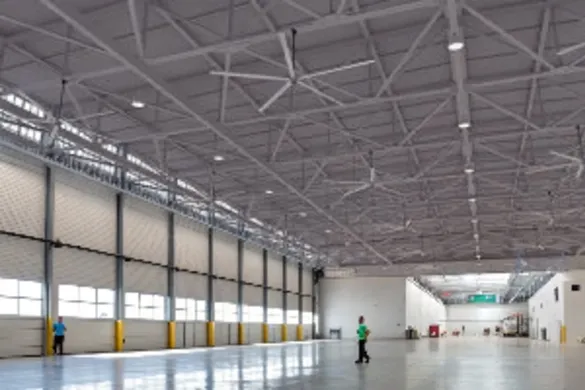
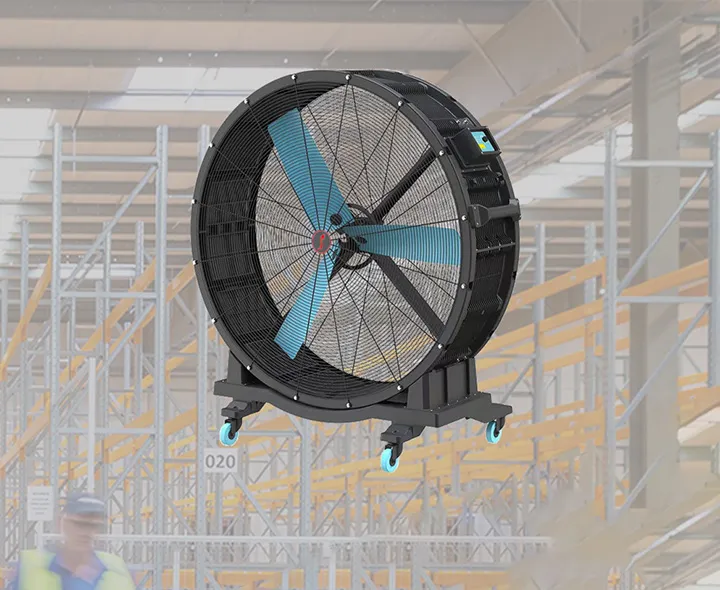
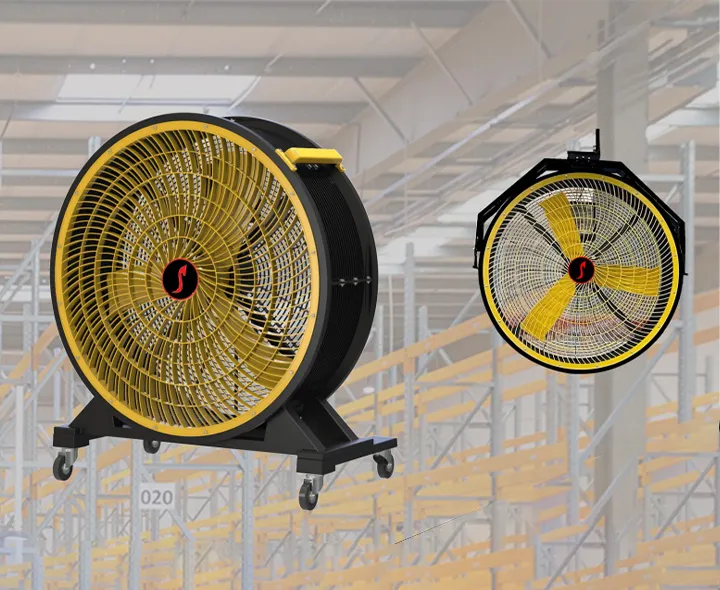
Stifling heat, poor air quality, and soaring energy bills are common struggles in large industrial and commercial spaces. These issues hinder productivity and create an uncomfortable environment. The right industrial fan provides a powerful solution, transforming your facility with efficient ventilation and creating a more productive atmosphere.[1]
There are two primary categories of industrial fans: axial and centrifugal. Axial fans move large volumes of air at low pressure, making them ideal for general ventilation.Centrifugal fans, or blowers, are designed for high-pressure applications, capable of moving air through ductwork and filtration systems by expelling it at a 90-degree angle.
What Are the Two Main Types of Industrial Fans?
As a manufacturing plant for ventilation products, we know that understanding the fundamental differences between industrial fan types is the first step toward optimizing your facility’s environment. The entire world of industrial air movement is built on two core designs: axial fans and centrifugal fans. Though both move air, they do so in fundamentally different ways, making each suitable for very different applications.
An axial fan functions much like an airplane propeller. Its blades rotate around a central axis and push air in a direction parallel to that axis. Think of it as creating a direct, straight line of airflow. This design is highly efficient at moving a large volume of air when there is little resistance or low static pressure.[1] This makes axial fans perfect for tasks like general space ventilation, cooling large open areas, and simple exhaust applications.
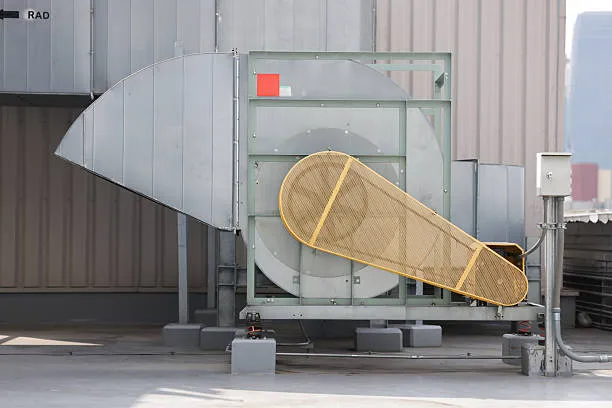
A centrifugal fan, on the other hand, resembles a hamster wheel or “squirrel cage.”Air enters the center of the fan wheel (the impeller) and is then thrown outward at a 90-degree angle by centrifugal force.This change in direction increases the air’s pressure, making centrifugal fans capable of overcoming significant resistance from ductwork, filters, or materials. If your application involves dust collection, fume extraction, or complex HVAC systems, a centrifugal fan is the heavy-duty workhorse you need.
| Característica |
Ventilador axial |
Centrifugal Fan (Blower) |
| Dirección del flujo de aire |
Parallel to the axis (straight through) |
Perpendicular to the axis (90-degree turn) |
| Presión |
Low Pressure, High Volume |
High Pressure, Lower Volume |
| Mejor para |
General ventilation, cooling large open spaces |
Ducted systems, dust collection, high-resistance applications |
| Diseño |
Propeller-like blades on a central hub |
Impeller (wheel) inside a scroll-shaped housing |
| Nivel de ruido |
Generally quieter at lower pressures |
Can be louder due to high pressure, but designs vary |
How Do Axial Fans Work for General Ventilation?
Axial fans are the cornerstone of general ventilation for a reason: they are masters of moving large volumes of air efficiently and cost-effectively. The secret lies in their fan design. The blades are shaped like airfoils, and as they rotate, they create a pressure difference between the front and back surfaces. This difference generates lift, propelling the air forward in a column parallel to the fan’s shaft.It’s a simple yet powerful mechanism for creating widespread air circulation in an industrial space like a warehouse or factory floor.
For general ventilation, the goal is often to exchange the entire volume of air in a space a certain number of times per hour to improve air quality and manage temperature. Because axial fans can move such a high volume of air with relatively low energy consumption, they excel at this task. They can be installed in walls to exhaust stale or hot air, in ceilings to circulate and destratify air, or within ductwork to boost airflow over long distances. This versatility makes them an indispensable tool for maintaining a healthy and comfortable environment in large facilities.
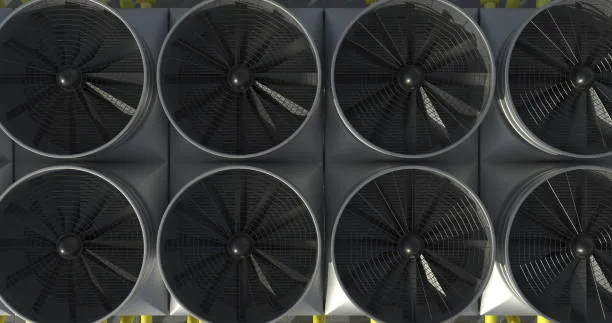
How Do Axial Fans Work for General Ventilation
What Are the Different Types of Axial Fans?
While all axial fans share the same core principle, there are several distinct fan types designed for specific ventilation needs. Understanding these variations helps in selecting the right fan for the job.
- Propeller Fans: This is the most common type of axial fan, characterized by a simple propeller with two or more blades mounted in a frame or panel.[1] They are excellent for moving large quantities of air at very low static pressure. You will often see these used as exhaust fans in walls or for air circulation in open spaces where there is no ductwork.[1]
- Tube Axial Fans: A tube axial fan is essentially a propeller fan placed within a cylindrical tube or housing. This fan design helps to concentrate the airflow, making it more efficient and allowing it to operate against moderate static pressure, such as in short duct runs.They are a step up from propeller fans for applications requiring a more focused air stream, like exhausting fumes from a specific area through a roof vent.
- Vane Axial Fans: Vane axial fans represent the most efficient design in the axial flow fan family. They are similar to tube axial fans but include stationary guide vanes either before or after the fan wheel.[1] These vanes straighten the swirling motion of the air as it exits the fan, converting wasted rotational energy into useful linear flow and higher static pressure capability.This makes them suitable for more demanding applications in HVAC systems where both high volume and moderate pressure are required.
When Should You Choose a Centrifugal Fan?
You should choose a centrifugal fan, often called a blower, whenever your air-moving application involves high resistance. Unlike axial fans that push air straight through, centrifugal fans use an impeller to draw air into the fan housing and discharge it at a 90-degree angle.This process significantly increases the air’s pressure, giving it the force needed to navigate complex paths and overcome obstacles.
Think of it this way: if an axial fan is like an open-field sprinter, a centrifugal fan is like a powerful running back, built to push through a line of resistance. Common scenarios demanding a centrifugal fan include:
- Systems with Ductwork: Moving air through long or winding ducts creates a lot of friction, or static pressure. A centrifugal fan has the power to maintain consistent airflow throughout the ventilation system.
- Filtration and Dust Collection: Applications that require air to pass through dense filters to remove contaminants rely on the high-pressure capabilities of centrifugal blowers.
- Material Conveying: In industries like agriculture and manufacturing, centrifugal fans are used to pneumatically convey light materials such as grains, sawdust, or plastic pellets through pipes.
- Exhaust Applications with Fume Hoods: Extracting fumes or hazardous gases from a specific source often requires a powerful fan to pull the contaminated air through hoods and ducting to the outside.
Exploring the Different Types of Centrifugal Fans
Just as with axial fans, centrifugal fans come in several designs, with the primary difference being the shape and orientation of the fan blades on the impeller. This fan blade design dramatically affects the fan’s performance, efficiency, and suitability for different industrial tasks.
Here are some of the most common centrifugal fan designs:
- Forward-Curved: These fans have many small, curved blades that point in the direction of the fan’s rotation.[1] They are capable of moving large volumes of air at relatively low speeds and are often used in HVAC and other clean-air applications.
- Backward-Inclined/Curved: The blades on this type of centrifugal fan are slanted or curved away from the direction of rotation.This fan design is highly efficient and operates quietly, making it a popular choice for clean-air ventilation systems where energy savings are a priority.
- Radial: Radial blade fans feature straight blades that extend radially from the hub. This simple, heavy-duty design is self-cleaning and excellent for handling air that contains dust, debris, or particulate matter, making them a go-to for industrial dust collection and material handling systems. The robust construction of a radial fan ensures it can withstand harsh operating conditions without significant fan failure.
Ventiladores centrífugos
What’s the Difference Between Fans and Blowers?
The terms “fan” and “blower” are often used interchangeably, which can be confusing. In the industrial world, the distinction comes down to the pressure ratio they generate. While both are mechanical devices designed to move air, a blower is essentially a type of fan that operates at a higher pressure.
A fan is a broad term for any device that creates airflow. This includes everything from a small desk fan to a large axial fan used for general ventilation. Fans are typically used to move large volumes of air at low pressure.
A blower moves air with more force. Specifically, an industrial blower uses an impeller to accelerate air and increase its pressure significantly. All centrifugal fans are technically blowers because they discharge air at a high velocity and pressure. They occupy an intermediate space between standard fans and air compressors. So, if your task requires simply circulating air in a room, you need a fan. If you need to push that air through a filter, duct, or another form of resistance, you need a blower.
How Does an Industrial Fan Improve Air Quality and HVAC Efficiency?
An industrial fan plays a critical role in creating a healthier and more energy-efficient facility. By ensuring continuous air movement, these fans prevent the buildup of stagnant air, which can harbor pollutants, fumes, and excess humidity.Proper ventilation, driven by a powerful industrial fan, helps exhaust these contaminants and introduces fresh air, directly improving the overall air quality for employees and protecting sensitive equipment.
Furthermore, industrial fans are a powerful ally to your existing HVAC system. In large buildings with high ceilings, air tends to stratify, with hot air rising and cool air settling near the floor. An industrial fan, particularly a large ceiling fan, effectively mixes these layers. During warmer months, this creates a cooling breeze that can make the environment feel significantly cooler, allowing you to raise your thermostat setting and reduce air conditioning costs. In cooler months, the same fan can be run in reverse to push trapped heat down from the ceiling, reducing the load on your heating system and leading to substantial energy savings.
What Are HVLS Ceiling Fans and Why Are They Different?
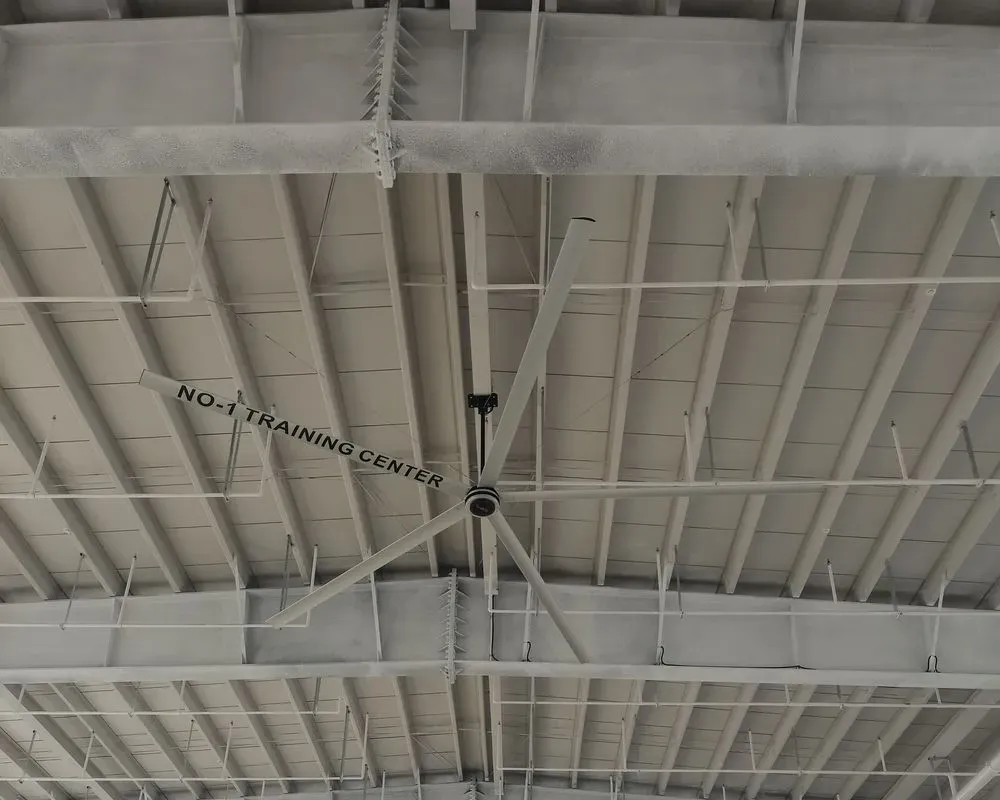
This brings us to a revolutionary category of industrial fans: High-Volume, Low-Speed (HVLS) fans. As an fabricante de ventiladores hvls, we’ve seen firsthand how these fans transform large spaces. An HVLS fan is a type of axial fan, but its sheer size—typically over 7 feet in diameter—sets it apart. Unlike traditional fans that rely on high speed to move air, ventiladores hvls use their massive, specially designed airfoil blades to move a huge column of air slowly and gently
This high volume, low speed approach is incredibly energy-efficient. A single HVLS fan can replace dozens of smaller, high-velocity fans while consuming a fraction of the energy.They are exceptionally effective at destratifying air in tall spaces like warehouses, manufacturing facilities, and gyms, leading to significant reductions in HVAC-related energy costs.The gentle but pervasive airflow improves comfort across a vast area without creating disruptive drafts, making them one of the Los mejores ventiladores HVLS for environments where both productivity and comfort are paramount.
¿Por qué elegir HVLS?
How to Select the Right Industrial Fan for Your Application?
Choosing the right fan involves more than just picking a size. It’s a calculated decision that impacts efficiency, safety, and your bottom line. The first step is to assess your primary need: are you looking for general ventilation in an open area or a high-pressure solution for a specific process? Your answer will immediately point you toward either an axial or centrifugal fan.
Next, you need to quantify your airflow requirements, usually measured in cubic feet per minute (CFM). This involves calculating the volume of your space and determining how many air changes per hour are needed for effective ventilation.You must also consider static pressure—the amount of resistance in your system from ducts, filters, and louvers.Mismatching the fan to the static pressure can lead to poor performance and energy waste. Finally, consider environmental factors like temperature, corrosive elements, and noise level requirements to select a fan built from the right materials and with the appropriate operational characteristics.
What Are the Key Considerations for Industrial Fan Maintenance?
Investing in the right industrial fan is only half the battle; proper maintenance is essential for ensuring a long, efficient service life and preventing costly downtime. Regular inspection is the foundation of any good maintenance plan. This includes checking for excessive vibration, which could indicate an imbalance in the fan wheel or a problem with the bearings.
Cleanliness is also crucial. Dust and debris can accumulate on fan blades, causing imbalance and reducing efficiency. In environments with heavy particulate matter, frequent cleaning of the impeller and fan housing is a must. Lubrication is another key aspect. Motor and fan bearings should be lubricated according to the manufacturer’s schedule to prevent premature wear and failure. Finally, periodically check belt tension on belt-driven fans and ensure all safety guards and electrical connections are secure. A proactive maintenance routine not only extends the life of your fan but also ensures it operates safely and at peak efficiency.
Preguntas frecuentes
Can an industrial fan be used for cooling?
Yes, while industrial fans move air rather than cool it, this airflow creates a significant evaporative cooling effect on the skin, making people feel several degrees cooler. This is particularly effective with Almacén Ventiladores HVLS, which can improve comfort across a very large area.
What is the difference between static pressure and airflow?
Airflow (measured in CFM) is the volume of air a fan can move per minute. Static pressure is the amount of resistance the fan must overcome to move that air, such as from ductwork or filters. These two factors have an inverse relationship; as static pressure increases, a fan’s ability to produce high airflow decreases.
How do I determine the size of the industrial fan I need?
Sizing an industrial fan requires calculating the volume of your space (length x width x height) and determining the desired number of air changes per hour for proper ventilation. This will give you the required CFM (Cubic Feet per Minute), which you can then match to a fan’s performance specifications.
Are industrial fans noisy?
Noise levels vary significantly between different fan types. High-pressure centrifugal blowers can be quite loud, while low-speed fans like HVLS models are known for their quiet operation. Always check the manufacturer’s decibel rating to ensure the fan is suitable for your environment.
What materials are industrial fans made from?
Industrial fans are built from heavy-duty materials to withstand demanding environments. Common materials include steel, stainless steel, and aluminum. For corrosive environments, fans may be coated with special materials or made from fiberglass-reinforced plastic (FRP).
Why is an industrial fan a better choice than multiple smaller commercial fans?
A single, well-chosen industrial fan, especially an HVLS fan, is far more energy-efficient and effective at circulating air in a large space than multiple smaller fans. For example, grandes ventiladores de techo comerciales para edificios comerciales applications provide more uniform airflow without the high energy consumption and clutter of numerous floor fans, making them ideal for everything from ventiladores de techo industriales para fabricación to sports centers.
Puntos clave
- The two primary types of industrial fans are Axial (for high volume, low pressure) and Centrifugal (for high pressure, lower volume)
- Axial fans, including propeller, tube axial, and vane axial types, are best for general ventilation and cooling open spaces.
- Centrifugal fans (or blowers) are necessary for applications with high resistance, such as ductwork, filtration systems, and material conveying.
- HVLS (High-Volume, Low-Speed) fans are a highly energy-efficient type of axial fan that excels at circulating air in large, tall spaces, significantly improving comfort and reducing HVAC costs.
- Selecting the right fan requires a careful assessment of airflow (CFM), static pressure, and environmental conditions.