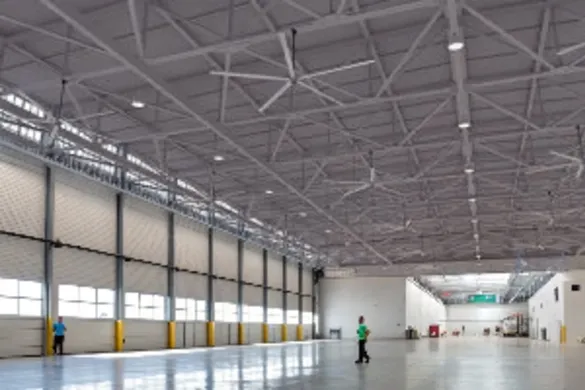
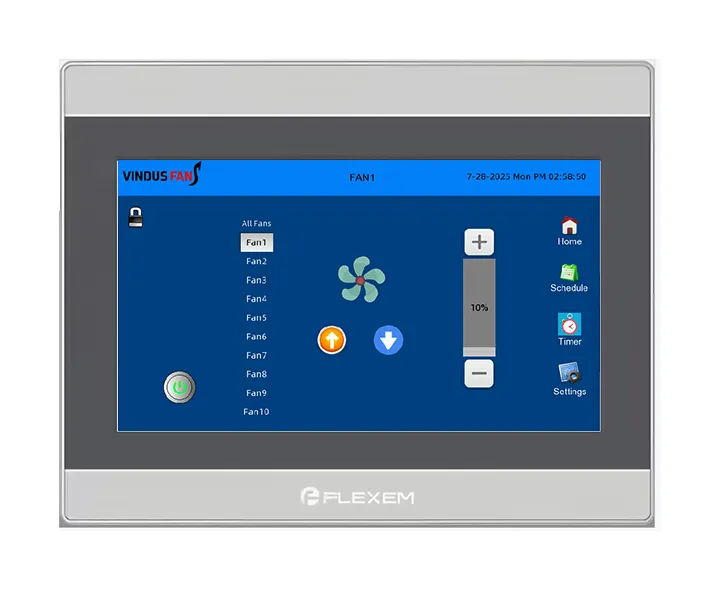
Uneven temperatures, hot dock doors, and weak airflow can quietly slow a distribution center down. Workers get tired faster, comfort drops, and managers end up chasing the problem with too many small fans. A better solution is whole-space air movement built around the right HVLS fan.
HVLS fans help distribution centers by moving large volumes of air across wide floor areas, improving thermal comfort, reducing hot and cold zones, and supporting worker productivity. They do not replace proper ventilation or cooling, but in large warehouse-style buildings they often improve air mixing and help HVAC systems work more effectively.
Artikelübersicht
- Why are distribution centers hard to keep comfortable?
- What does an HVLS fan do differently from smaller fans?
- How does airflow affect worker productivity?
- Why do HVLS fans work well in large pick-and-pack spaces?
- HVLS fans vs spot cooling: which is better?
- How do HVLS fans support HVAC performance?
- Can HVLS fans help reduce wasted energy?
- What should you check before specifying fan layout?
- What common mistakes reduce results?
- When is an HVLS system the right move for a distribution center?
Why are distribution centers hard to keep comfortable?
A distribution center is not just a big room. It usually has tall clear heights, open racking zones, dock doors opening all day, changing labor density, and long walking paths. In spaces like this, temperatures often separate from floor to roof, and air can feel stale or heavy in one zone while another area feels drafty. AMCA notes that large-diameter ceiling fans are commonly used in high-ceiling spaces because thermal mixing and floor-to-ceiling temperature control are major issues in these buildings. Heat also affects people more than many operators expect. OSHA says increased airflow can make the workplace safer by increasing evaporative cooling, and it also notes that heat stress can contribute to decreased performance and lost productivity. That matters in distribution centers, where workers walk, scan, lift, sort, and repeat the same tasks for long shifts.
From our side as an HVLS fan manufacturer, this is the pattern we see most often: the building is large, the cooling is uneven, and the owner first tries to fix it with scattered fans. That may help one station, but it rarely solves the whole-air problem across the full distribution floor.
What does an HVLS fan do differently from smaller fans?
An HVLS fan is a high-volume, low-speed ceiling fan designed to circulate large volumes of air using low operational speed. AMCA describes these fans as large-diameter units built for broad air movement rather than narrow, high-velocity blast. That is the core difference between an HVLS system and clusters of smaller fans.
Smaller fans usually create a strong stream of air in one direction. That can feel helpful right in front of the fan, but the effect falls off quickly with distance. An HVLS fan works differently. It creates a large column of moving air that spreads across a wide occupied zone, which makes it much more useful in open warehouse-style buildings.
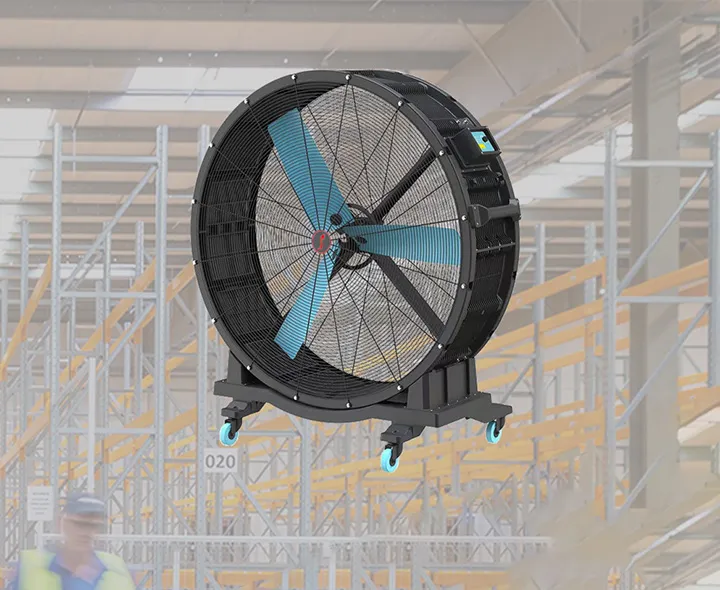
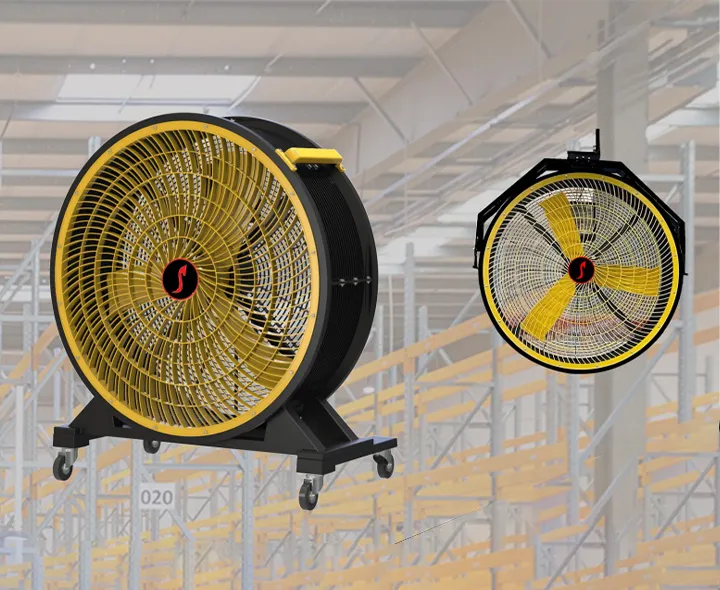
That does not mean smaller fans are useless. It means they solve a different problem. Spot fans are good for a local hot workstation. HVLS fans are better when the goal is stable airflow across a broad distribution center floor.
How does airflow affect worker productivity?
Productivity is not only about labor planning and software. It is also about the physical work environment. OSHA states that heat stress can cause decreased performance and lost productivity, and that fine motor performance can deteriorate under heat strain. In a distribution center, that can affect scanning accuracy, walking pace, comfort, and recovery between tasks.
ASHRAE’s thermal comfort framework also matters here. Elevated air speed can improve acceptable comfort conditions, which means people can feel more comfortable even when the thermostat is not set aggressively low. That is important in active workspaces where people are constantly moving.
A simple truth follows from that: better airflow supports better work. It does not magically turn a weak operation into a strong one, but it reduces one common source of drag. If workers feel less overheated and less boxed into heavy air, the building becomes easier to work in.
Why do HVLS fans work well in large pick-and-pack spaces?
Distribution centers are usually built for movement: pallets, conveyors, carts, forklifts, and people all sharing long aisles and open work zones. That type of layout rewards large-area air movement. AMCA highlights thermal mixing as one of the most common energy-saving and comfort applications for HVLS fans, especially in high-ceiling spaces. HVLS fans are especially useful in pick-and-pack zones because they influence the broader occupied area instead of only one point. In practical terms, that means air movement follows the work, not just the fan location. Workers do not need to stand directly in front of a pedestal fan to feel relief.
They also help bridge the difference between interior zones and dock-facing zones. Distribution centers often have variable heat loads because doors open, trailers arrive, sunlight shifts, and occupancy changes by hour. A large fan cannot stop all of that, but it can make the building feel more even.
Why HVLS fits distribution centers
| Building condition |
Why HVLS helps |
| Tall clear height |
Reduces floor-to-ceiling temperature differences |
| Large open floorplate |
Covers more area with fewer units |
| Active labor movement |
Supports comfort over broad walking zones |
| Mixed dock and storage areas |
Improves air mixing between uneven zones |
| Long daily operating hours |
Helps support comfort and HVAC efficiency |
The logic in this table reflects AMCA’s explanation of HVLS fan operation and ASHRAE’s work on thermal mixing in large-volume buildings. HVLS fans vs spot cooling: which is better for a distribution center?
The best answer is not always “one or the other.” Spot cooling is useful when one location needs extra help. OSHA notes that increasing airflow with fans can help workers stay cooler and that local cooling approaches can be effective in specific work areas. But for most distribution centers, the main problem is not one hot spot. It is uneven whole-space comfort. That is where HVLS systems usually outperform collections of smaller fans. A few local fans can cool a packing station. They do not usually fix stratification or wide-area stagnation across the building.
So the right way to think about it is this: use spot cooling where heat is truly local, and use HVLS where comfort needs to travel with the workforce across the floor. In many facilities, the strongest strategy uses both.
How do HVLS fans support HVAC performance?
This is one of the biggest reasons large facilities choose HVLS fans. DOE says using a ceiling fan can allow you to raise the thermostat by about 4°F without reducing comfort. That principle comes from improved air movement and the cooling effect people feel when air passes over them.
ASHRAE’s research on HVLS fans in large spaces also shows that these fans lower average space temperature near the ceiling by reducing excess heat overhead, which reduces HVAC system use. In other words, the fan does not replace cooling equipment, but it can help the HVAC system operate more effectively by improving air distribution.
That matters in a distribution center because cooling bills can be high and comfort complaints can still remain. When air is mixed better, the system does not have to fight such a strong vertical temperature split. That supports more stable conditions with less wasted effort.
Can HVLS fans help reduce wasted energy?
Yes, but the savings are usually indirect. The motor still uses electricity, so the fan is not free. The savings come from better thermostat strategy, better thermal mixing, and less overuse of cooling just to make people feel comfortable. DOE’s ceiling-fan guidance points directly to this by linking fan use to higher cooling setpoints. In large buildings, destratification matters too. When heat collects near the roof, the HVAC system may work harder than necessary while the occupied zone still feels uncomfortable. ASHRAE’s hangar research found that HVLS fans reduce this excess heat near the ceiling and lower HVAC use. Distribution centers have similar large-volume characteristics, so the same design logic applies.
That is why facility managers often see HVLS as both a comfort tool and an efficiency tool. It improves how conditioned air is used instead of simply demanding more cooling capacity.
Main paths to lower energy waste
- Higher cooling setpoints while preserving comfort Better floor-to-ceiling thermal mixing
- Fewer scattered fans and less patchwork airflow management
- Better support for HVAC sequencing and zone performance
What should you check before specifying fan layout?
Good results depend on good layout. AMCA’s HVLS design guidance emphasizes fan selection, application, and specification instead of guessing based on diameter alone. That means you should start with ceiling height, racking layout, obstructions, sprinkler coordination, and the main work zones.
You also need to think about where workers actually spend time. A fan plan that looks balanced on paper may still miss pack-out lines, loading lanes, or mezzanine-adjacent walkways. Distribution centers work best when airflow design follows labor patterns, not just roof geometry. That last point is an operational inference, but it aligns with OSHA’s emphasis on making workplace controls fit actual work conditions. Finally, make sure the products you compare have trustworthy performance data. AMCA notes that certified product ratings help simplify selection and give buyers a more reliable basis for comparing large-diameter ceiling fans.
What mistakes reduce results in a distribution center?
The first mistake is treating HVLS as a decoration instead of a building-performance tool. If the layout is wrong, the fan size is wrong, or the fan ends up fighting supply air or structural obstructions, the results will disappoint. OSHA’s technical manual even notes that poorly designed ventilation systems can interfere with worker productivity and lead people to bypass them.
The second mistake is relying on too many small fans and calling it a strategy. That may create motion, noise, and clutter without truly fixing airflow. In a large warehouse-style building, that approach often adds maintenance points without solving the root problem of uneven air distribution. This conclusion follows directly from AMCA’s explanation of how HVLS systems differ from local air movers.
The third mistake is expecting fans alone to solve every thermal problem. A fan supports comfort and air mixing, but it does not replace ventilation requirements, source control, or properly sized HVAC where those are needed.
When is an HVLS system the right move for your distribution center?
An HVLS system makes the most sense when the building is tall, open, labor-intensive, and hard to keep comfortable evenly. That includes many distribution centers, e-commerce fulfillment spaces, cross-dock facilities, and large storage operations. AMCA’s published examples and ASHRAE’s large-volume thermal mixing work both point to these kinds of environments as strong use cases.
It is also the right move when management wants to improve comfort without only turning down the thermostat. DOE’s guidance shows why fans matter in that equation, and OSHA’s heat-stress guidance explains why airflow is a safety and performance issue, not just a comfort preference.
From our perspective as a manufacturing plant for HVLS products, the best projects are the ones that treat the fan as part of an air strategy. When that happens, the distribution center usually becomes more even, more comfortable, and easier for people to work in.
FAQs
Do HVLS fans really improve worker productivity in a distribution center?
They can support productivity by reducing thermal discomfort and heat-related performance drag. OSHA says heat stress can contribute to decreased performance and lost productivity, so better airflow can help create a more workable environment.
Are HVLS fans better than pedestal fans in warehouse aisles?
For wide-area comfort, usually yes. Pedestal fans are useful for local relief, but HVLS fans are designed to move large volumes of air across broader areas and are generally better suited to large-volume buildings.
Can HVLS fans replace air conditioning in a distribution center?
Not usually. DOE says ceiling fans can support higher thermostat settings and improve comfort, but they are generally a supplement to cooling rather than a full replacement in large conditioned buildings.
Helfen die HVLS-Ventilatoren auch im Winter?
Yes. ASHRAE’s research shows that large fans can reduce heat stratification by minimizing excess warm air near the ceiling, which supports HVAC efficiency in colder periods.
What matters most when choosing an HVLS layout?
Ceiling height, obstructions, worker zones, and certified performance data are among the most important factors. AMCA’s design guidance stresses proper selection and specification instead of rule-of-thumb guessing.
Sind HVLS-Ventilatoren nur für Lagerhallen geeignet?
No. They are also used in manufacturing plants, sports centers, commercial buildings, gyms, schools, and other large spaces where air mixing and comfort matter.
Key takeaways
- Distribution centers are difficult to cool evenly because they are large, tall, and operationally dynamic.
- HVLS fans move large volumes of air at low speed and are designed for broad coverage, not local blast cooling.
- Better airflow supports worker comfort, and OSHA links heat stress with lower performance and lost productivity.
- HVLS fans work especially well in distribution centers because they improve whole-floor air movement and reduce temperature layering.
- They also support HVAC performance by improving mixing; DOE says fans can allow roughly a 4°F higher thermostat setting without reducing comfort.
- The best results come from proper fan selection, certified performance data, and layout that follows the real work pattern of the building.