Struggling with hot, stuffy air in a tall building? The wrong ceiling height or fan size can waste energy and still leave people uncomfortable. By matching HVLS fan size to your ceiling height, you can fix airflow, boost comfort, and cut energy bills.
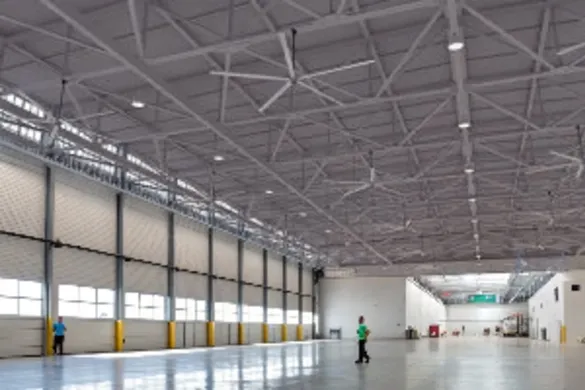
In most commercial and industrial spaces, HVLS ceiling fans should be mounted so the blades are at least 10 feet (3 m) above the floor, with a total ceiling height of around 13 feet or more. Larger industrial HVLS fans in warehouses and factories work best with ceiling heights of 20–40 feet, where they can move high volumes of air safely and efficiently.
Table of content
- What is an HVLS fan and how is it different from a normal ceiling fan?
- What is the minimum ceiling height requirement for HVLS fans?
- How ceiling height, room size and fan diameter work together
- HVLS ceiling fan size guide based on ceiling height
- Mounting height, sprinklers and safety clearances
- How to choose the right HVLS ceiling fan size for your space
- Simple HVLS fan size chart (based on ceiling height)
- How many fans do you need, and where should you place them?
- What happens if you choose the wrong size HVLS fan?
- How HVLS fans help factories, warehouses and gyms save energy
- Case study: Selecting the right size HVLS fan for a warehouse
- FAQs about ceiling height and HVLS fan sizing
- Work with a professional HVLS fan manufacturer to get the right size
- Key points to remember (quick checklist)
What is an HVLS fan and how is it different from a normal ceiling fan?
A High Volume Low Speed (HVLS) fan is a very large industrial ceiling fan, usually 8–24 feet in diameter. Unlike a small ceiling fan you might see at home, an HVLS fan turns slowly at low speed but moves massive amounts of air over a big area. One 24-foot HVLS fan can move up to 375,000 cubic feet of air per minute.
A normal Deckenventilator is designed mainly for small rooms and low ceilings. It has short blades, higher speed, and covers a limited Zimmergröße. In large industrial spaces, you would need many small ceiling fans to get the same coverage that a single industrial HVLS fan can handle.
As an Produktionsstätte für HVLS-Ventilatoren, we design commercial and industrial HVLS fans specifically for:
- Factories and production lines
- Warehouses and logistics hubs
- Sports centers, gyms, and school halls
- Commercial buildings and large indoor public areas
These industrial fans are designed to be installed high on the Industriedecke, where they can move massive amounts of air at low speed to improve comfort and reduce energy use.
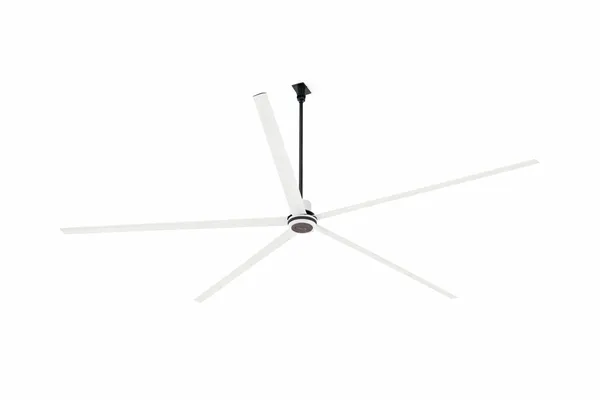
What is a HVLS fan
What is the minimum ceiling height requirement for HVLS fans?
For safety and performance, there are two key height ideas to remember:
- Blade-to-floor height
- Ceiling height and mounting height
Industry guidelines and building codes often require that the Deckenventilator muss keep fan blades at least 10 ft (3 m) above the finished floor in industrial or commercial spaces.
Many HVLS manufacturers recommend:
- Minimum mounting height (blade to floor): 10–13 ft (3–4 m)
- Minimum ceiling height: about 13 ft (4 m) total, and often 20 ft or more for full-size HVLS Industrie-Deckenventilatoren
In simple terms:
- If your building has a ceiling lower than about 13 ft, you may need a kleinerer Lüfter or a different solution.
- If your ceiling is 20–40 ft high, you can use a größerer Lüfter and get excellent airflow and destratification.
Rule of thumb: An HVLS fan is often not installed below 15 ft total height in serious industrial or commercial applications.
How ceiling height, room size and fan diameter work together
When we do HVLS fan sizing, we always look at three basic facts:
- Deckenhöhe
- Size of the space (square meters or square feet)
- Fan diameter (fan size)
Der größer der Lüfter, the more air it can move at niedrige Geschwindigkeit. Lüfter mit hohem Volumen und niedriger Geschwindigkeit push air down in a big column, then out across the floor, where the air spreads and rises again. This loop lets fans move massive amounts of air gently, not like a noisy high-speed blower.
Wenn die Deckenhöhe Ist too low für die Lüfterdurchmesser, then:
- Blade tips may be too close to people or equipment.
- Airflow may “bounce” and feel uneven.
- Der ceiling fan size is crucial for safety and comfort.
If the ceiling is very high but the fan size is small, Die fan can cover only a limited circle. Warm air from the ceiling stays trapped, and the Ventilatoren arbeiten harder without really fixing the hot and cold spots. That’s why fan size is critical in any fan size selection discussion.
HVLS ceiling fan size guide based on ceiling height
Here is a simple HVLS ceiling fan size guide based on ceiling height and typical Größe des Raumes. This comes from common practices used by major manufacturers and application guides.
| Ceiling height (ft) |
Typical mounting height (blade to floor) |
Suggested fan diameter |
Approx. coverage per fan* |
| 13–16 ft |
10–12 ft |
12–14 ft |
6,000–8,000 sq ft |
| 16–20 ft |
12–14 ft |
14–18 Fuß |
8,000–12,000 sq ft |
| 20–30 ft |
15–20 ft |
18–22 ft |
12,000–18,000 sq ft |
| 30–40 ft |
20–30 ft |
22–24 ft |
18,000–22,000+ sq ft |
*Actual coverage depends on layout, Industriedecke obstructions, and Zimmergröße.
Some warehouse experts recommend 14–24 ft fans for typical warehouses with 20–30 ft ceilings, mit 18–20 ft as a very common ideal fan size.
As a supplier of HVLS fans, we always check:
- Dein Deckenhöhe Und Montagehöhe
- Der Größe des Zimmers Und Größe des Raumes (length × width)
- Racks, beams, lights, sprinklers, and other obstacles
From this data, we help determine the size and Holen Sie sich den richtigen Ventilator oder right size HVLS fan for your project.
Mounting height, sprinklers and safety clearances
Ceiling height is not the only number that matters. Montagehöhe and safety rules set a erforderliche Mindesthöhe for every Industrieller Deckenventilator oder HVLS-Ventilator.
In buildings with fire sprinklers, NFPA 13 requires:
- A minimum of 3 ft (0.9 m) vertical clearance from the HVLS fan to sprinkler deflectors
- Fans centered roughly between four sprinklers
- Fans interlocked to shut down automatically when the system detects water flow
Other common clearance rules from manufacturer guides include:
- Blade tips at least 3 ft away from any area where a person can reach
- At least 2 ft from lights, cables, or other fixtures
- Fan located mindestens 1–2 fan diameters away from HVAC diffusers and exhaust fans
- Mehrere Lüfter spaced at 2.5–3× the diameter of the fan center-to-center to find the distance between fans
Even for standard ceiling fans, many codes say blades must be at least 7 ft above the floor in homes and 10 ft in industrial spaces. That means the ceiling fan is crucial to plan early in design—ceiling fan size chart and clearance rules should be part of your project layout.
How to choose the right HVLS ceiling fan size for your space
Here’s a simple step-by-step process we use when selecting the right HVLS fan oder selecting the right HVLS ceiling solution for a customer.
Step 1: Measure the size of the space
- Messen length × width um die Größe des Raumes.
- Note any zones that do not need airflow (for example, blocked storage or high racks).
This helps us help determine the size of fan and the Anzahl der Fans required.
Step 2: Check ceiling height and minimum height requirement
- Measure total Deckenhöhe from floor to roof steel.
- Decide the Montagehöhe so dass die ceiling to floor distance at the fan blades is at least 10–13 ftWenn Ihr Decke is too low, then a großer Deckenventilator may not work. In that case, a kleinerer Lüfter oder mehr industrielle Luftzirkulatoren might be better.
Step 3: Choose fan diameter (fan size selection)
In many projects:
- Small to mid-size buildings: 12–16 ft diameter of the fan
- Large warehouses or arenas: 18-24 Fuß size of HVLS
Remember, Lüfter sind so dass die größer der Lüfter, the more Luftvolumen bei niedrigen speed it can move. But the fan size is critical—too large can clash with obstructions; too small wastes your ceiling height.
Simple HVLS fan size chart (based on ceiling height)
Here is a simplified HVLS ceiling fan size chart that we often use as a starting point in design talks:
| Deckenhöhe |
Typical HVLS fan size |
Anmerkungen |
| 13–16 ft |
12–14 ft HVLS fan |
Light industrial or commercial, low racks |
| 16–20 ft |
14–18 ft HVLS fan |
Standard Industrie- oder Gewerbeflächen |
| 20–30 ft |
18–22 ft HVLS fan |
Large industrial or commercial spaces |
| 30–40 ft |
22–24 ft HVLS fan |
Very large industrial buildings, arenas |
In vielen commercial and industrial HVLS fans projects, the fan hangs about 25% of its diameter below the ceiling, and blades are still at least 10 ft above the floor.
This is not a rigid rule, but a Größenleitfaden für HVLS-Deckenventilatoren to help you select the best fan Und correct fan size for your site.
How many fans do you need, and where should you place them?
After deciding the richtige HVLS-Deckenventilatorgröße, we look at:
- Number of fans
- Distance between fans
- Distance from walls and obstacles
Common design rules:
- Distance from wall: um 1.5 × fan diameter
- Distance between fans: 2.5–3 × fan diameter (center to center)
- Keep fans away from high racks, big ducts, and HVAC diffusers
For example, if the Ventilator ist 6 Fuß in diameter:
- Min. distance to wall ≈ 9 ft
- Distance between two fans ≈ 18 ft
Larger fans can cover more area, so you often need fewer units. But sometimes multiple mid-size fans are the best fan for your space if the building shape is complex.

How many fans do you need
What happens if you choose the wrong size HVLS fan?
Die richtige Größe wählen matters. If fan size is critical and you get it wrong, you will feel it every day.
If the fan is too small
A kleinerer Lüfter installed high in a warehouse may:
- Fail to push enough air down from the Decke
- Leave “dead zones” where workers still feel hot
- Run at higher speed, using more energy and making more noise
In this case, the ceiling fan for your space is simply not strong enough. Even if HVLS-Ventilatoren helfen some areas, the size for your facility is still wrong overall.
If the fan is too large
A größerer Lüfter in a low building can:
- Break the erforderliche Mindesthöhe
- Reduce clearance around sprinklers and lights
- Collide with beams or HVAC ducts
Sometimes, people think “bigger is always better.” But when fans move massive amounts of air at the wrong height, they can cause drafts, discomfort, or safety issues. That’s why selecting the right size Und selecting the right HVLS model should always be done with proper design.
How HVLS fans help factories, warehouses and gyms save energy
Many studies and manufacturers report that HVLS-Ventilatoren arbeiten with HVAC systems to cut energy use by 20–30% or more, thanks to destratification and higher thermostat set points.
Key benefits for industrial or commercial users:
- Energieeinsparungen: Bis zu 30% heating or cooling cost reduction in some projects
- Comfort: Air feels 4–8°F cooler in summer while actual temperature stays higher
- Destratification: Mixes warme Luft von der Decke down to floor level in winter
- Long lifespan of the fan: Simple design, low RPM, and robust motors
For example, one warehouse that installed large HVLS-Deckenventilatoren reduced HVAC use by about 40% and saved around $18.000 pro Jahr, with payback in less than two years.
As an HVLS-Ventilator manufacturer, we design our große Industrie fans so they:
- Run at niedrige Geschwindigkeit with very low kW input
- Use strong, lightweight Deckenventilatorflügel Entwürfe
- Offer stable airflow in Industrieflächen without strong drafts
Wenn Sie Wählen Sie das richtige industrial HVLS ceiling fan size, you are not just buying airflow. You are buying comfort, safety, and long-term savings.
Case study: Selecting the right size HVLS fan for a warehouse
Let’s walk through a simple example the way we would with a real client.
Project:
- 50 m × 40 m warehouse (≈ 2,000 m² / 21,500 sq ft)
- Ceiling height: 12 m (≈ 39 ft) steel structure
- Use: mixed storage, light assembly, forklifts
Step 1: Check ceiling and mounting height
With a 12 m ceiling, we aim for a blade mounting height of about 8–9 m, leaving 3–4 m down to the floor. This matches common guidance that optimal blade height is 6–8 m above the floor, and not more than about 14 m.
Step 2: Select fan size
Using the Größenleitfaden für HVLS-Deckenventilatoren, we see:
- Ceiling near 40 ft
- Best size HVLS fan: 22–24 ft Durchmesser
Eins 24 ft HVLS fan dürfen cover up to about 22,000 sq ft in a clean, open layout.
Step 3: Number of fans and placement
Because the Größe des Zimmers is close to the max area one HVLS-Ventilator can handle, we can:
- Installieren one 24 ft HVLS fan centered in the open zone, or
- Verwenden two 20 ft fans to avoid tall racks and create more even airflow
We then calculate distance between fans (≈ 2.5–3 × diameter) and distance to walls (≈ 1.5 × diameter) to set exact coordinates.
This simple process shows how Deckenhöhe, Lüfterdurchmesser, Und Größe des Raumes all guide us in choosing the right HVLS fan.
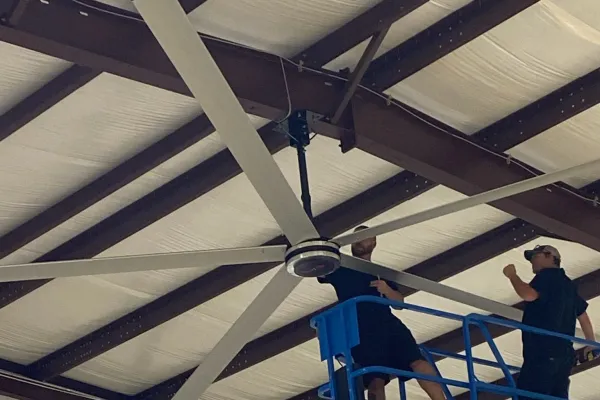
Selecting the right size HVLS fan for a warehouse
FAQs about ceiling height and HVLS fan sizing
What is the minimum ceiling height for an HVLS fan in an industrial building?
Most manufacturers recommend installing an HVLS-Ventilator so the blades are at least 10–13 ft above the floor. This usually means a Deckenhöhe of about 13 ft or more, and in many cases 20 ft or higher for full-size fans. Always check local codes and the specific product manual.
Can I use HVLS ceiling fans in a building with a low ceiling?
If your ceiling is below about 13 ft, a large HVLS-Deckenventilator may not be safe. Instead of one big size HVLS fan, you may need kleinere Fans or high-performance industrielle Luftzirkulatoren. Our engineering team can review your site and suggest the der richtige Ventilator für Ihren Raum.
How does ceiling height affect the right hvls fan size?
Higher ceilings trap more hot air near the roof. In these cases, a größerer Lüfter with bigger Größe der Deckenventilatorflügel can push air down further and mix temperatures better. For low ceilings, we choose a smaller Lüftergröße to meet the erforderliche Mindesthöhe while still moving enough air.
How many HVLS industrial ceiling fans do I need?
It depends on Größe des Raumes, Lüfterdurchmesser, and layout. We often start with coverage per fan, then adjust using rules like 2.5–3 × diameter between fans and 1.5 × diameter from walls. This method helps us find the distance between fans Und selecting the right HVLS fan count.
Do high volume low speed fans work with HVAC systems?
Ja. Lüfter mit hohem Volumen und niedriger Geschwindigkeit are designed to work mit your heating and cooling, not replace it. Many users report 20–30% energy savings when combining HVAC with HVLS-Ventilatoren, because they can raise or lower thermostat set points while keeping people comfortable.
How long is the typical lifespan of the fan?
A quality HVLS-Ventilator built for gewerbliche und industrielle use can last many years, often over a decade, with basic maintenance. Because these fans are specially designed to run at niedrige Geschwindigkeit and low stress, the lifespan of the fan is usually much longer than many small high-speed fans.
Work with a professional HVLS fan manufacturer to get the right size
Als engagierter Produktionsstätte für HVLS-Ventilatoren, we do more than just sell a Deckenventilator. We help you design the right size HVLS fan solution for your factory, warehouse, gym, school, or commercial building:
- We study your Deckenhöhe Und Größe des Raumes.
- We recommend Größe des HVLS-Deckenventilators based on safety codes and best practices.
- We calculate fan size selection, Anzahl der Fans, and mounting details.
- We support you from design to installation and after-sales service.
If you’re planning a new project, or tired of hot, uneven air in an existing building, we can help you select the best fan Und Größe des Deckenventilators so your workers, students, or customers feel better—and your energy bills go down.
Key points to remember (quick checklist)
- Ceiling height matters: Most HVLS-Ventilatoren should have blades at least 10–13 ft above the floor, with higher buildings favored for larger fans.
- Fan size is critical: Spiel Lüfterdurchmesser Zu Deckenhöhe Und Zimmergröße-die correct fan size avoids dead zones and safety issues.
- Use a size guide: A simple HVLS ceiling fan size guide (ceiling vs. diameter) helps you Wählen Sie das richtige starting point.
- Check clearances: Respect the erforderliche Mindesthöhe, sprinkler clearance, wall distance, and distance between fans.
- High volume low speed fans save energy: Properly sized HVLS-Ventilatoren helfen cut heating and cooling costs by 20–30% in many gewerbliche und industrielle Gebäude.
- Professional design is best: Work with an experienced supplier of HVLS fans Zu selecting the right hvls fan and layout for your facility.