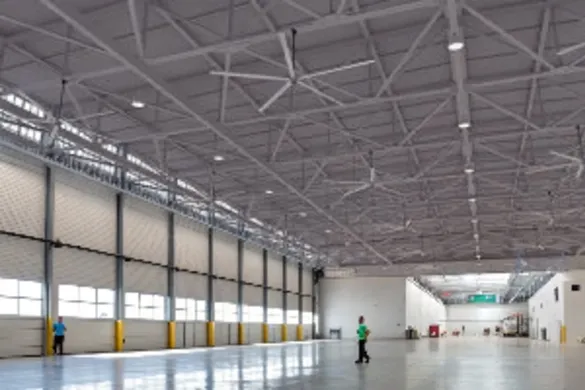
Hot and cold spots waste energy and slow teams down. Stale air, humidity, and uneven temperatures make a warehouse feel sluggish. A properly sized HVLS fan retrofit evens out temperatures, boosts comfort, and trims bills—without rebuilding your ceiling or ductwork.
Retrofitting HVLS fans works because these large, low speed systems move large volumes of air to destratify warm air, improve air circulation, and support your existing HVAC with measurable energy savings in big, tall spaces. Done right, installing an HVLS fan is fast, safe, and cost-effective.
What is an HVLS fan and why do fans in warehouses matter?
A HVLS fan (High-Volume, Low speed fan) is a very large industrial fan that rotates slowly to move a large amount of air gently across a large space. Typical diameters range from 12 ft to 24 feet. Because these fans move large volumes of air with minimal power, HVLS fans help stabilize temperatures and cut drafts.
In a warehouse, tall racks trap heat near the ceiling, while workers feel cooler at floor level. The result is wasted heating and poor airflow. HVLS fans are designed to destratify warm air and improve air mixing so conditions stay comfortable and safe. That’s why well-planned fans in warehouses deliver fast wins for comfort and bottom-line performance.
“Destratification from HVLS units can save up to ~25% on winter heating and up to ~30% on summer cooling when paired with smart setpoints.”
Choosing the right HVLS fan for your warehouse (how do you choose the right model?)
To choose the right HVLS fan, start with fan size, mounting height, and clearances. Ceiling height, obstructions, and aisle width drive the sweep diameter you can safely use. For many bays, HVLS fans come in 14–24 ft sizes, and fans are available with hub-to-floor safety systems and smart controls.
Beyond diameter, think about usage and ventilation goals. If you run conditioned air, the existing HVAC system benefits from destratification. If you don’t, HVLS fans provide an airflow solution that makes ambient conditions far more tolerable. When selecting a fan, a fan specialist models throw distance and fan placement to hit your targets for air circulation and reach in industrial facilities.
Tip: We manufacture and commission HVLS systems daily; our engineers map the amount of air needed per bay and propose fans for warehouse applications that meet code, safety, and ROI.
How do HVLS fans in warehouses improve airflow and ventilation?
Think of a gentle, room-sized “river” of airflow. The fan blades push air at low velocity down, then it spreads outward, washing aisles before rising along racks to be pulled back through the ceiling zone. Fans work with natural convection and ventilation systems to improve air quality and cut stagnant zones.
Because HVLS fans work continuously, they balance hot and cold surfaces and reduce moisture. This stabilizes humidity spikes around docks and doors. In short, HVLS fans can significantly enhance perceived cooling via evaporation in summer and reduce energy consumption in winter by destratifying.
Can HVLS ceiling fans for warehouse cut energy costs?
Yes. In summer, pairing HVLS ceiling fans for warehouse with setpoint adjustments lets you raise the thermostat while maintaining comfort—delivering real energy savings and lower energy costs. In winter, destratification limits heat pooling at the roof so the burner runs less.
- Evidence: An ASHRAE-published hangar study recorded 29% lower gas use from destratification with a single HVLS fan.
- Manufacturer and chapter guidance: Up to ~25% cost savings on heating and ~30% on cooling are achievable with proper control strategies.
When you use HVLS fans alongside the existing HVAC, the systems share the load—improving comfort while trimming run-time. Fans also support cooling and ventilation in non-conditioned buildings where air feels stagnant.
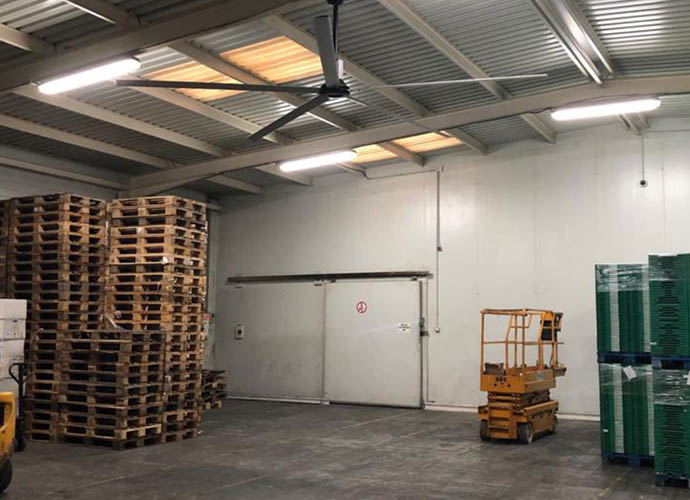
HVLS ceiling fans for warehouse
Retrofit checklist: fan placement, mounting, and HVLS fan installation
Goal: Install HVLS safely in an existing HVAC environment without disrupting operations. A typical HVLS fan installation follows this flow:
- Survey the warehouse space
Measure clearances, locate sprinklers, lights, cranes, and walkways. Confirm the structure where fans are installed (purlins, I-beams). Engage EOR when required.
- Engineering & fan placement
We map throw patterns, aisle directions, and racking heights to ensure fans move air along work zones. Proper fan placement avoids shadowing and meets local codes.
- Power & controls
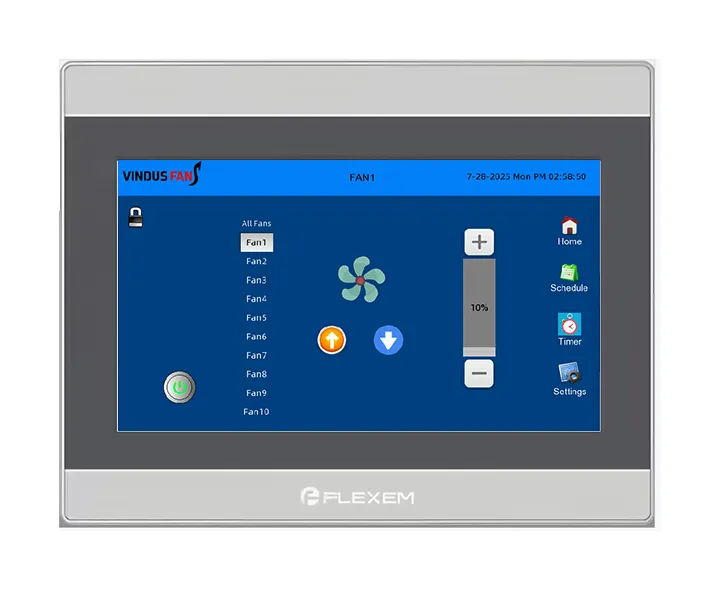
Integrate with building management controls for seasonal profiles. You can run the fans on temperature or schedule, and interlock with smoke detection when required.
- Commissioning
Verify rotation, balance, speed curves, and destratification effects. Train warehouse managers on seasonal setpoints and maintenance.
Safety note: Fans operate near the ceiling and should maintain sprinkler clearances per your AHJ. Always follow the manufacturer’s structural and electrical guidelines.
Sweating slab syndrome: can HVLS warehouse fans really help?
Sweating slab syndrome happens when warm, moist air meets a cool concrete floor and condenses—turning aisles slick. An HVLS retrofit improves airflow and mixes temperatures, reducing dew-point risks across bays and docks. HVLS fans can help lower slip hazards and improve uptime by keeping floors dry.
We’ve seen busy docks stabilize after adding one HVLS fan for your space per bay: fewer wet-floor flags and smoother forklift traffic. This keeps teams comfortable and safe and protects inventory.
Integrating with the HVAC system you already have
Retrofitting doesn’t mean starting over. Pair the fan’s destratification with the existing hvac system:
- Winter: Reduce envelope losses by eliminating thermal layers; supply registers can back off while the fan fans effectively mix warm air uniformly.
- Summer: Raise setpoints 1–3°C and hold comfort with air speed. This is how HVLS fans provide measurable savings with minimal changes to ducts or unit heaters.
We typically install hvls fans on dedicated VFD controllers or tie into BACnet to automate schedules and seasonal modes for smooth heating and cooling transitions.
Sizing guide: fan size, speed, and coverage for large industrial spaces
Selecting a fan is about diameter, mounting height, and obstacles. Here’s a quick warehouse coverage view:
| Diameter (ft) |
Typical Mount Height (m) |
Approx. Coverage (m²) |
Best For |
| 12 |
6–9 |
650–900 |
Low to mid bays, pick lines |
| 16 |
8–12 |
1,000–1,500 |
Mixed storage/packing |
| 20 |
10–14 |
1,600–2,200 |
High-bay aisles |
| 24 |
12–16 |
2,400–3,000 |
Large industrial sortation |
Fans can move vast “air rivers”—volumes of air at low rotation. Because the disk is huge, fans reduce hot/cold spots without drafts. Fans provide gentle, even airflow at floor level, which lifts productivity in task zones.
Rule of thumb: allow clear sweep under trusses and lights, and keep a safety envelope around sprinklers. When in doubt, call a fan specialist.
Controls, safety, and maintenance: keep it comfortable and safe
Modern HVLS fans require little upkeep: periodic torque checks, gearbox or direct-drive inspections, and firmware updates for controls. Fans are available with auto-reverse for seasonal modes and networked dashboards for alerts.
On controls, we often install HVLS fans with setpoint strategies: raise summer AC a couple degrees and let the fan move large volumes of air; in winter, maintain a low, continuous destratification speed. This adds comfort and energy stability across shifts while protecting racks and mezzanines.
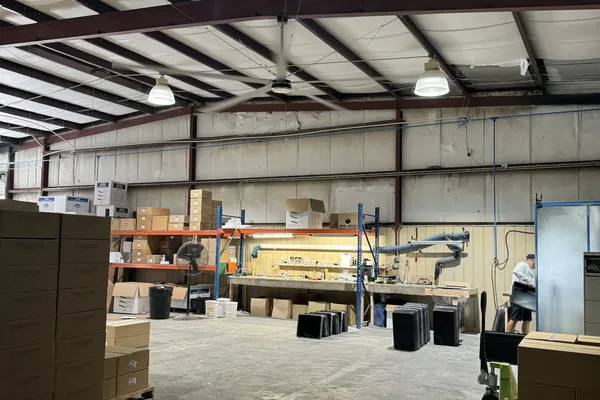
keep it comfortable and safe
Case study: a distribution center retrofit and ROI
At a 30,000 m² distribution center, management struggled with hot mezzanines and chilly docks. After a three-day retrofit of four HVLS warehouse fans, temperature spread dropped from 6°C to ~1.5°C. The team raised cooling setpoints by 2°C and trimmed burner cycles in winter.
- Result: Lower blower run-time and documented bill reductions in both seasons, consistent with industry reports of 20–30% savings potential when strategies are applied.
Do Vindus fans fit retrofits, and what about brands?
Vindus fans are a well-known retrofit option—broad size range, efficient drives, and integration support for BMS. Published guidance highlights destratification benefits and energy savings when paired with setpoint control and schedules. Other brands offer similar capabilities; the key is engineering, placement, and controls.
As a HVLS fan manufacturing partner, we recommend performance-based specs (CFM/W, coverage, controls) and site drawings before purchase to ensure your warehouse facility gets the outcome you expect.
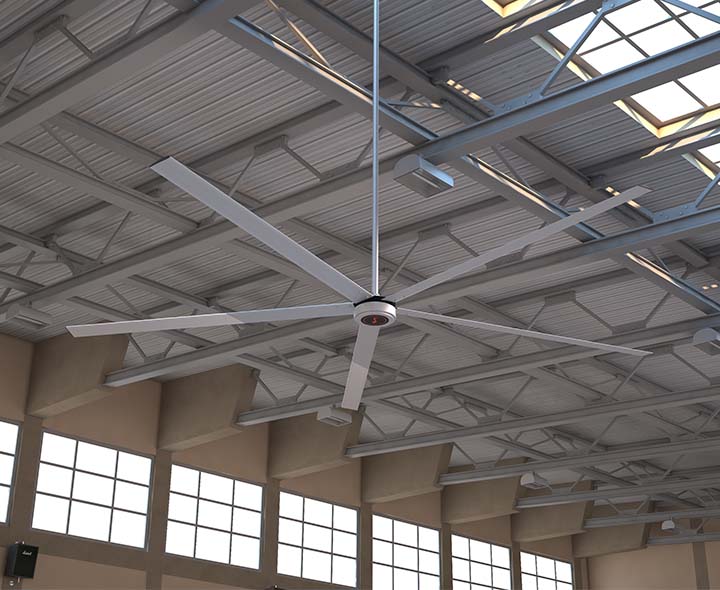
VINDUS M650 Series HVLS Fans
Quick buyer’s table: retrofit signals and actions
| Symptom |
What it Means |
Action |
| Hot roof / cold floor |
Thermal stratification |
Destratify with HVLS fan continuous low-speed mode |
| Slick dock floors |
Dew-point condensation |
Add fans to mix air and reduce sweating slab syndrome risk |
| Stale corners |
Poor ventilation |
Redirect throw and tune speeds |
| High bills |
Inefficient mixing |
Pair fans with setpoint strategy for cost savings |
FAQ
Will installing an HVLS fan disrupt operations?
Downtime is minimal. With lift access and pre-fab mounts, we can install hvls fans between shifts. Most jobs complete quickly after structural checks and power prep.
Do HVLS fans for your facility replace air-conditioning?
No. They complement HVAC. Air speed boosts comfort so you can adjust setpoints. In non-conditioned warehouse buildings, they make heat bearable by improving air circulation and perceived cooling.
Are HVLS fans for warehouse applications noisy?
They’re quiet. The large disk at low speed creates smooth airflow with minimal turbulence or hiss—ideal for pick lines and QC stations.
How do I choose the right HVLS fan for your space?
Consider height, obstructions, aisle widths, and target zones. Work with a fan specialist to model coverage and confirm structure. That’s choosing the right hvls fan with data, not guesswork.
What about safety under sprinklers and cranes?
Follow clearances and local codes. Mounts, guy wires, and shutdown interlocks protect systems when required. When fans are installed per spec, they operate comfortable and safe for people and equipment.
Putting it all together (editor’s guidance and practical notes)
- If you already have air-conditioning, existing hvac equipment runs less because destratification reduces runtime.
- If you don’t, fans for warehouse comfort still deliver value through stable airflow and evaporative relief.
- “Refresh fans” (as some teams nickname them) work best when you plan fan placement for aisles and docks, then automate speeds by season to improve air mixing throughout the day.
Implementation mini-plan (use this to start fast)
- Walkthrough – Map hot/cold spots, door cycles, and shifts across the warehouse.
- Engineering – Calculate throw per HVLS fan and obstructions; create a layout with callouts for near the ceiling mounts.
- Controls – Create a seasonal schedule (summer setpoint raise; winter destrat).
- Commissioning – Validate mixing and comfort; document before/after.
- Training – Hand off SOPs so warehouse managers can tune and run the fans with confidence.
Terminology and phrases you’ll hear (so specs make sense)
- HVLS fans work by moving a large amount of air gently with a huge disk.
- “Fans come with direct-drive motors or gearboxes; both can be efficient.”
- “Fans perform best when they can breathe—keep clearances open.”
- “Fans for better destratification run continuously in winter.”
- “Fans effectively complement unit heaters and RTUs.”
- “Fans and air speed together drive comfort; it’s not only temperature.”
Final notes on selection and ownership
A well-planned retrofit reduces energy costs, stabilizes conditions, and supports safety—without complex duct changes. Vindus fans and other premium options integrate with controls easily, and fans are available in multiple diameters and finishes to match your warehouse needs. The best path is a consultative design with a manufacturing partner that builds, installs, and supports your system end-to-end.
Bullet-point summary (what to remember)
- HVLS fan retrofits move large air masses gently to destratify and stabilize conditions.
- Proper fan placement and controls deliver seasonal savings and better comfort.
- Pairing with HVAC setpoint strategies yields measurable reductions in energy consumption.
- Use fans to combat sweating slab syndrome, especially near docks.
- Size by height and obstructions; diameters up to 24 feet cover big bays.
- Start with a walkthrough, layout, controls plan, and safe HVLS fan installation.
- Well-executed projects are comfortable and safe, efficient, and scalable across sites.