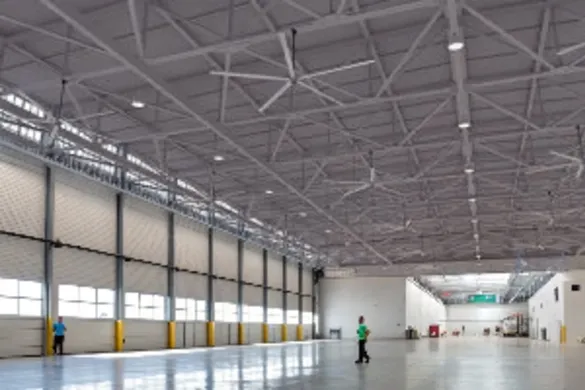
Your huge warehouse has a big problem. The air doesn’t move. In summer, it gets too hot. In winter, all the warm air gets trapped at the ceiling. This makes workers unhappy and your power bills soar, costing you money every day. This is a common issue called air stratification.
You need a solution, not just a guess. The answer is a smart plan for High-Volume, Low-Speed (HVLS) fans. These giant, slow-moving fans are the key to a comfortable, low-cost warehouse. This guide provides a scientific way to plan your HVLS fan layout and solve your air problem for good.
At Vindus Fans, we are experts in moving air. Our story started in Spain in 2019 with a big idea: to move air in a smart, green way. We grew quickly, opening a hub in Qingdao, China in 2020, and expanding to the United States in 2021. Our skilled Swedish engineering team designs top-quality fans for all kinds of spaces, like a commercial building, a gym, or a large logistics facility. Our goal is to give you fresh, moving air.
1. Look First: Get the Facts for Your Warehouse
You have a big problem. Your warehouse has bad air. But you cannot fix it with a guess. Guessing where to put big fans is like throwing money away. You might put them too close. Or you might put them too far apart. You will still have hot spots and cold spots. The problem will not go away.
This is very frustrating. You spend a lot of money on industrial ceiling fans. But your workers still complain. Your power bills are still high. You did not get the energy savings you wanted. You need a real plan, not a guess. A bad plan can even be unsafe.
The solution is to start with data. You must be a detective in your own warehouse. A good plan starts with good facts.
- 1.1. Measure Your Big Space:
- First, find out the size. How many square meters is your space? You need the exact number.
- Next, look up. How high is your ceiling? This ceiling height consideration is very important. It tells you what size fan you need. This is the first step in a good warehouse ventilation design.
- 1.2. Find and Map Your Roadblocks:
- Your warehouse is not empty. It has things in it. These things can block air.
- Get a map of your floor. Mark all the big things. This includes pallet racking, shelves, and big machines. Do you have an overhead crane? Mark that, too. Do you have a mezzanine level ventilation challenge? Put it on the map. Every obstruction clearance matters.
- 1.3. Know Your Work Areas:
- Your warehouse has different zones. Each zone has a different job.
- You have loading dock airflow areas. You have places for packing. You have long aisles for picking. These are called pick module ventilation areas. Each zone needs air in a special way. Good zoned fan control will be important later.

Get the Facts for Your Warehouse
2. Pick Your Fans: Get the Right Tools for the Job
You have a new problem. You know your space. But what fan do you buy? There are so many choices. Big fans, small fans. Different motors. It is confusing.
If you choose the wrong fan, you will waste money. A fan that is too small will not move enough air. It will be like a whisper in a storm. A fan that is too big for the space can create too much wind. This can blow papers around and make workers unhappy. You want a gentle breeze, not a hurricane. Making the wrong choice hurts your Return on Investment (ROI) for HVLS fans.
The solution is to choose your fans with care. Use your data to pick the right size and the right number of fans. This is how you get the best HVLS fan performance.
- 2.1. Fan Size and Ceiling Height:
- There is a simple rule. High ceiling means you need a big fan. Large diameter fans are best for high-bay warehouse climate control. A fan with a 24-foot blade can move a huge column of air from the ceiling to the floor.
- Look at this chart for help. It is a good starting point for your fan diameter selection.
| Fan Diameter (feet) |
Typical Ceiling Height (feet) |
Maximum Coverage Area (sq. ft.) |
| 8 |
30 |
60 |
| 12 |
35 |
70 |
| 16 |
45 |
90 |
| 20 |
52.5 |
105 |
| 24 |
57.5 |
115 |
- 2.2. How Many Fans Do You Need?
- To get a good guess, use a fan sizing formula. You can find these online. Or even better, ask an expert.
- The basic idea is to divide your total floor space by the area one fan can cover. This will tell you about how many fans you need for full fan coverage area.
- 2.3. Motors and Smart Controls:
- You can choose a direct drive motor or a geared motor HVLS. A direct drive motor is very quiet. This is good for areas where people work close by.
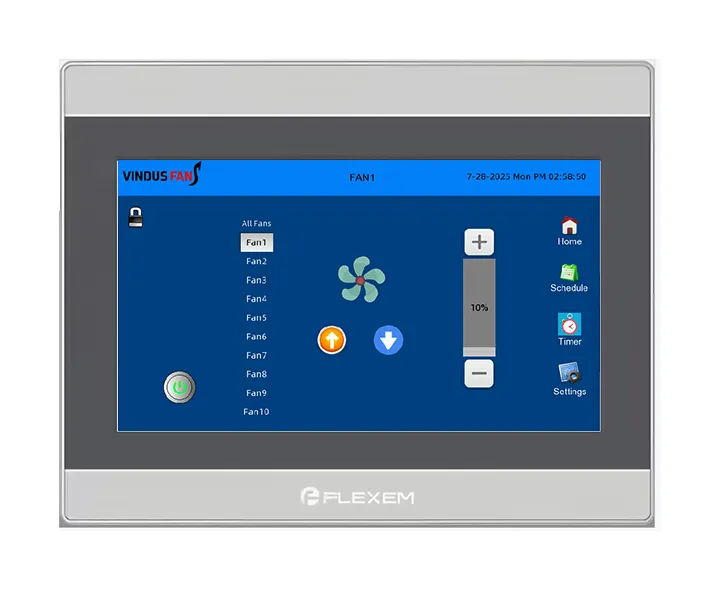
- You also need smart controls. A Variable Frequency Drive (VFD) lets you change the fan speed. This is very important for energy-efficient air movement. It lets you get the perfect airflow velocity. Many modern fans, like the M750 Series HVLS Fans, have these smart controls. They help you save the most money.
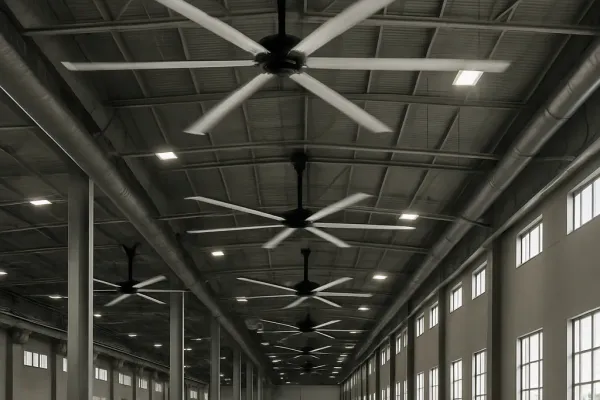
Pick Your Fans
3. Place Your Fans: A Map for Perfect Air
Now you have the right fans. But where do you put them? This is a very big question. If you put them in the wrong place, the air will not move everywhere. You will create a new problem: dead air spot elimination.
It is so frustrating to spend money on the best fans ,only to have hot and cold spots. Some workers are sweating, and others are freezing. This means your plan failed. The air circulation patterns are fighting each other. Or they are not reaching the corners. Your goal of air distribution uniformity is lost.
The solution is a smart layout plan. This is the most important step. It is how you create one big, gentle flow of air. It is how you achieve true destratification.
- 3.1. Rules for Open Spaces:
- In big, open areas, the rule for HVLS fan spacing is simple. The space between fans should be about three to four times the fan’s size.
- Also, keep fans away from walls. The fan should be at least 1.5 times its size away from a wall. This gives it room to breathe.
- 3.2. A Mix for Tricky Spaces:
- What about spaces with high racks? This is a common problem in a 3PL warehouse ventilation plan. A big fan up top cannot push air down a narrow aisle.
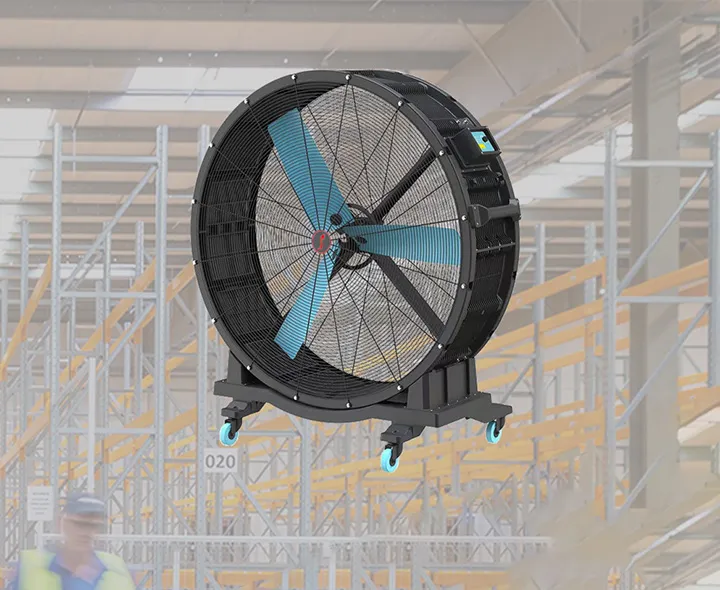
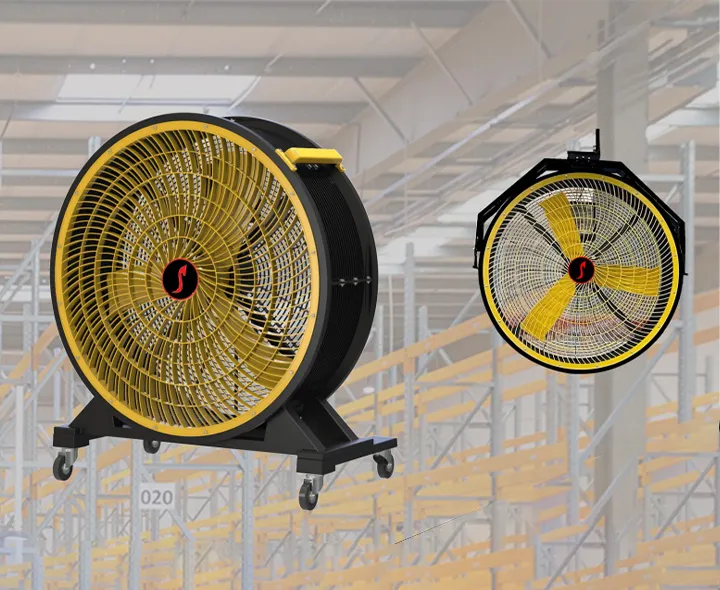
- The answer is to use a mix. Use large diameter fans in the open areas. Then, use smaller, directional fans, like a Galvanized Hanging Ceiling Fan, to push air down the aisles. This blended plan is very effective.
- 3.3. Special Plans for Special Zones:
- Loading Docks: Put fans here to make workers feel good. It also stops outside heat or cold from coming deep into the building.
- Work Areas: Put fans right over the spots where people work. This gives them the most comfort. This helps a lot with employee productivity benefits. A happy worker is a good worker.
- Mezzanines: These areas can trap hot air. A well-placed fan keeps the air from getting stuck.
For complex buildings, you need more than a simple plan. You need to see the air. Experts can use a computer to do an airflow simulation. This is called Computational Fluid Dynamics (CFD). Software like Ansys Fluent or SolidWorks Flow Simulation can create a 3D map of your air. This is the best way to plan.
4. Safety First: Rules You Cannot Ignore
You have a big plan for your big fans. But are they safe? A giant fan spinning high up is a big piece of machine. You cannot just hang it up and forget it. There are rules you must follow.
If you ignore safety rules, bad things can happen. A fan could fall. That is very dangerous. A fan could also block a fire sprinkler. This is a huge risk. If there is a fire, the sprinklers must work. Not following rules from groups like OSHA or the NFPA can lead to big fines. Or worse, someone could get hurt.
The solution is to make safety your top priority. A safe fan system is a good fan system. This is not a place to cut corners.
- 4.1. Rules for Fire Sprinklers:
- The National Fire Protection Association has rules. One is NFPA 13. This rule is about sprinklers.
- You must keep your fan blades at least 3 feet below the sprinklers.
- It is best to put the fan right in the middle of four sprinkler heads.
- Your fans must also be linked to the fire alarm. If the sprinklers go off, the fans must turn off right away. This is a must-have safety rule.
- 4.2. Keep a Safe Distance:
- Fans need space. Keep them away from lights. If a fan is too close to a light, it can make a bad flickering effect.
- Make sure the mounting height is high enough. Forklifts and other tall machines must be able to drive under the fans without any risk. The fan’s airfoil blade design is strong, but it should never be hit. Always use guy wires and safety cables for extra protection.
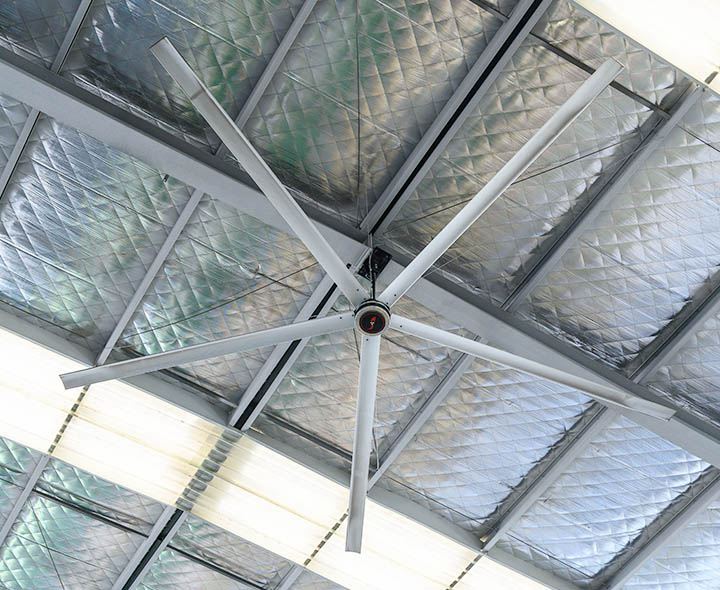
Rules You Cannot Ignore
5. Get Help: Use an Expert and Avoid Mistakes
You are planning a big project. It is easy to make a mistake. There is a lot to think about. What if you miss something?
Common HVLS layout mistakes can cost you a lot of money to fix. You might have to pay a team to come back and move the fans. You might realize you did not buy enough fans. Or you bought the wrong kind. These mistakes are painful. They hurt your budget and delay the benefits of better air. You will not see the fast ROI that case studies promise.
The solution is to work with a partner who knows HVLS fans. A professional company can help you avoid these problems.
- 5.1. The Power of a Pro Air Plan:
- Many companies that sell fans, including us at Vindus Fans, offer design help. Our background is in manufacturing high-quality fans. We can help you plan the perfect layout for your manufacturing plant or warehouse.
- We can use a CFD analysis to show you exactly how the air will move. This lets you see and fix problems before a single fan is installed.
- 5.2. Big Mistakes to Avoid:
- Bad Spacing: This is the #1 mistake. Too close means air fights itself. Too far means you get dead spots.
- Ignoring Blockers: You must plan for your racks and machines. Air cannot go through a solid wall of boxes.
- One-Size-Fits-All: A plan for an empty room will not work in a busy e-commerce fulfillment center. Every space is different. You need a custom plan. You can learn more by reading about what HVLS fans are used for.
Look at what is possible with a good plan.
| Facility Profile |
Installation Details |
Projected Annual Savings |
Payback Period |
| 30,000 sq ft Warehouse |
4 HVLS Fans |
$7,500 (30% of HVAC cost) |
5.3 years |
| 120,000 sq ft Plant |
14 HVLS Fans |
$63,000 (35% of HVAC cost) |
1.9 years |
| 150,000 sq ft Warehouse |
5-7 Fans |
$35,000 – $80,000 |
12 to 24 months |
These numbers show that a smart plan pays for itself very quickly.
6. After You Install: Check and Change
Your new fans are installed. The job is done, right? Not quite. Just because the fans are spinning does not mean the plan is perfect. You need to check if it is working as you hoped.
If you do not check, you might not be getting all the benefits. There could still be a hidden dead spot. The fan speed might be too high or too low. You might be missing out on extra energy savings. The job is not over until you know the system is working perfectly.
The solution is to test and fine-tune your new system. A little bit of checking can make a big difference. It ensures you get every penny of value from your investment.
- 6.1. See the Air and Ask Your Team:
- How do you know the air is moving? You can do a simple smoke test. This is an airflow visualization technique. It will show you if the air is reaching every corner.
- The best way to know is to ask your workers. Are they comfortable? Do they feel a nice, gentle breeze? Their feedback is very valuable.
- 6.2. Smart Changes for a Smart System:
- Your fans have two jobs: one for summer and one for winter.
- In the summer, run the fans forward. This creates a breeze that makes people feel 6 to 10 degrees cooler. This is called the thermal comfort effect. It can reduce heat stress.
- In the winter, run the fans in reverse at a very low speed. This is the magic of winter destratification with HVLS fans. It pushes the trapped hot air from the ceiling down to the floor. This simple trick can cut your heating bills by up to 30%.
A well-planned HVLS fan system, from trusted makers like MacroAir, Greenheck, or Blue Giant, is more than just equipment. It is a powerful tool for your business. It is a way to save money, boost productivity, and create a better, safer place to work.
From our start in Spain to our work today across the globe, our team at Vindus Fans is proud to be a part of this solution. Our company introduction is built on a promise of quality and sustainable innovation. We bring that promise to every warehouse, automotive shop, and agriculture barn we work with. A smart plan for your air is a smart plan for your future.
Frequently Asked Questions (FAQ)
How many HVLS fans do I need for a warehouse?
There is no single answer. It depends on your warehouse’s size, ceiling height, and what is inside. First, find the total square meterage. Then, check the fan maker’s guide for the coverage area of one fan. A rough estimate is to divide your total area by the fan’s coverage area. For the best plan, get an expert to do an airflow analysis.
What is the best HVLS fan spacing?
A good rule for open areas is to space fans about 3 to 4 times the fan’s diameter apart. For example, two 24-foot fans should be about 72 to 96 feet from each other. This creates overlapping circles of air and prevents dead spots. The right spacing also depends on the obstacles in your space.
Are HVLS fans safe with fire sprinklers?
Yes, they are safe if you follow the rules. The main rule, from NFPA 13, is that fan blades must be at least 3 feet below the sprinkler heads. Also, the fans must be connected to the fire alarm system. If the alarm goes off, the fans must shut down automatically. This ensures they do not affect how the sprinklers work in a fire.
Can HVLS fans reduce heating costs in winter?
Yes, absolutely. In winter, you run the fans in reverse at a very low speed. This gently pushes the warm air that is trapped at the ceiling down to the floor where people work. This process is called destratification. It can lower your heating bills by 20% to 30% because your heating system does not have to work as hard.