Do you have bad air in a big room? This guide will show you how to fix it. We will teach you the rules for a good hvls fan layout design. We will show you how to meet safety rules and how to check your work. You will learn all you need for a system that gives you even air distribution, gets rid of trapped heat with destratification, and gives you real measurable performance data. A good design uses fans that are tested to tough standards, like ANSI/AMCA 230 or 10 CFR Appendix U. This makes sure you get what you pay for.
What “HVLS fan system design” actually means
Design goals in large industrial spaces
Big buildings have big air problems. In the winter, heat rises and gets stuck at the ceiling. This is called thermal stratification. Your heaters work hard, but the floor stays cold. This is a big problem. In the summer, the air just sits. It gets hot and sticky. This makes workers unhappy and slow.
A good hvls fan system design fixes these problems. It has two main goals:
- Destratification vs comfort cooling (winter vs summer)
- In winter, the goal is destratification. Big, slow fans push the trapped hot air down. This is the hvls fan destratification winter mode. It mixes the air. This vertical temperature gradient reduction makes the whole room feel warm. It saves a lot of money on heating bills. A good destratification fan design is key.
- In summer, the goal is comfort cooling. The fans create a gentle breeze. This is a summer comfort cooling airflow strategy. The breeze makes people feel much cooler. This is the evaporative cooling effect. It helps with heat stress mitigation airflow.
- What does a good design look like? It means you have uniform air speed across the floor. You reduce hot spots warehouse airflow can cause. You have fewer cold zones. The air is always moving, just a little. This is called industrial air circulation planning.
This kind of large space air mixing strategy is used in many places. We see it in almost any facility with high ceilings.
Common facility types:
- Warehouse: A warehouse hvls fan design keeps products and people happy.
- Distribution center: A distribution center hvls fan layout is vital for moving goods.
- Manufacturing plant: A factory hvls fan design improves safety and work speed. We see this in many places, like an automotive assembly plant.
- Aircraft hangar: An airplane hangar hvls fan design needs special care due to huge doors.
- Gymnasium: A gymnasium hvls fan design keeps players and fans cool.
- Agricultural barn: A heat destratification system design can keep animals healthy.
From a food processing facility to a cold storage unit, a good manufacturing plant air circulation design is the solution to air problems.
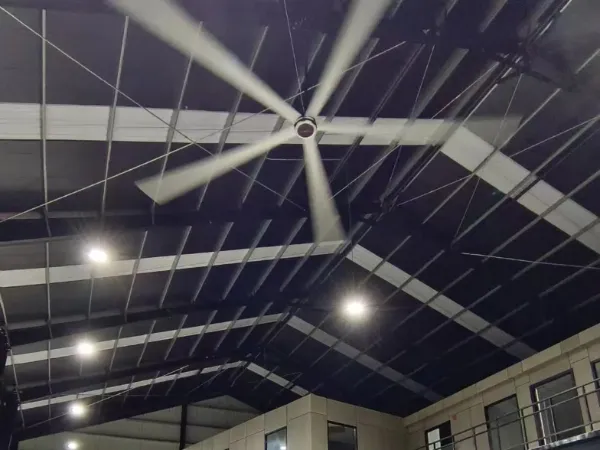
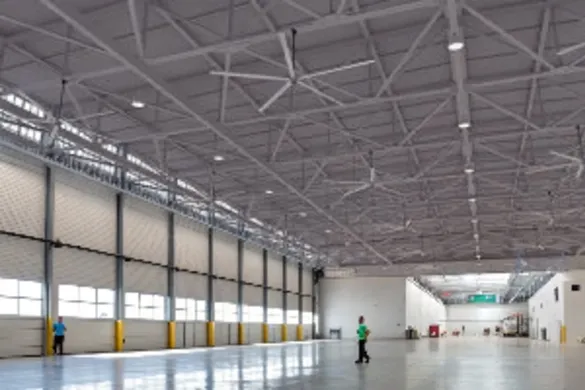
Industrial HVLS fan moving air in a warehouse
Inputs you must collect before layout (fast checklist)
Facility data needed for correct layout
You cannot guess where to put fans. Bad hvls fan placement plans waste money. You have a problem: you need perfect air movement, but your building is full of stuff. This stuff can block the air.
This is a big worry. If air is blocked, you get gaps. Some spots are hot, and some are cold. You might have hvls fan obstructions coverage gaps. Your system will not work right. You will not get the airflow uniformity large facilitys need.
The solution is to measure first. A good hvls fan quantity per square foot depends on your building. You need a list of things before you start the industrial ceiling fan system design.
Here is a checklist:
- Ceiling height + structure type: How high is the ceiling? What is it made of? This helps choose the right downtube length selection hvls fans need. You also need to know if you have a ceiling slope mount hvls fan situation.
- Racking/mezzanine/lighting/sprinklers/overhead cranes: You must know where everything is. This is key for hvls fan clearance requirements. You need to know the hvls fan beam and sprinkler clearance, hvls fan lighting clearance, and hvls fan crane clearance. For warehouses, hvls fan rack aisle clearance is very important. You also need to think about a hvls fan mezzanine clearance and hvls fan docking bay constraints.
- HVAC type and schedule: What kind of heaters and air conditioners do you have? Do you use make-up air units or RTUs? When do they run? This helps to interlock hvls fans with hvac systems. This also helps improve hvac efficiency with hvls.
- Problem zones: Where are the hot spots? Where does it feel stuffy? Do you have wet floors from condensation? A goal is to prevent slippery floors condensation control. You want to reduce condensation with hvls fans.
Collecting this data is the first step in a smart airflow design for warehouses and other big spaces.
Performance ratings and standards you should specify (to avoid “marketing airflow”)
The rating stack that matters for HVLS system design
Some companies make big claims about their fans. They say their fans move a lot of air. But the numbers can be fake. This is a problem. You could buy a fan that does not work as promised. You will be stuck with a weak system.
This is frustrating. You spent money but did not solve your air problem. You need a way to know you are getting a good fan. You need proof.
The solution is to ask for fans that are tested by the rules. This ensures you get what you pay for. Manufacturers who are serious about quality, like Vindus Fans with their Swedish engineering team, believe in these standards. They build robust, efficient fans and prove it with data. They know that a good fan is the start of a good system. A great hvls fans manufacturer will always provide this data.
Here are the ratings and standards that matter. These are often managed by organizations like AMCA (Air Movement and Control Association) and ASHRAE.
- ANSI/AMCA 230: This is the rule for amca 230 fan airflow rating. It tells you how to test a fan in a lab to see how much air it really moves. Always ask for fans with an AMCA 230 test report.
- AMCA Certified Ratings Program: Look for the AMCA seal. This means the fan company paid for an independent lab to check their numbers. It is a sign of trust.
- DOE compliance: The U.S. DOE (HVLS ceiling fan regulations) has rules for fan efficiency. There is a DOE hvls ceiling fan compliance database. Make sure the fan you choose is on the list. The metric they use is called the Fan Energy Index (FEI), which replaced the old CFEI. It is also covered by AMCA 208 fan energy index FEI.
- UL 507 / ETL: These are safety listings. UL (Underwriters Laboratories) is a key organization here. A UL 507 listed hvls fan means the fan has been tested so it will not cause fires or electric shocks. It is very important for safety.
When you write your plan, use this language: “All fans must be tested to AMCA 230. All fans must be listed on the DOE database. All fans must have a UL 507 safety listing.” This is the hvls fan specification guide for engineers.
Layout logic: spacing, coverage, mounting height (how designers think)
How to build an HVLS fan layout plan (step-by-step)
Just buying good fans is not enough. Where you put them is the most important part. The problem is that big rooms are tricky. If you put fans too close, you waste money. If you put them too far apart, you get dead spots with no air.
This can ruin the whole project. You will still have unhappy workers. You will not get the energy savings you wanted. All your planning will be for nothing. A bad layout means a bad system.
The solution is a step-by-step plan. This is how professional designers think. They use hvls fan spacing guidelines to create a map for the air.
- Step 1: Define zones. A factory is not just one big room. You have production lines, packing areas, and loading docks. Each zone may need a different amount of air.
- Step 2: Select fan size. The size of the fan, or hvls fan diameter selection, depends on the ceiling height. A higher ceiling needs a bigger fan. This also depends on the things in the room.
- Step 3: Draft a spacing grid. A common rule is to space fans about 3 to 5 times their diameter apart. This is a good start. Your goal is to make sure the air from one fan meets the air from the next fan. This avoids dead zones. You want good air mixing effectiveness hvls provides.
- Step 4: Check clearances. This is a critical step. Use your checklist from Section 2. You must have at least 3 feet of space between the fan blades and sprinklers. This is an NFPA rule for sprinkler clearance. You also need to check the hvls fan mounting height requirements. The fan should be high enough to be safe but low enough to move air on the floor.
- Step 5: Iterate and improve. Look at the corners. Look at the areas near big doors. Do these spots get enough air? You may need to move a fan or add a smaller one. The goal is airflow optimization using cfd or simple rules. You want to achieve temperature equalization high bays need for comfort.
This careful planning ensures the indoor air circulation for high ceilings is perfect. It’s a core part of ventilation enhancement hvls fans provide.
Modeling & validation (when you should use CFD vs field measurement)
CFD and airspeed mapping for large facilities
How do you know your layout plan will work? You can’t be sure just by looking at a drawing. The problem is that air is invisible. You can’t see where it will go. For a simple room, the spacing rules work well. But for a very complex building, like a huge logistics hub or an automotive plant, you may need more proof.
The risk is being wrong. A big installation costs a lot of money. If it does not work, it is a huge waste. You need to be sure before you install dozens of fans.
The solution is to use special tools to see the air. This is called modeling and validation.
- When to use CFD: CFD (Computational Fluid Dynamics) is a computer tool. It lets you do an hvls fan cfd simulation. Engineers build a 3D model of your building in a computer. Then they add the fans. The computer shows how the air will move. You can see an airflow contour map hvls fans create. You can see the velocity vector field hvls fan produces. A ventilation efficiency cfd study is helpful when the building has many blockages, or when the cost of being wrong is very high. Some engineers use tools like AutoCAD and OpenFOAM for this cfd airflow modeling warehouse fans need.
- How to validate: After the fans are installed, you need to check the work. This is called commissioning airflow verification. You use a tool called an air velocity anemometer. You walk around the building and measure the air speed. This is airflow measurement validation. You create an air speed mapping study. This proves the system works as designed. It shows you have the right airflow velocity target at occupant level. It also shows good air speed distribution warehouses require. This performance testing hvls fans undergo is the final proof.
This process is sometimes called a design of experiments hvls airflow study. It links the fan throw and coverage modeling to real-world results. It is the best way to ensure the ventilation modeling for high bay facilities was a success. For complex projects, this can also be done in Revit to perform bim hvls fan coordination and clash detection hvls fan install.
Controls strategy: VFD, zoning, and BMS integration
Controls that make HVLS a “system,” not just fans
You have great fans in the perfect spots. But what tells them what to do? The problem is that a building’s needs change. A loading dock is busy in the morning but empty at night. A production line runs on some days but not others. If your fans run at full speed all the time, you waste energy.
This is a big missed opportunity. You are not getting the full savings you could be. Your fans are not being smart.
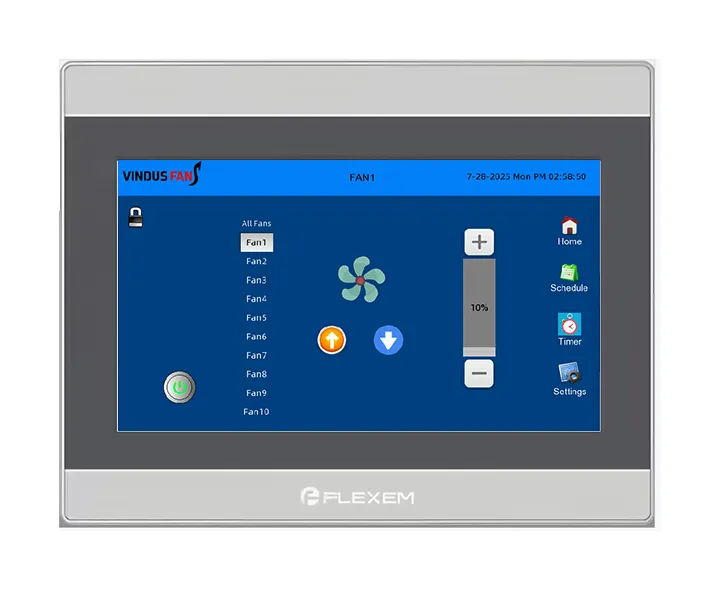
The solution is a smart hvls fan control system design. This turns your fans into a thinking system. This is where a company’s technology matters. A great provider offers controls that are easy to use but very powerful. This is how you achieve a true networked hvls fan system.
Here are some control ideas:
- VFD speed control: Every HVLS fan has a VFD (variable frequency drive). This lets you change the speed. An hvls fan vfd control strategy allows you to run the fans very slowly in the winter for stratification reduction industrial buildings need, and faster in the summer for cooling. This is the difference between the winter reverse mode control and the summer cooling mode control.
- Zoning: You can create a zoned hvls fan control system. You can put fans in one area on a single controller. For example, the dock fans can be on Zone 1. The packing line fans can be on Zone 2.
- Smart triggers: You can use an occupancy sensor hvls fan control. The fans turn on when people are in the area. You can also use temperature-based hvls fan control. The fans get hotter as the room gets hotter. This is part of demand-based ventilation + hvls.
- BMS integration: Many big buildings have a BMS (Building Management System). You can connect your fans to it. This allows bms integration hvls fans need. The two common languages for this are BACnet and Modbus. You can get a bacnet hvls fan controls or a modbus hvls fan controller. This lets one person manage the whole building from a computer, using a central hvls fan management platform.
- Schedules: You can do scheduling hvls fans for shifts. The fans turn on 30 minutes before workers arrive and turn off after they leave.
These smart hvls fan controls are key to maximizing your savings and comfort. They also allow for fault monitoring hvls fan systems and can help with predictive maintenance hvls fan controls. The final commissioning controls sequence hvls should be tested thoroughly.
Safety + compliance coordination during install
Installation constraints engineers must coordinate
Putting up a giant fan is a big job. The fan is heavy. It hangs high in the air. The problem is that if it is not installed right, it can be very dangerous. A fan could fall. It could shake too much. It could interfere with fire safety systems.
This is a huge risk. The safety of your workers is the number one priority. A mistake here is not an option.
The solution is to plan for safety from the start. A good installation is part of the system design.
Here are things to coordinate:
- Structural support: The hvls fan mounting structure design must be approved by a structural engineer. The ceiling must be strong enough to hold the fan’s weight and motion.
- Seismic and vibration: In some areas, you need seismic bracing hvls fan mount designs. You may also need vibration isolation hvls installation to stop the fan from shaking the building.
- Sprinkler coordination: This is a big one. As we said before, you need at least 3 feet of clearance. The fan must also be centered between four sprinkler heads. Most important, the fan must automatically shut down if the sprinklers go off. This requires an interlock with the fire alarm system, as noted by NFPA 72.
- Maintenance access: How will you clean or fix the fan? You need to plan for hvls fan maintenance access planning. Can you get a lift to the fan? This should be part of the plan.
A good industrial fan install commissioning checklist will include all of these safety checks.
Final deliverables (what your design package should include)
What to hand to the client / GC / MEP team
The design is done. Now you need to share it. The problem is that if the plan is not clear, people will make mistakes. The wrong fan could be ordered. The fans could be installed in the wrong place.
This leads to confusion and delays. The project will take longer and cost more.
The solution is a complete design package. It should have everything the installers and owners need to know.
Here is what it should include:
- Layout drawing + fan schedule: A map showing where each fan goes. A list of the fan models, sizes, and specs.
- Clearance notes: A drawing showing the clearances to lights, sprinklers, and cranes.
- Controls sequence: A document that explains how the controls work. For example: “At 7 AM, fans in Zone 1 will turn on to 50% speed.”
- Submittal requirements: A list of documents the fan supplier must provide. This must include AMCA 230 testing data, proof of DOE listing, and the UL/ETL listing for safety.
- Commissioning checklist: A list of tests to be done after installation to prove the system works right.
This package ensures everyone is on the same page. It is the key to a successful project.
FAQs
Frequently Asked Questions
- How many HVLS fans do I need for a 100,000 sq ft warehouse?
- It depends on the ceiling height and layout. For a simple, open warehouse with a 30-foot ceiling, you might use 8 to 12 large 24-foot fans. But you must do a proper layout design.
- What’s the best mounting height and clearance for HVLS fans?
- The fan blades should be at least 10 feet from the floor for safety. They should be at least 3 feet from the sprinklers. The ideal height depends on the fan diameter and your goal (destratification vs. cooling).
- Should I require AMCA 230 test data in the specification?
- Yes, absolutely. This is the only way to know you are getting the airflow the company promised. It is a key part of an honest comparison.
- How do HVLS fans help destratification in winter?
- They run slowly to push the hot air trapped at the ceiling gently down to the floor without creating a draft. A field study in an airport hangar showed this can cut the floor-to-ceiling temperature difference from 6.0°F down to just 0.7°F and reduce gas use by 29%.
- Can HVLS fans integrate with BACnet/BMS?
- Yes. Most top-tier HVLS fans can be ordered with controllers that speak BACnet or Modbus, allowing them to be fully integrated into a building management system.
Send your building dimensions, ceiling height, and layout. We’ll return a layout, fan schedule, and compliance-ready spec notes (AMCA 230 / DOE / UL). Contact Vindus Fans today to learn about the best hvls fans for your space and see how our industrial ceiling fans for manufacturing can transform your facility.