Dust builds up, bolts loosen, and tiny faults grow. That’s how quiet fan failures start. A short, clear maintenance checklist and ten minutes per month keep comfort high and downtime low—so your team stays safe and productive.
A good HVLS fan maintenance checklist covers: safety lock-out, visual inspections, mounting hardware checks (including safety cable and guy wire), electrical connections, clean the top of the fan and fan blades, look for signs of wear or signs of damage, verify controls, document findings, and schedule quarterly service for deeper tasks.
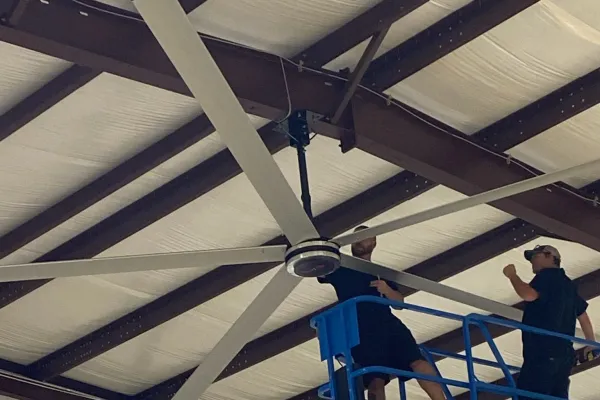
Why does maintenance matter for an HVLS fan?
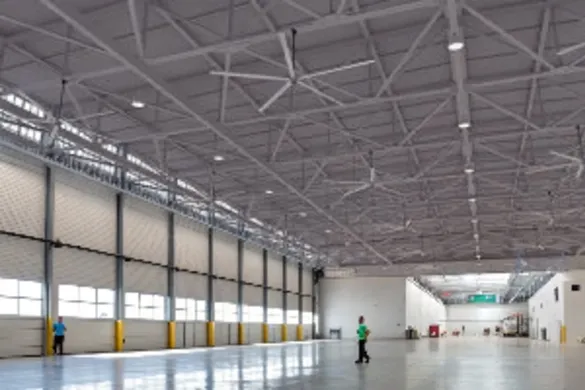
If you manage a factory, gym, school, or warehouse, your hvls fan is not just “a big industrial fan.” It’s a comfort system. Quiet, high volume airflow at low speed improves worker focus and reduces heat stress. HVLS fans are designed to run for years with minimal maintenance, yet small issues can expand quickly without a plan.
Maintenance helps you spot potential issues early. Loose bolts and nuts, dust on the blade, or a slack guy wire can create noise, vibration, and unbalance. With proper maintenance, you protect the performance of your hvls and keep people feeling cool through steady airflow and improved air circulation.
Looking for models that pair easy service with strong output? See our lineup of HVLS fans built for all-day duty.
What should your HVLS fan maintenance checklist include?
Start with a simple document—your fan care card—that your in-house team can update. List each specific fan, serial number, and maintenance schedule. Add a space for notes and maintenance recommendations so trends are easy to track and avoid costly repairs.
Here is a core fan maintenance checklist you can adapt:
- Lock out power; confirm stoppage.
- Do regular visual inspections: mountingpoints, guy wire, safety cable, and hub.
- Check electrical connectionsat the control box and drive.
- Clean the top of the fanand fan blades; check balance.
- Look for signs of wearor signs of damage; fix unbalance
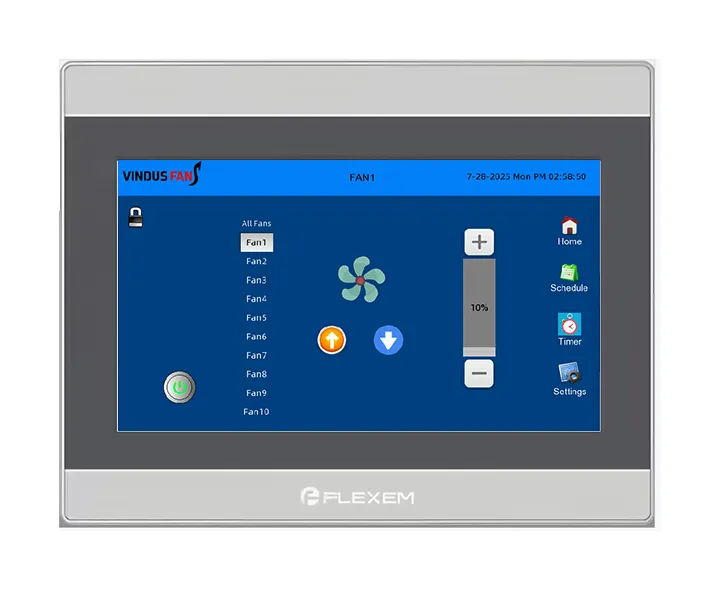
- Verify controls and control systemssettings for optimal performance.
- Document findings on the maintenance planand schedule quarterly service.
Need help matching the list to your plant? Compare options in our best HVLS fans for tough duty cycles.
How often should I inspect mounting hardware, safety cable, and guy wire?
Do a quick inspection monthly—especially the mounting system. Confirm the safety cable is secure and the guy wire is tensioned correctly. Look at the bracket, beam clamp, and fan mounting plate. A two-minute check prevents a two-hour fix. Add “inspection every month” to your whiteboard so it never slips.
During preventive maintenance, torque-check bolts and nuts and look for paint rubs (a tell for movement). Verify properly installed guy wires: no frays, correct angle, and solid anchor points. If your site has heavy cranes or vibration, do a quick mid-month inspection too.
Working in production lines? Review our industrial ceiling fans for manufacturing to align your maintenance with line changeovers.
: blades, top of the fan, and control box
Dust steals airflow and can throw a hvls fan out of balance. Plan frequent cleaning for the top of the fan, hub, and each blade. Use a dry microfiber mop or vacuum; avoid harsh sprays. A clean radius moves air better, keeps bearings happier, and lowers load on the drive.
While cleaning your hvls, open the control box and check for dust and loose terminals. Look at cable strain reliefs and gland nuts, then confirm the enclosure is sealed. Keep documentation tight—routine maintenance notes help you spot patterns, cut maintenance costs, and raise energy efficiency by reducing energy waste from fouled surfaces.
Working spaces vary. For tall gyms and arenas, explore commercial ceiling fans for sports-centers to see layouts that simplify service access.
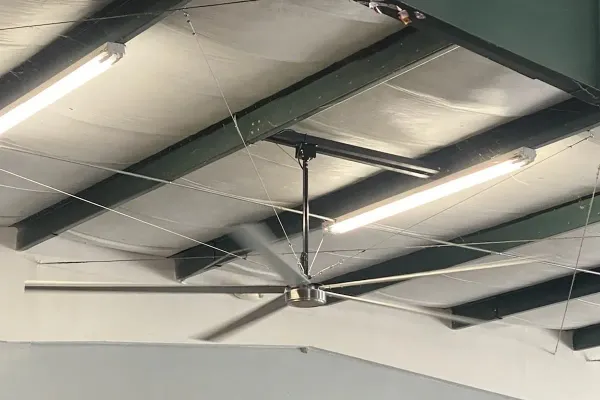
Cleaning your HVLS
Electrical connections, vibration, and unbalance: how to keep your fan running efficiently
Loose terminals and connectors cause nuisance trips. During a monthly inspection, confirm electrical connections are snug, ferrules are intact, and the VFD display shows no fault history. Then spin the hvls fan slowly by hand and listen—clicks can point to signs of wear.
Vibration often starts as dust, grows into unbalance, and ends as noise that sparks customer complaints. Balance after cleaning, verify mounting hardware, and re-check the guy wire. These steps ensure your fan operates smoother and help keep your fan running efficiently through peak season.
If you’re benchmarking layouts, see large-floor examples in big commercial ceiling fans for commercial-building projects.
Preventive maintenance schedule for large spaces like a warehouse or gym
Create a simple calendar so you can ensure that your hvls program becomes habit. In large spaces (a warehouse, training hall, or production bay), match checks to cleaning days and safety walks. Regular maintenance and a steady maintenance schedule make the work light and predictable.
Sample schedule (minimum):
| Interval |
Tasks (short list) |
| Monthly |
Lock-out, quick visual inspections, dust check, mount glance, hub lookover |
| Quarterly |
Torque bolts and nuts, deeper clean, balance check, verify control systems, log quarterly service |
| Annually |
Full structural review, inspection of mounting beam and anchors, controller firmware review, inspect lubricant (if gearbox type) |
“Small, steady checks beat big, rare overhauls. That’s how we keep your fan running day after day.”
Moving goods nonstop? Our WAREHOUSE HVLS FANS layout ideas show mounting clearances that make service fast.
Troubleshooting potential issues and customer complaints before they become fan failures
Here are common potential issues we see on service calls: drifting setpoints in the VFD, dirty sensors, and hub-area dust that hides cracks. Keep a short decision tree in your maintenance practices: isolate the fault, document, fix, verify, and record the outcome.
If you field customer complaints about squeaks or wobble, check balance and look for rub marks. Inspect the safety cable and guy wire routing. Review electrical connections and the VFD log. This proactive approach is classic proactive maintenance—find small errors early and avoid costly repairs that take a hvls fan offline.
For rapid reference builds (especially multi-dock setups), browse our quietest industrial fan approaches for logistics spaces.
Troubleshooting potential issues
Pro tips to maximize HVLS fan airflow, energy efficiency, and lifespan
Set clear targets: stable airflow, better comfort, reducing energy costs, and fewer stops. Tune setpoints by zone and season; check that the hvls ceiling fan height fits your ventilation pattern. A tidy plant floor improves air circulation and keeps debris away from the hub and controller.
Use your VFD’s smart modes to trim runtime and raise energy efficiency. Log data for each industrial hvls unit so you can spot outliers. A simple label noting “high volume low speed” reminds staff why slow feels so cool: big disks at gentle RPM move lots of air with less power.
If you’re comparing footprints, see our background as an HVLS fans manufacturer, then weigh alternatives you know—some teams also look at macroair fans for reference when building their spec.
The complete HVLS fan maintenance checklist (copy, adapt, and post)
Below is a quick-post version you can copy into your CMMS. It’s short, clear, and works for most hvls fan models. We recommend a laminated version at each area lead’s desk.
Lock-out and safety
- De-energize at disconnect; verify zero energy.
- Cone off the area. Confirm PPE.
Structure and mounts
- Visual inspectionsof beam, bracket, mounting hardware, safety cable, and guy wire.
- Check clearances to racking, duct, and lights.
Drive and controls
- Open control box, dust out, and reseal.
- Confirm electrical connectionstight; inspect harness strain reliefs.
- Verify setpoints in control systemsand fault-free history.
Clean and balance
- Dust the top of the fanand fan blades; check for rubs.
- If required by your model, inspect lubricantand add lubricant per OEM.
- Spin test for noise; fix unbalance.
Document
- Note maintenance recommendations, maintenance practices, and next step on the maintenance plan.
- Add photos of signs of wearor signs of damage.
ASCII “effort chart” for a quick stand-up:
Monthly : #### (Light)
Quarterly: ######## (Medium)
Annual : ############ (Deep)
For multi-venue facilities (gyms, arenas, malls), review layout and service reach from our HVLS fans for sports centers and arenas.
Case study: keeping your hvls fan reliable in a busy warehouse
Goal: steady comfort with fewer stops. Setting: 10-meter clear height warehouse with five dock doors and two lines. Result: after a simple checklist and tailored maintenance, the team saw steadier temperatures and fewer resets. The payoff wasn’t just comfort—it was confidence.
We focused on three things. First, dust management and frequent cleaning near docks. Second, mounting torque checks after a racking change. Third, a short laminated guide so supervisors could start a quick inspection on their round. That simple playbook helps extend the lifespan of hvls units, reduce maintenance costs, and keep hvls fan runtime smooth.
Want to see how layouts change by building type? Browse our hvls fans selections for commercial buildings.
Safety and standards: simple rules that matter
Always follow lock-out rules and OEM instructions. Where applicable, think about recognized safety standards—like Underwriters Laboratories listing for electrical components. Keep ladders stable, tie-off when required, and use non-conductive tools around live gear.
The right checklist makes safety automatic. Print it, post it, and train new hires on day one. This is proper maintenance made easy—short steps, steady rhythm, strong results for your hvls fan fleet.
FAQ: quick answers for busy facility teams
Do HVLS programs require a lot of staff time?
No. A few minutes per unit per month covers most needs. The deeper items fit into quarterly service windows or annual shutdowns. That’s how we keep your hvls fan reliable with minimal maintenance.
What about gearboxes and lubrication?
Many drives are sealed, but some use reducers. For those, inspect lubricant and add OEM-recommended oil. If you’re unsure about your specific fan, note it on the fan care card and flag the OEM page.
Are these steps different for a large industrial space?
The tasks are the same, but access is different. In a large industrial hall, plan scissor lift access and pair checks with other overhead work. That saves time and fits your maintenance schedule.
Can this reduce energy bills?
Clean, balanced disks move air with less drag, reducing energy costs across the season. In shoulder weather, your hvls fan lets you mix air to stay comfortable while reducing energy use from HVAC.
Is this the same for all brands?
Basics don’t change—clean, check, tighten. Whether you’re looking at our line or benchmarking with macroair fans, you’ll find the same fundamentals, plus brand-specific notes in the OEM guide.
Sources and further reading
- ASHRAE Thermal Comfort guidance(best practice context): org
- UL(component listing and safety framework): com
One-page printable: HVLS Maintenance Schedule (Template)
| Area |
Monthly |
Quarterly |
Annual |
| Safety & Lock-out |
Verify LOTO, cones, PPE |
Drill review |
Annual training refresh |
| Structure |
Visual inspections of beam, bracket, mounting hardware, guy wire, safety cable |
Torque check bolts and nuts |
Structural review |
| Drive & Controls |
Dust check control box |
Firmware/config check in control systems |
Controller review |
| Cleaning |
Dust top of the fan & fan blades |
Balance and vibration check |
Full hub cleaning |
| Docs |
Update maintenance plan |
Archive, photo notes |
Review KPIs |
If you’re scoping new installs alongside service, check our compact lineup of hvls fans and best hvls fans to match diameter and reach.
Final notes on maintaining your hvls fan
- Keep it simple: clean, check, tighten.
- Use a posted schedule and a fan care card.
- Tie tasks to operations so you never skip inspection.
- Save photos in the log to track signs of wear.
- Lean on OEM manuals for maintenance recommendationsand oil specs.
Key takeaways
- A short, steady program protects comfort, airflow, and energy efficiency.
- Use preventive maintenanceto stop potential issues
- Document everything so you can avoid costly repairsand keep hvls fan health visible.
- Train area leads—small checks cut big problems fast.
- Match service access to site type (gym vs warehousevs factory).
- This approach will extend the lifespan of hvlsequipment and boost the lifespan of hvls fans across your network.
About us :
We are an hvls fans manufacturing plant focused on reliable, high-quality hvls solutions for factories, commercial buildings, and schools. We design for large spaces, strong air circulation, and simple maintenance practices that ensure that your hvls program is easy to run day to day