Poor airflow in a barn can quietly damage bird comfort, feed conversion, and daily output. When heat, moisture, dust, and ammonia build up, animals struggle, workers feel it, and costs rise. A well-designed HVLS fan system solves this by improving air movement where it matters most.
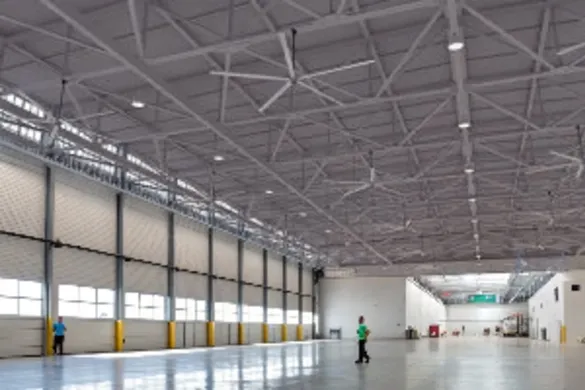
An HVLS fan for poultry farm ventilation is a large, low-speed, high-volume ceiling fan built to move air evenly across wide farm spaces. In poultry houses, dairy buildings, and other livestock facilities, it supports better ventilation, helps reduce heat stress, improves perceived cooling, and can lower reliance on high-energy cooling methods when used with proper inlets and exhaust fans. Research from poultry and dairy extension sources consistently shows that air speed, air exchange, and heat-abatement design directly affect animal comfort and performance.
As a manufacturer of hvls industrial fan systems, we work with customers who run factories, warehouses, schools, sports centers, gyms, and agricultural sites. On farms, the question is not whether air should move. It is how to move it safely, evenly, and efficiently across large spaces without creating wasteful turbulence or dead zones.
What Is an HVLS Fan and Why Does It Matter in Poultry Buildings?
HVLS means high-volume, low-speed. That simple idea matters because farm buildings are wide, busy, and full of living heat loads. Instead of blasting one narrow stream of air like small fans, an hvls fan uses long fan blades and a carefully matched motor to create broad, steady air movement over birds, feed lanes, litter, and working zones.
In practical terms, this means the fan can move large volumes of air while using a lower rotational speed. That matters in a barn, a dairy barn, or large poultry structure because the goal is not just wind. The goal is uniform comfort. Air should reach ground level, pass through the occupied zone, and reduce stagnant pockets where heat, dust, and moisture collect. University and extension guidance on poultry and dairy cooling repeatedly emphasizes that air speed and controlled ventilation design are central to heat abatement.
This is why many buyers now compare industrial ceiling fans with traditional barn fans and ask a better question: which solution gives more consistent air circulation across the whole building?
Why Is Ventilation So Important in Poultry Houses?
Good ventilation does far more than make a building feel cooler. It removes excess moisture, helps manage humidity levels, and limits the buildup of ammonia and other harmful gases. In enclosed animal buildings, poor air turnover is closely tied to wet litter, strong odour, dirty surfaces, and more stressful conditions for birds and staff.
Extension guidance from Mississippi State and long-running poultry ventilation research both show that air speed and fan selection are major factors in poultry-house performance, especially during hot weather and when bird density is high. In cold periods, fan-driven air exchange also supports air quality control rather than temperature control alone.
For operators, this leads to a simple truth: poor ventilation systems cost money. They raise risk, increase stress, and reduce the margin for error during the summer months.
How Do HVLS Fans Improve Airflow Compared to Traditional Barn Fans?
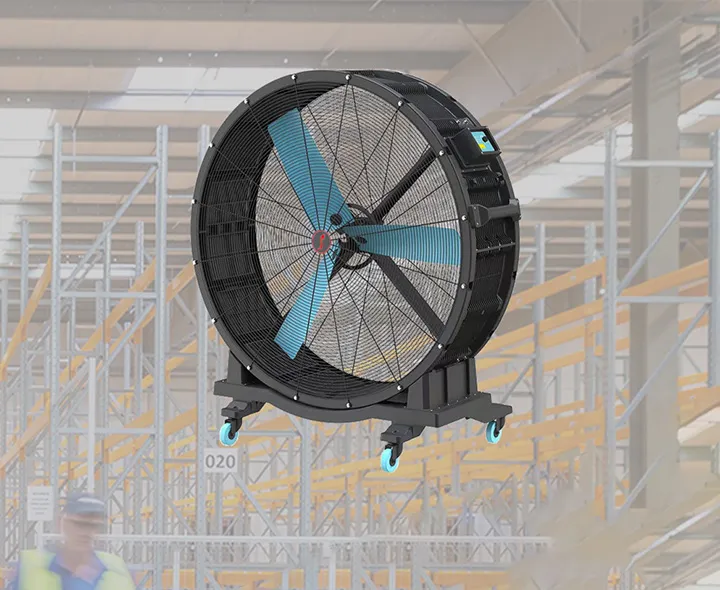
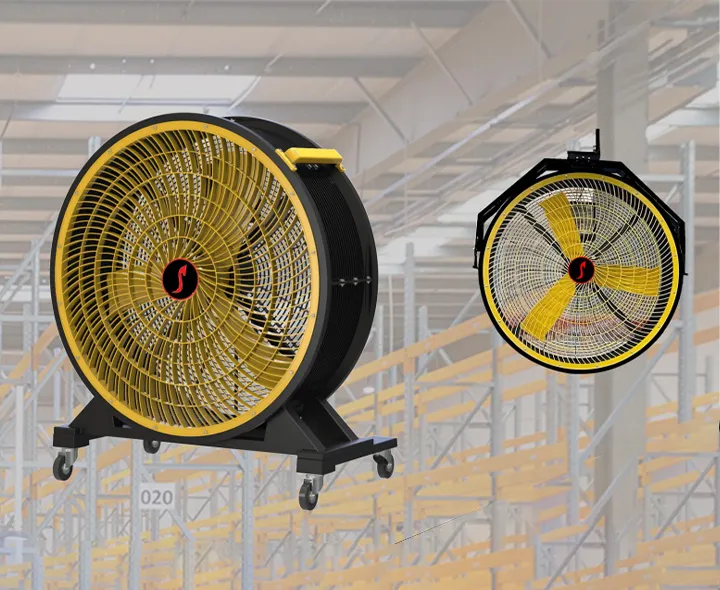
A traditional industrial fan or row of circulation fans can help, but coverage often becomes uneven. One area gets too much air. Another gets almost none. That matters in farm environments, where uniformity is often more valuable than raw velocity.
An hvls industrial setup works differently. The wide blade span helps distribute air in a larger circular pattern, then pushes that air outward and downward. This creates more stable airflow and superior air circulation across the occupied zone. The result is a more comfortable environment for animals and people alike.
Here is a simple comparison:
| Feature |
Traditional Fans |
HVLS Fans |
| Air pattern |
Narrow and directional |
Wide and even |
| Coverage area |
Smaller zones |
Broad building coverage |
| Speed style |
Higher speed |
Low-speed |
| Typical result |
Spot cooling |
Whole-space air circulation |
| Use case |
Local hot spots |
Full-building farm use |
That is why buyers often choose hvls fans for barns when they want to improve conditions across full production areas, not just one lane or corner.
Can an HVLS Fan Reduce Heat Stress in Poultry and Livestock?
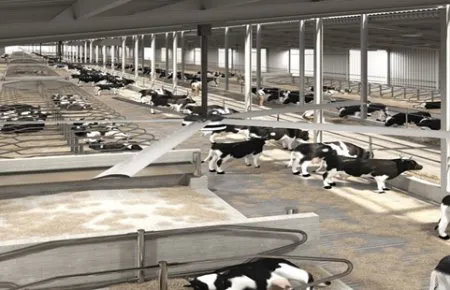
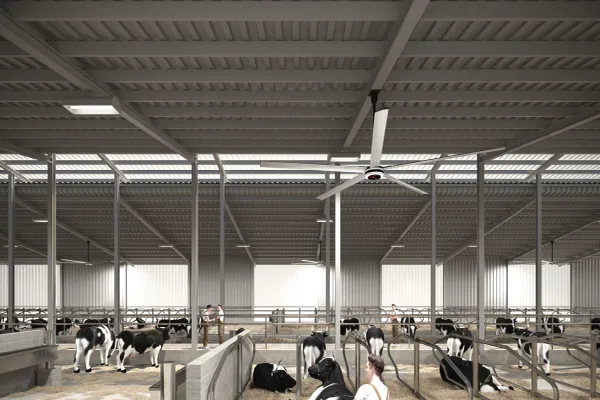
Yes, when the system is designed correctly. Heat stress is one of the biggest risks in animal buildings. Poultry research has shown that increasing air speed over birds can significantly improve cooling rates, and tunnel-style systems often target strong air velocity to reduce heat load during hot weather. That matters not only for broilers but also for broader livestock production. Dairy extension sources note that effective mechanical ventilation helps reduce heat stress in cows, supporting comfort and productivity. In dairy settings, this directly connects to milk production and overall cow comfort.
So while this article focuses on poultry houses, the lesson extends to dairy cows, calves, and mixed-animal operations. Fans help reduce the thermal burden on animals, especially when paired with inlet design, tunnel airflow, sprinkling, or evaporative options where appropriate.
Good farm cooling is rarely one device. It is a system.
Are HVLS Fans Enough on Their Own, or Should They Work with Exhaust Fans?
In most real projects, the best answer is “both.” An hvls fan improves internal air mixing and occupied-zone cooling, but exhaust fans are still essential in many buildings for removing heat, moisture, dust, and gases. Poultry and dairy ventilation guidance strongly supports matched system design rather than single-device thinking.
Think of it this way:
- Exhaust fans remove stale air.
- An hvls ceiling fan improves internal air movement.
- Inlets control where fresh air enters.
- Controls decide when each part should run.
This kind of layered strategy helps operators regulate temperature, reduce poor air quality, and keep air throughout the building more balanced. It also gives more flexibility when outdoor conditions change.
What Should You Look for in an HVLS Industrial Fan for Farm Use?
Not every large fan is built for the agricultural industry. Real farm duty needs heavy-duty construction, corrosion resistance, stable controls, and safe operation in dusty, high-humidity spaces.
When we help buyers choose an hvls industrial fan, we focus on these points:
- Motor reliability for long operating hours
- Strong, balanced fan blades for steady performance
- Mounting options suited to a barn roof or truss layout
- Safety systems for agricultural conditions
- Simple speed control for seasonal adjustment
- Coatings suitable for high humidity, dust, and corrosive air
- Support for integration with broader hvac systems or farm controls
A high-performance fan is not just large. It must be engineered for durability, safe air delivery, and long service intervals in real farm environments.
How Do HVLS Fans Support Animal Welfare and Better Air Quality?
Air is part of animal care. That is why animal welfare should not be treated as a soft topic. In a poultry or dairy building, better air circulation can help manage moisture, reduce hot and stale zones, and support cleaner breathing conditions.
This matters because poor ventilation can allow dust, ammonia, and even pathogen pressure to rise. Better internal mixing, together with proper air exchange, supports improved air quality and healthier daily conditions. Wisconsin and Penn State dairy resources also connect effective ventilation with reduced heat stress and better overall barn comfort.
For farm managers, the benefit is practical: healthier animals, calmer behavior, and better working conditions for staff.
Are HVLS Fans Energy-Efficient for Large Barns and Poultry Farms?
This is one of the most common buying questions, and it should be. Running fans all season affects energy costs, so the system must deliver more air with less waste.
Because fans are designed to move air over a very wide area, one large industrial fan can often cover zones that would otherwise need many smaller units. That can improve energy efficiency, especially compared to traditional spot-fan layouts that create overlap and uneven coverage. In many applications, an energy-efficient fan strategy also helps reduce strain on supplemental cooling or mechanical hvac support.
Here is a practical planning view:
| Goal |
How HVLS Helps |
| Lower energy consumption |
Fewer units may cover more floor area |
| Better comfort |
More uniform air evenly across occupied zones |
| Less overcooling |
Broad airflow reduces hot spots without harsh drafts |
| Lower operating waste |
Better matching of airflow to building volume |
Of course, savings depend on layout, climate, building height, stocking density, and whether the fan works with existing hvac systems or tunnel ventilation systems.
Where Should HVLS Fans Be Installed in Poultry, Dairy, and Mixed Livestock Facilities?
Placement matters as much as fan size. A good installation plan accounts for roof height, truss spacing, feeder lines, equipment paths, lighting, sprinkler lines, and bird or animal occupancy patterns.
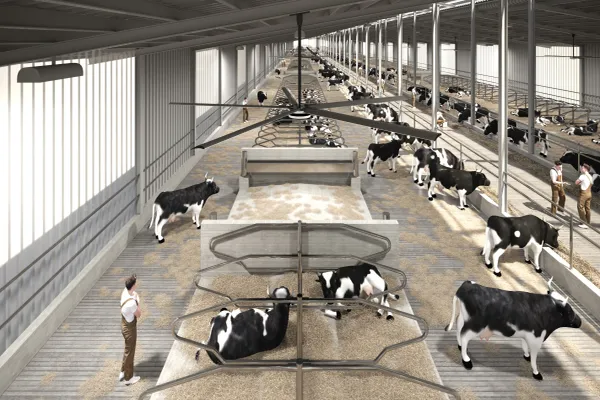
In a poultry building, placement should support broad airflow without interfering with equipment or creating dead spots near sidewalls. In a dairy barn, the goal may be to support feed lanes, resting zones, or cross-ventilated layouts. Penn State and Michigan guidance on dairy ventilation highlights the importance of matching fan placement to animal location and airflow targets.
We often tell customers to think in zones:
- Bird or animal zone
- Worker zone
- Feed and litter zone
- Service aisle or storage areas
- Entry and transition zones
The best result comes when the fan is placed to circulate air where animals actually live, not just where installation is easiest.
What Types of Agricultural Buildings Benefit Most from HVLS Fans?
The obvious answer is poultry houses, but the real answer is broader. These fans are useful in many agricultural structures where operators need high volume air delivery across wide floor plates.
Common examples include:
- Poultry houses
- Dairy barn buildings
- Calf and livestock facilities
- Feed and crop storage
- Packing areas
- Greenhouse support zones
- Multi-use barn and ranch buildings
In dairy farming, better airflow can support cooling and cleaner conditions. In poultry production, it can reduce moisture stress and help manage hot periods. In a greenhouse, gentle whole-space air mixing may also support more stable growing conditions, though crop needs differ from animal housing.
What Does a Good Farm Ventilation Plan Look Like?
A good plan is simple in idea but detailed in execution. It blends air exchange, internal mixing, seasonal control, and building-specific design. It also respects that fans are designed to move not just air, but comfort and consistency across an active production space.
A practical ventilation checklist
- Measure building dimensions and occupancy load
- Review existing exhaust fans and inlet design
- Check roof height and mounting conditions
- Identify hot spots, wet areas, and dead-air zones
- Select fan diameter and motor size carefully
- Plan control settings for mild, hot, and peak-heat days
- Consider future expansion or changes in production layout
Simple decision chart
| Farm Condition |
Recommended Focus |
| High humidity |
Stronger air exchange + internal mixing |
| Heavy stocking density |
Wider coverage and better control response |
| Hot climate |
Combine HVLS with exhaust/tunnel strategy |
| Existing fan clutter |
Replace overlap with more efficient wide coverage |
| Dust and corrosive air |
Use protected, high-performance components |
That is how smart operators move from “we need more fans” to “we need a better system.”
Case Study: Why One Air Strategy Outperformed a Patchwork of Small Fans
A customer managing a large poultry site asked us why temperatures felt uneven even after adding more fans. The answer was clear during the site review: too many localized units, poor overlap, and inconsistent air movement across the bird zone.
We redesigned the concept around broader air delivery and system coordination. Instead of relying only on small fans, the site used fewer large overhead units for uniform mixing and kept the primary exhaust strategy for air exchange. The result was steadier conditions, less visible stagnant air near the floor, and a simpler maintenance plan.
This is a common pattern. More hardware does not always mean better cooling. Better design does.
Frequently Asked Questions
Are HVLS fans safe for poultry farm buildings?
Yes, when selected and installed correctly. Farm-rated models use secure mounting, balanced blades, speed controls, and safety features designed for agricultural conditions.
Do HVLS fans replace ventilation systems?
No. They improve internal air mixing and perceived cooling, but they usually work best alongside inlet design and exhaust-based ventilation.
Can one HVLS fan cover an entire barn?
Sometimes, but not always. Coverage depends on building width, ceiling height, layout, and airflow goals. Large spaces often need a planned multi-fan layout.
Are HVLS fans useful in dairy facilities too?
Yes. Dairy extension sources consistently show that heat-abatement ventilation supports comfort and can help protect productivity in cows.
Will an HVLS fan reduce ammonia and odour by itself?
Not by itself. It helps mix air and reduce stagnant zones, but ammonia and odour control still depend on proper air exchange, litter or manure management, and exhaust design.
What is the main advantage over traditional barn fans?
The biggest difference is coverage. An HVLS solution moves volumes of air at low speed across a wide zone, rather than pushing narrow high-speed streams in isolated areas.
Final Thoughts
If you run a poultry farm, dairy building, or mixed animal facility, airflow should be treated like infrastructure. It affects comfort, performance, labor conditions, and operating cost. A good hvls fan system is not just a product. It is a building-performance tool.
As a manufacturer, we design solutions for demanding commercial and industrial spaces, including agricultural projects that need reliable, energy efficient, heavy-duty air movement. If your goal is better ventilation, lower stress, and more stable farm conditions, the next smart step is to review your building layout and fan strategy as one system.
Key Takeaways
- HVLS fans are built to deliver broad, even air coverage in large spaces.
- In poultry buildings, better airflow helps reduce heat stress and supports cleaner air conditions.
- In dairy facilities, ventilation is closely tied to comfort and productivity. (Penn State Extension)
- The best results usually come from combining HVLS fans with inlets and exhaust fans.
- A proper layout matters more than simply adding more fans.
- Farm-ready fans should be corrosion-resistant, safe, durable, and easy to control.
- Better air strategy can improve comfort for animals, workers, and the full building.
Sources