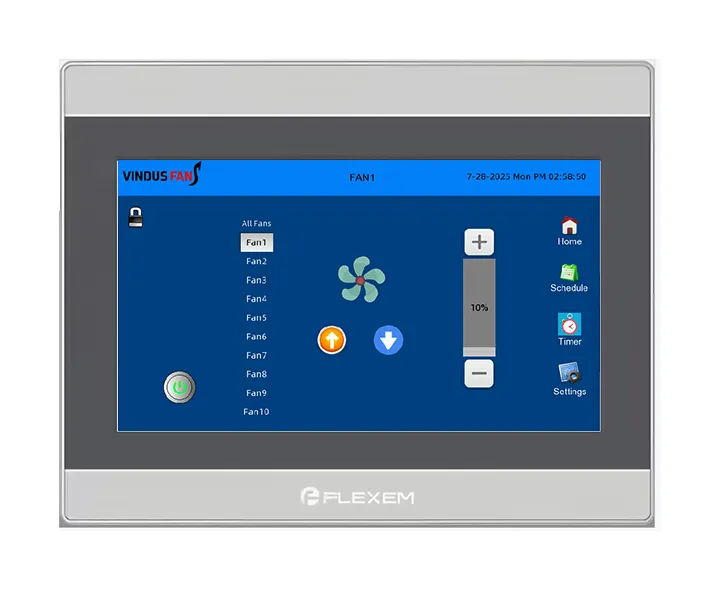
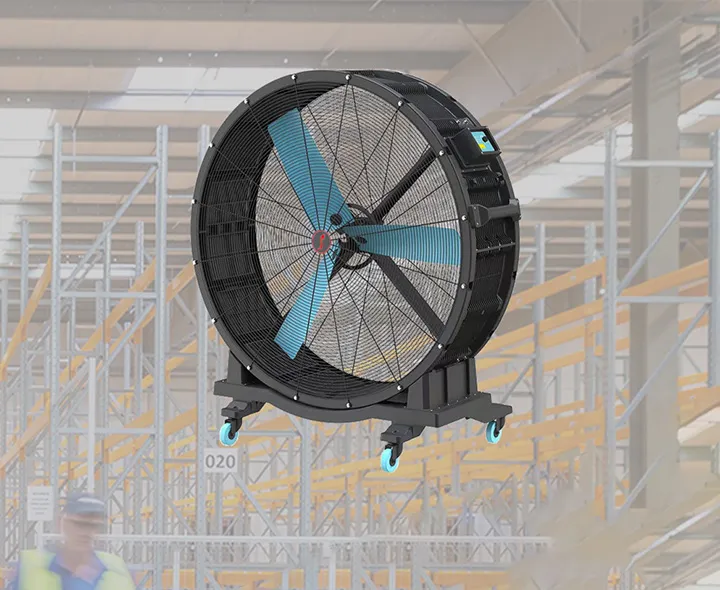
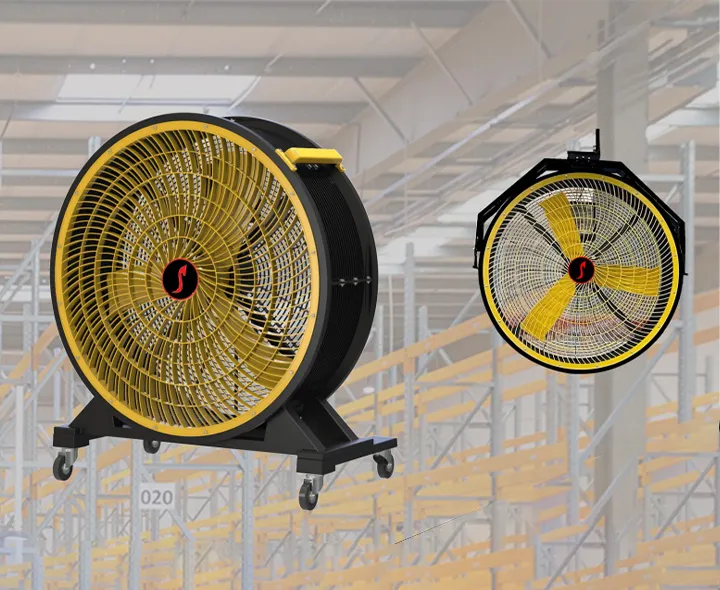
Hot aisles and sticky work zones feel miserable. People complain, managers lower setpoints, and the energy bill spikes. The fix is not always “more cooling.” Often, a well-designed ceiling fan system solves comfort with airflow.
A large ceiling fan moves air so people feel cooler, even when the thermostat is higher. The U.S. DOE notes that ceiling fans can allow about a 4°F higher thermostat setting without reducing comfort when occupants feel the breeze.
Executive Summary
- Comfort rule: fans cool people; they do not cool empty rooms.
- Budget rule: cost to run a ceiling fan = (watts ÷ 1000) × hours × rate.
- Spec rule: compare ceiling fan electricity consumption and airflow at multiple speeds, not just max.
- System rule: airflow plus HVAC often beats “HVAC only” for comfort planning.
- Standards rule: elevated air speed methods tie back to ASHRAE Standard 55 guidance, and safety discussions commonly reference UL 507 for electric fans.
1) Understanding ceiling fan power consumption: watt, wattage, and energy use
Buyers often mix three ideas: watt, kWh, and comfort. Start here:
- watt is instant draw.
- wattage changes by fan speed and blade load.
- Your bill is based on kWh over time, not on the nameplate alone.
This is the heart of understanding ceiling fan power consumption: the consumption of a ceiling fan is “power × hours.” A ceiling fan’s rated number helps, but your schedule decides the real energy use.
One more practical point for managers: the energy consumption of a ceiling in summer is usually dominated by cooling equipment, not by airflow devices. So your goal is comfort per kWh: get more comfort without forcing extra cooling.
RFQ line you can reuse: “Provide ceiling fan power consumption data by speed setting and standby, plus measured airflow and sound.”
What to verify before ordering
- Mounting height limits and downrod options
- Controller type wall remote BMS and warranty
- Service approach spare controllers spare blades and lead times
2) Ceiling fan use cost: a calculator that matches your electricity bill
If someone asks about much electricity ceiling fans use, answer with math. This is how you estimate ceiling fan use cost in minutes, and it answers much does it cost without guessing.
Formula copy paste
- kWh = (watts ÷ 1000) × hours
- cost = kWh × electricity rate (per kwh)
Example: if a unit draws 75 watts and you run a ceiling fan for 10 hours, the energy usage is 0.75 kWh. That is your fan electricity line item.
Mini table illustrative only
| Input power |
Hours per month |
Monthly energy |
Monthly fan costs |
| 30 W |
240 |
7.2 kWh |
$1.15 |
| 75 W |
240 |
18.0 kWh |
$2.88 |
| 150 W |
240 |
36.0 kWh |
$5.76 |
Use your tariff to estimate electricity costs and to forecast the monthly bill impact across zones. This also gives a clean way to compare bids when vendors use different assumptions.
Time of use note for procurement
If your utility uses peak and off peak pricing, ask vendors to estimate kWh by shift day vs night. This matters when operations run long hours: even a small change in average watts can add up across many units. For sites with demand charges, the key is not more airflow, but steady low speed operation and zoning.
How to ask suppliers for real numbers
- Ask for measured input power at each speed not only a brochure max
- Ask for a simple duty cycle profile by shift example 70 percent low 25 percent mid 5 percent high
- Ask them to show the same schedule using your local tariff
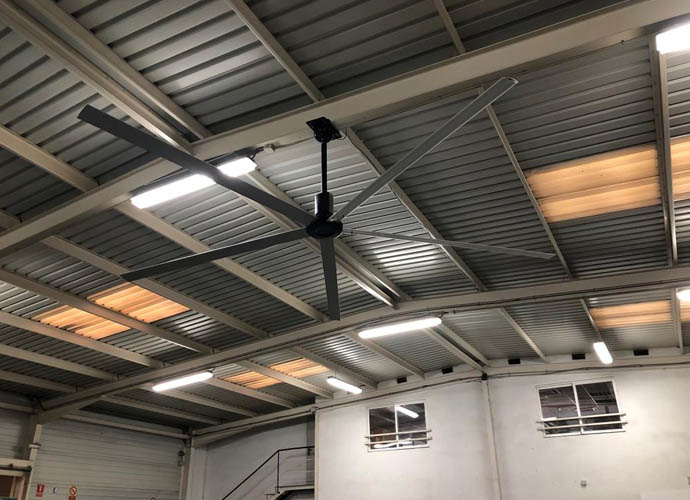
Ceiling fan use cost
3) Fan speed, low speed, and why speed setting changes energy consumption
In real sites, fan speed drives most of the operating cost. A unit at low speed can still deliver comfort by mixing air steadily; high speed is for short peaks.
The comfort mechanism matters: ceiling fans create a wind chill, and fans create a wind chill effect on skin. That is why ceiling fans cool people.
So if a zone is empty, leaving the ceiling fan running is wasted electricity use. fans help only when people are there to feel the air movement.
Quick operating tip
In many facilities, start at low speed, wait 5–10 minutes for the room feel to stabilize, then increase only if needed.
Common mistake
- Running high all day because the layout is wrong. Fix layout first, then tune speed.
4) Fan size and placement: choosing the right fan size without draft complaints
Fan size is not bigger is better. It is coverage and layout. In a high bay or modern ceiling environment, sprinklers, beams, lights, and cranes can change airflow.
Here is the practical rule: choosing the right fan size starts with the occupied zone, not the total floor area. Then confirm spacing so you do not create dead spots. Too many ceiling fans in one area can interfere with each other; many ceiling fans can look safe on paper but feel uneven in practice.
If you are planning a large site, a ceiling fan collection organized by coverage not by decorative style makes planning faster. Also, use ceiling fans to air mix large zones only after you map obstructions and safety clearances.
Para select the right ceiling fan, request a coverage map or a simple layout recommendation and confirm mounting height limits. This avoids rework during installation.
Placement checklist simple but effective
- Keep blades clear of lights signage and sprinklers per local code
- Use consistent mounting heights within a zone for stable airflow
- Avoid placing units where large doors blast outside air directly onto workers
For high traffic industrial zones, document the final layout as a simple one page drawing: unit locations, mounting heights, controller zones, and emergency shutoff procedures. This makes inspections easier and speeds up future expansion. It also reduces the risk that later changes like new racking or ductwork will block airflow.
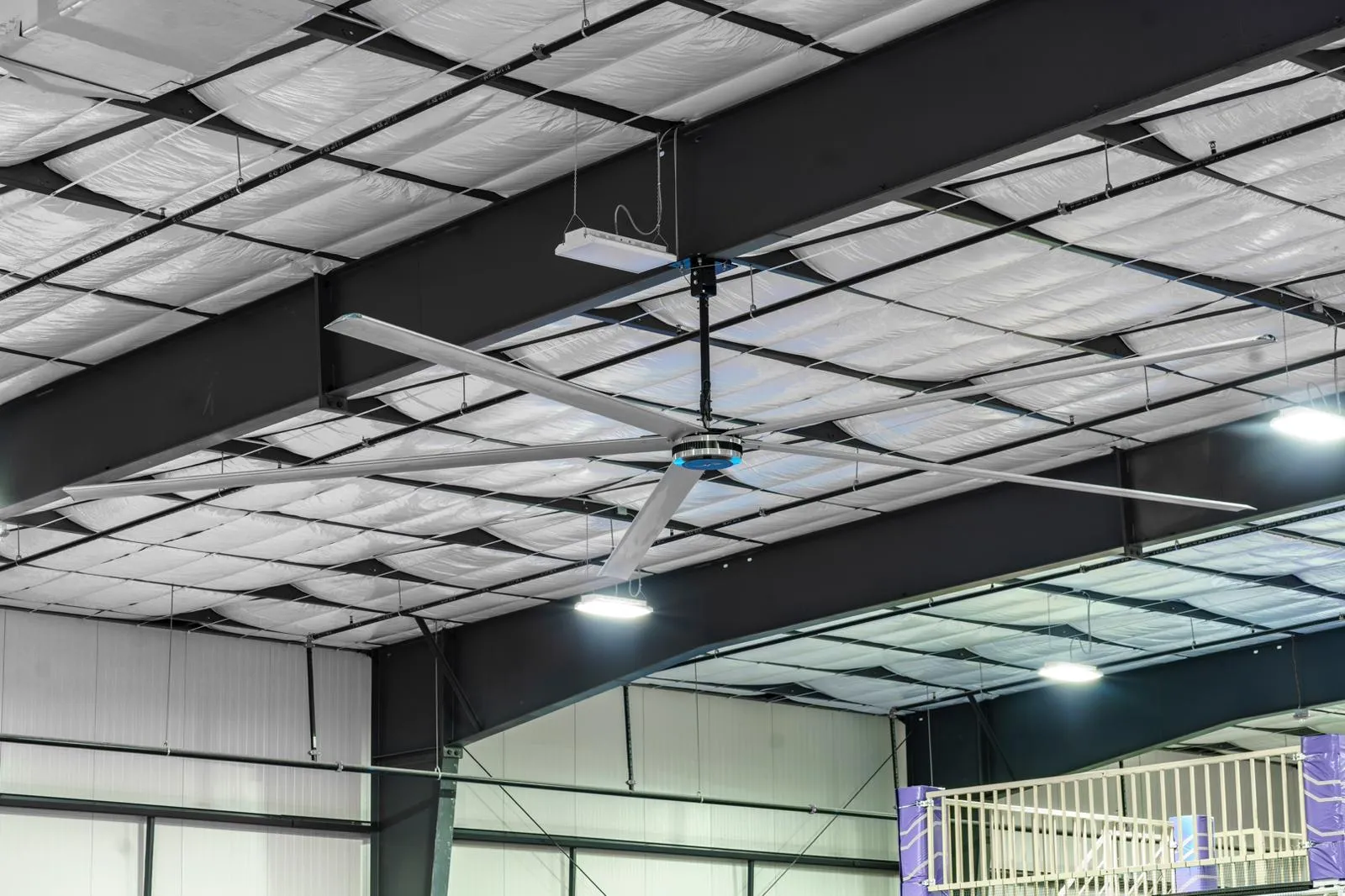
choosing the right fan size without draft complaints
5) DC motor ceiling fans vs traditional ac motor fans
Many projects compare dc motor ceiling fans with traditional ac motor fans, but the best choice depends on control needs, budget, and maintenance.
General buying logic:
- fans with dc motors often deliver better airflow per watt at common settings
- dc fans can feel smoother on control
- but installation quality can matter more than motor type
The type of fan matters because blade design, controller behavior, and real world duty cycle can change results. For procurement teams, ventiladores com eficiência energética are an excellent choice when they hold comfort at low speed with stable control and measured data.
Ask for measured airflow and efficiency CFM per watt where available. The program specification defines how those metrics are handled across multiple speeds and standby.
In short: fans offer value when the data is measured and the controls are right.
Maintenance reality what buyers forget
- Controller availability matters more than the motor type
- Dusty sites need cleaning access and stable balancing
- Stock one spare controller per project cluster to reduce downtime
6) Airflow plus cooling: ROI, trade-offs, and limits
Airflow is not refrigeration. Cooling equipment removes heat and moisture; it also manages humidity and filtration. Air movement changes how people feel.
That is why this approach can deliver saving on energy costs in occupied zones. It can also deliver energy savings when managers stop chasing a colder thermostat and focus on airflow comfort. The DOE guidance explains the raise the thermostat concept clearly.
In plain terms: a well managed airflow plan can use less energy because you are not buying extra cooling just to solve stuffy comfort complaints. In many sites, you can achieve less electricity than air conditioners for the same perceived comfort in occupied areas, because the fan strategy targets people, not the entire air volume.
Use this approval sentence: fans and air conditioners work together; airflow supports comfort so teams can reduce cooling effort during working hours.
Also keep the ROI message simple: if workers feel comfortable, you can often avoid over cooling, which is the real driver of operating costs. That is the second reason this strategy helps with saving on energy costs.
How to present ROI without arguing
For finance approval, keep it to three levers:
- comfort improvement fewer complaints and fewer turn it colder requests
- control strategy runtime and speed profiles
- setpoint opportunity if your process allows a higher cooling setpoint
When you write a proposal, include one clear line about energy efficient operation: “The airflow plan targets occupants, so we get comfort without forcing the cooling system to work harder.”
Limits be honest:
- If you must hold strict humidity, you still need air conditioning control.
- If you must hold strict process temperature, airflow may be secondary.
- If you must maintain airflow containment, mixing may not be allowed.
This is where ceiling fans can complement, and where ceiling fans can complement air is a valid comfort strategy, but only when the process allows it. The same idea can be written as: fans can complement air conditioning.
One caution: in very hot climates, cooling loads can be much energy. Air movement improves comfort, but it does not remove heat.
7) Large sites in 2026: reduce energy with HVLS airflow, not more small motor fans
In warehouses and factories, the question is comfort per kilowatt-hour. One ventilador de teto grande can cover a wide area, which can replace multiple small motor fans and reduce maintenance points.
A practical operations approach:
- Set target comfort zones.
- Tune speed setting by shift.
- Add schedules so the fan operates only when needed.
- Track comfort complaints and make small adjustments.
This is how teams reduce energy and reduce electricity without making people complain. Done well, you may also use less electricity while providing the same comfort.
In mixed use sites like a small office attached to a warehouse, you can still track home’s energy style metrics: runtime, occupancy, and comfort feedback. The same logic applies—do not waste airflow in empty zones.
This is the third time I will say it because it matters: smart airflow is about saving on energy costs without sacrificing comfort.
Two quick case patterns
- Pick and pack aisles: focus airflow over where people stand; reduce drafts at door edges
- Production lines: tune low speed for steady comfort; limit high speed to breaks or heat spikes
Commissioning checklist one page
- Confirm mounting hardware torque and vibration checks after the first week
- Record baseline settings speed schedule sensor thresholds
- Walk the floor: if one area feels still, adjust zoning instead of increasing speed everywhere
- Train supervisors: the goal is comfort, not maximum airflow at all times
This mindset is the same whether you track a factory KPI dashboard or simple home energy style metrics.
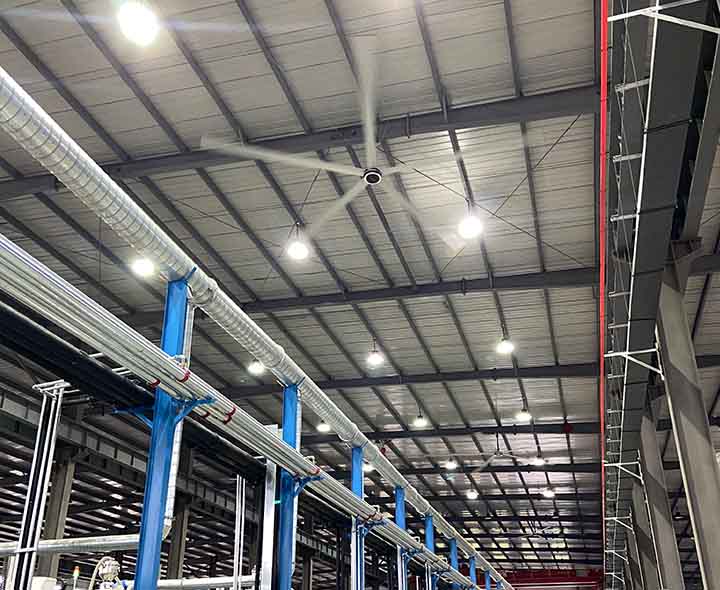
reduce energy with HVLS airflow
8) Reading specs like a buyer: what to copy from energy star® ceiling fans criteria
You do not need to buy a labeled product to use the spec logic. energy star® ceiling fans criteria define airflow terms, efficiency terms, and how testing is handled across multiple speeds and standby.
For procurement language, it is fair to say: Compare to energy star® ceiling criteria where applicable.
What to request:
- airflow CFM at each speed
- efficiency CFM per watt
- standby power for controls
- sound data at typical operating points
This is practical energy efficiency management for buyers.
Why this helps
- It makes quotes comparable
- It reduces marketing only claims
- It forces clarity on low speed performance, which drives most real operating time
9) Smart ceiling fans and schedules: the fastest way to cut waste
Most sites do not overspend because of hardware. They overspend because of runtime.
Smart ceiling fans can use sensors and schedules so fan running matches real occupancy. This is how you lower your energy bill without discomfort.
Two habits matter:
- using a ceiling fan only when the zone is occupied
- using your ceiling fan at low speed for steady mixing, then increasing only for peaks
Also remember: fans consume energy even when comfort is not needed, so a simple schedule can be your best ROI. If a zone is unoccupied, do not leave your ceiling fan on just in case.
Easy control options from simplest to strongest
- Shift schedule only
- Schedule + manual speed presets
- Occupancy + schedule + temperature triggers
- BMS integration with zone level rules
Noise and comfort validation
After installation, validate comfort with a quick walk through: stand at worker height in the hottest zones, note perceived airflow, and listen for tonal noise or wobble. If noise is high, the fix is usually balancing, mounting stiffness, or speed limits—rarely more power. Also confirm that signage, lighting, and suspended utilities are not creating unexpected turbulence.
10) FAQs + a buyer checklist for ceiling fan electricity consumption
Quick FAQ
Do ceiling fans use a lot of electricity?
Sometimes. The problem is usually runtime, not the motor. Start with schedules, then tune speed.
How should I compare quotes?
Ask each vendor to state assumptions for ceiling fan electricity usage, including hours per day, duty cycle, and speed profile. Then compare like for like.
How does fan size affect cost?
A larger unit can often run slower for the same comfort. That can reduce power consumption and noise.
What about winter?
In winter, reverse mode at low speed can help bring warm air down from the ceiling and reduce stratification.
Buyer checklist copy paste
- Provide electricity usage by speed, including standby
- Provide ceiling fan electricity consumption W by speed
- Provide airflow and efficiency CFM and CFM per W
- Provide safety documentation UL 507 discussion and local requirements
- Provide installation limits and clearances
- Provide warranty, spares, and service plan
Mini RFQ template fast copy
Include these fields so quotes are comparable:
- airflow and efficiency at each speed CFM and CFM per W
- input power by speed and standby W, plus control description
- installation requirements height clearance mounting hardware
- documentation package manuals wiring and safety statements
- delivery plan spare parts list and response time for service
If you want, I can format this into a vendor ready RFQ document for your procurement team.
If you share your building type, ceiling height, and shift schedule, I can help you choose the right ceiling fan layout, estimate fan costs, and draft an RFQ that compares models fairly.

 Portuguese
  English
  German
  French
  Italian
  Spanish
  Hindi
Hindi  Chinese